 |
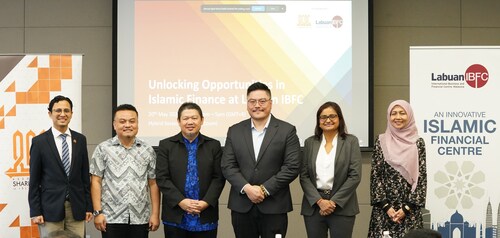
| Source: Labuan IBFC. Representatives from Labuan IBFC, Labuan Financial Services Authority (FSA) and ASAS at the training programme. |
Labuan International Business and Financial Centre (Labuan IBFC), together with the Association of Shariah Advisors in Islamic Finance Malaysia (ASAS), recently hosted a training session highlighting opportunities in Islamic finance, encompassing shari'ah-compliant fintech, captive and cross-border wealth management solutions within Labuan IBFC.
The hybrid event gathered Islamic finance professionals and shari'ah advisers from Malaysia and abroad to explore Labuan IBFC's proposition as global business hub offering Islamic finance solutions. Participants gained key insights into the digital acceleration of Islamic finance and its innovative financial structures.
In opening remarks, Tn. Haji Makhtar Abdullah, CEO of ASAS commented: "The future of Islamic finance will depend not only on products and regulations, but also on the quality, integrity, and commitment of the talents who guide the industry forward. Therefore, I hope today's programme will serve as a catalyst that inspires all of us, as ASAS members, to continue contributing our shari'ah knowledge and expertise towards strengthening the Islamic finance ecosystem."
Ben Quah, CEO of Labuan IBFC, underscored Labuan IBFC's position as Asia's premier international financial hub in a keynote. "Labuan IBFC's robust Islamic finance framework has successfully positioned the jurisdiction as a leading global hub in this sector. Consequently, we are confident that this collaboration with ASAS will further accelerate and advance the Islamic finance agenda," he said.
The main session focused on the Islamic Digital Asset Centre (IDAC), which drives Islamic digital finance beyond Labuan IBFC. Emerging opportunities exist in digital banking, fintech innovation and broader digital financial services, delegates learned.
The session also underscored the growing relevance of captive takaful structures as a strategic tool for risk management and cost optimisation.