Showing posts with label book. Show all posts

Saturday, 13 February 2021

Mosques and imams in East Indonesia: some studies

Source: NUS Press website. Cover, Mosques and Imams featuring an imam holding a sleeping baby.
Source: NUS Press website. Cover, Mosques
and Imams.

NUS Press has published Mosques and Imams: Everyday Islam in Eastern Indonesia.

Edited by Kathryn M. Robinson, Emeritus Professor of Anthropology at the Australian National University, the S$42 work is an introduction to the many ways of being Muslim across this diverse archipelago, from Sulawesi to Maluku and Nusa Tenggara Timor, as seen through the role of imams and the institution of the local mosque.

The volume is not only unique in its geographic coverage, but also in the way it takes as an organising principle the individuals and institutions that embody Islam in local communities, NUS Press said. The book complements and contributes to broader discussions of contemporary issues in Islam and other contemporary religions, including migration, proselytisation, networks, and changing models of religious authority.

Islam is at home in many of the areas of eastern Indonesia, with the early 15th-century Masjid Tua Wapauwe in Northern Maluku arguably the oldest mosque in Indonesia.

Professor Robinson specialises in studies of eastern Indonesia, everyday Islam, social impact of mining, and gender relations.

Details:

Publication year: 2020

Paperback, 292 pp

ISBN: 978-981-325-120-5

Saturday, 30 November 2019

New book seeks to further understanding on Sufism


Source: Dr Ahmad Javid. Cover, Sufi Experience of God.
Source: Dr Ahmad Javid.
Sufism is often linked with inner peace and mystical spirituality. A new book, Sufi Experience of God, seeks to further understanding about Sufism and is billed as "a dervish guide to life and love in the modern world".

Author Dr Ahmad Javid Sarwari Qaderi aims to capture the essence of the Quran in Sufi Experience of God, and includes personal recollections and experiences of other Sufis in the book as well.

Dr Ahmad Javid spent 17 years in Iran where he studied Sufi literature and poetry. He also wrote Sufi light: the secret of meditation, The Spirit of a Sultan, Sufi Prayer and Love. 

Details:

The paperback costs US$7.99 on Amazon while the Kindle version is US$2.99.

Buy the book (September 2019)

Friday, 15 November 2019

Definitive history of Islam in Malaysia is launched

Islam in Malaysia: An Entwined History by Dr Khairudin Aljunied has been launched. This is the first book to provide an account of Islam in Malaysia according to publisher Oxford University Press.

Source: OUP. Cover, Islam in Malaysia
Source: OUP.
The book investigates how Islam has shaped the social lives, languages, cultures and politics of both Muslims and non-Muslims in Malaysia, and charts the evolution of Malay states and societies from colonial regimes to the pluralised society that exists today.

This book covers the growth and development of Islam in Malaysia from the 11th to the 21st century, and shows how Muslims in Malaysia built upon the legacy of their pre-Islamic past while benefitting from Islamic ideas, values, and networks.

Dr Aljunied is Associate Professor at the National University of Singapore and Senior Fellow at the Prince Alwaleed Bin Talal Center for Muslim-Christian Understanding, Georgetown University. Dr Aljunied has authored and edited several books, including Muslim Cosmopolitanism: Southeast Asian Islam in Comparative Perspective (2017) and Hamka and Islam: Cosmopolitan Reform in the Malay World (2018). His research covers topics such as religious cosmopolitanism, social movements and intellectual history.

Details:

Islam in Malaysia: An Entwined History
October 2019
328 pages, hardback
£64 Buy the book or e-book
ISBN: 9780190925192

Thursday, 7 February 2019

Dr Raja Al Gurg publishes an autobiography

Source: Dubai Chamber of Commerce and Industry.
Women are playing a vital role in shaping the UAE’s future, making the country a shining example of women empowerment, according to Dr Raja Al Gurg, MD, Easa Saleh Al Gurg Group and President of the Dubai Business Women Council.

Dr Al Gurg spoke at a celebration for her new book, Raja Al Gurg: An Autobiography, which was hosted by the Dubai Chamber of Commerce and Industry.

The new book charts how Dr Al Gurg became one of the region’s most influential female business leaders during a transformational period for the UAE, including her career milestones and the challenges she faced along the way.

In his welcome remarks, HE Hamad Buamim, President and CEO of Dubai Chamber described the book as compelling, inspiring and honest and said it includes lessons that everyone can learn from.

“By sharing her story with the world, the book draws attention to the important role that women in the UAE are playing in government, business, and all aspects of our society,” said HE Buamim, adding that Dubai Chamber is proud to have supported the establishment of the Dubai Business Women Council. The organisation has thrived under the leadership of Dr Al Gurg, who also serves as a board member of Dubai Chamber.

Dr Al Gurg said the decision to publish the book in English came from her intention to change perceptions about women in the Middle East among international audiences. This is particularly so as her story sheds light on how women in the UAE are driving progress as leaders and making a significant contribution the country’s economy.

She added that the value and importance of education should not be underestimated as it provides younger generations with the foundation they need to build successful careers and fulfil entrepreneurial aspirations.

Her message for aspiring women entrepreneurs is that there is no substitute for hard work. She also said that dedication and ambition are crucial to succeeding in business.

Tuesday, 5 February 2019

Sheikh Zayed Book Award announces shortlisted titles for Literature, Literary & Art Criticism categories

The Sheikh Zayed Book Award (SZBA) has revealed the titles that have made the shortlist for the Literature and Literary & Art Criticism categories for the 13th edition of the award, following the Scientific Committee meeting last week.

The Literature shortlist consists of three titles out of 13 longlisted titles, while the Literary & Art Criticism shortlist consists of three out of nine titles selected in the longlist.

The shortlist for the Literature category comprises:

- Terter (ترتر, The Sequin Embroidery) by Iraqi novelist Nizar Abdelsattar, published by Nofal-Hachette Antoine, 2018.

- Ghawaso Al Ahqaf (غواصو الأحقاف, Divers of the Empty Quarter) by Saudi novelist Amal Al Faran, published by Jadawel Publishing, Translation & Distribution, 2016.

- The autobiography Al That Bayn Al Wujood Wal Eijad (الذات بين الوجود والإيجاد, The Self - between Existence and Creation) by Moroccan novelist Bensalem Himmich, published by Book Cultural Centre for Publishing & Distribution, 2018.

The shortlist for the Literary & Art Criticism category includes:

- Al Khetab Tholathy A Ab’aad: Derasat Fe Al Adab Al Mo’aser (الخطاب ثلاثي الأبعاد دراسات في الأدب العربي المعاصر, Three-dimensional Discourse in Contemporary Literature) by Syrian academic Dr Samar Al Dayyoub, published by Department of Culture – Sharjah, 2017

- Ketabat Al Qatl Fi Al Adab Al Arabi Al Qadeem (كتابة القتل في الأدب العربي القديم, Writing about Crime in Ancient Arabic Literature) by Tunisian academic Dr Amna Al Rumaili, published by Zeyneb Edition for Publishing & Distribution, 2018

- Al She’r Al ‘Arabi: Qasidat Al Nathr (الشعر العربي الحديث: قصيدة النثر, Contemporary Arabic Poetry - the prose) by Lebanese scholar Dr Charbel Dagher, published by Al Maaref Forum, 2018

The Literature category received the highest number of submissions for the sixth year in a row with 382 nominations, while the Literary & Art Criticism category received 151 nominations. The longlists for both categories were announced in November and December 2018.

Out of the 13 competing titles for Literature, the long list included three works published by Al Dar Al Masriah Al Lubnaniah, Cairo, Egypt; three novels published by Nofal-Hachette Antoine of Beirut, Lebanon; and two titles each by Jadawel Publishing, Translation & Distribution and Dar Al Adab Printing, Publishing & Distribution

Further announcements on shortlisted titles for the remaining categories will be made in the next few weeks.

Wednesday, 2 January 2019

Islam in International Relations to be launched mid-January

Source: Co-IRIS website. Cover for Islam in International Relations.
Source: Co-IRIS website.
Cover for Islam in International
Relations.
Islam in International Relations: Politics and Paradigms, is to be launched on 15 January 2019. The second Co-IRIS-edited volume is published under the Routledge’s Worlding beyond the West series.

Islam in International Relations: Politics and Paradigms, edited by Dr Nassef Manabilang Adiong, Dr Raffaele Mauriello, and Dr Deina Abdelkader, analyses the interaction between Islam and international relations (IR).

The volume opens with the discussion of the international thought of a major Muslim leader, followed by a chapter that addresses the ethical practice of IR, from traditional pacifism to modern Arab political philosophy. It then argues that the ethnocentric approach of Western academia has hindered readers' understanding of world affairs. The ISIS phenomenon is also addressed, as well as Islamic geopolitics.

Co-IRIS aims to explore Islamic contributions to the field of international relations. The name stands for International Relations and Islamic Studies Research Cohort.

Thursday, 27 December 2018

Islam in the Philippines series calls for proposals

DLSU Publishing House, publisher of the Islam in the Philippines series, is calling for proposals for new books.

The series focuses on long and short research monographs, policy-oriented books, handbooks, and collections of multidisciplinary studies and analyses on historical and contemporary Islam and Muslims in the Philippines. The series is in collaboration with Palgrave Macmillan on a project by project basis.

There are four chief editors:
  • Dr Nassef Manabilang Adiong, Assistant Professor at the Institute of Islamic Studies, the University of the Philippines Diliman
  • Dr Jeffrey Ayala Milligan, Professor of Philosophy of Education and Sociocultural & International Development Education Studies, and Director of the Center for International Studies in Educational Research and Development for the Learning Systems Institute at Florida State University, US
  • Mansoor L. Limba, Associate Professor of political science and international and Islamic studies at Ateneo de Davao University, Philippines, and
  • Isaac Donoso, at Universidad de Alicante, Spain
Details:

Email book proposals to Dr Nassef at contact at nassef.info.

All book proposals should include the following:

– The proposed title of the book.

– A description of the book (between 400 and 700 words) that explains its rationale, scope, significance to the series, its relations to competing works, and notable contribution to existing scholarship.

– A table of contents with chapter summaries.

– Estimated word length for the whole book, its proposed completion date, and description of its target readership.

– Optional: one or two sample chapters.

– Complete curriculum vitae of the author(s).

Friday, 21 December 2018

NUS releases catalogue for first half of 2019

NUS Press has released its catalogue for January to June 2019.

Source: NUS Press eDM. Cover for Islam, Humanity and Indonesian Identity.
Source: NUS Press eDM. Cover for
Islam, Humanity and Indonesian
Identity.
One of the highlighted books is Islam, Humanity and Indonesian Identity, which Mark Woodward of Arizona State University's  Center for the Study of Religion and Conflict says is "...a stunning, and yet hopeful, critique of Indonesian political culture and global capitalism...This is not just a book about religion and politics in Indonesia. It is a major contribution to political philosophy."

In the book Ahmad Syafii Maarif argues for an understanding that is both faithful to Islam's essential teachings and open to constantly changing social and cultural contexts. 

He addresses contemporary issues such as democracy, human rights, religious freedom, the status of women, and the future of Islam. 

Details:

View the catalogue on ISSUU or download the soft copy.

Islam, Humanity and Indonesian Identity
Available 30 January, 2019
US$25

Tuesday, 20 November 2018

Three publications gazetted as prohibited publications in Singapore

Source: Muis. The banned
S. Iswaran, the Singapore Minister for Communications and Information, has gazetted three publications as prohibited publications under the Undesirable Publications Act, effective 21 November 2018 following recommendations from the Islamic Religious Council of Singapore (Muis) that they be restricted from circulation in the country.

"Muis found that the publications advocate problematic and extremist views that promote enmity and hatred between Muslims and others, and encourage a culture of violence," the organisation said in a statement.

Those who are in possession of these materials should hand them to the police.

According to the Ministry of Communications and Information, the publications contain exclusivist or extremist religious views that promote enmity among different religious communities, with two publications also purveying divisive views against other groups within the same religion.

Such teachings and ideologies are detrimental to Singapore’s inter- and intra-racial and religious harmony and relations, the ministry stated. "The Singapore government has zero tolerance for individuals or publications which aim to incite hostility or violence among different religious groups, and has therefore decided to prohibit these publications," the ministry said in a statement.

It is an offence to distribute or possess prohibited publications. It is also an offence for any person to fail to deliver such a publication to the police. Those convicted of an offence could be liable to a fine, imprisonment or both.

Details:

The publications are: 

- Things that Nullify One’s Islaam by Shaykh al-Islaam Muhammad ibn ‘Abdil-Wahhaab, explained by Shaykh Saalih alFowzaan, 3rd edition, published by  TROID Publications, Canada, in 2013

- What Islam Is All About (Student Textbook) by Yahiya Emerick published by AS Noordeen in Malaysia 2007, and

- The Wisdom of Jihad by Abuhuraira Abdurrahman, published by Perniagaan Jahabersa, Malaysia, in 2000. 

According to Muis Things That Nullify One’s Islaam promotes hatred and animosity towards non-Muslims to the point of making it an obligation for a Muslim to be hostile to non-Muslims, while the author of the textbook accuses Muslim rulers of being hypocrites and slaves to the Christians and denigrates non-Muslims.
 
On The Wisdom of Jihad Muis commented, "Essentially, this book shares the same exclusivist and radical narratives as ISIS, and also glorifies a Muslim rebel group in the Philippines, the Moro Islamic Liberation Front (MILF)."

Tuesday, 13 November 2018

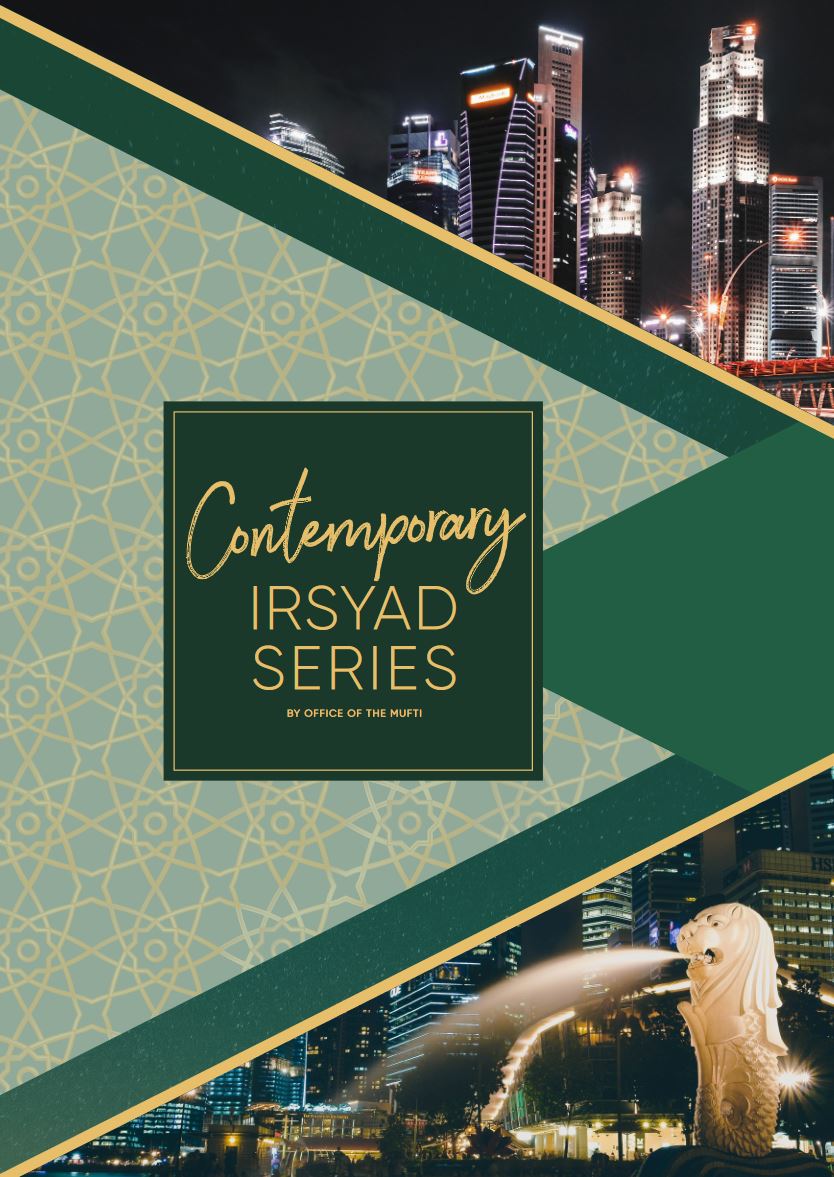
Contemporary Irsyad Series address questions by Muslims in modern times

Source: Muis. Cover for volume 1 of the  Contemporary Irsyad  Series.
Source: Muis. Cover for
volume 1 of the
Contemporary Irsyad
Series.
The Singapore Office of the Mufti has published the Contemporary Irsyad Series, which discusses the realities of finding solutions to current realities.

In the foreword, Dr Mohamed Fatris Bakaram, Mufti of Singapore, notes that Singapore is secular, multiracial and multireligious, with complex economic structures and advanced technology. "There is
a compelling need for us to be discerning – we have to stay true to the higher objectives of our religion and the broader jurisprudential and ethical frameworks, without necessarily attempting to force fit historical solutions to our current challenges and issues," he states.

Volume 1 focuses on questions of rituals, prayers and fasting, food, and interacting with other faiths.

Details:

Read volume 1 (PDF)

Hashtag: #BeingMuslimandSingaporean

Monday, 5 November 2018

Third edition of Invitation to World Religions now available

Oxford University Press has published a new edition of Invitation to World Religions. 

The 3rd edition, by Jeffrey Brodd, Layne Little, Bradley Nystrom, Robert Platzner, Richard Shek, and Erin Stiles, has a lucid, accessible writing style and includes personal, candid interviews in a new Voices section where people share how they live their faiths today.

Source: OUP. Cover, 3rd edition of Invitation to World Religions.
Source: OUP. Cover, 3rd edition of
Invitation to World Religions.
New to this edition is a Global Snapshot feature in each chapter, which highlights each religion's diaspora. More coverage of religion and conflict offers clear and balanced explorations of the ways in which religion has sometimes been used to justify oppression and violence.

A consistent, modular chapter structure allows easy comparisons between religions while Visual Guides provide keys to important religious symbols in easy-to-read tables.

An ancillary programme includes an Instructor's Manual with Computerized Test Bank on the book's Ancillary Resource Center. There is a companion website with additional student resources.

Details:

Invitation to World Religions (ISBN: 9780190690816) costs US$87.95. The paperback, published July 2018, has 656 pages.

Buy

Sunday, 9 September 2018

Journalism and Islam in Malaysia and Indonesia explored

Source: NUS Press. Cover for Mediating Islam.
Source: NUS Press. Cover for Mediating
Islam.
Janet Steele, Associate Professor of media and public affairs and international affairs at George Washington University, compares and contrasts Islamic aspects of journalism in Mediating Islam: Cosmopolitan Journalisms in Muslim Southeast Asia.

Day-to-day journalism as practiced by Muslim professionals at five news organisations in Malaysia and Indonesia are explored through an Islamic lens:

At Sabili, established as an underground publication, journalists are hired for their ability at da'wah (دعوة), or spreading of Islam. 

At Tempo, a news magazine banned during the Suharto regime, the journalists do not talk much about shari'ah law, but many are pious and see their work as a manifestation of worship. The Islam they practice is often viewed as progressive or liberal. 

At Harakah reporters support an Islamic political party, while at Republika they practice a "journalism of the Prophet". Secular news organisations, too, such as Malaysiakini, employ Muslim journalists. 

Details:


Buy Mediating Islam: Cosmopolitan Journalisms in Muslim Southeast Asia (184 pages)
Paperback, S$28
ISBN: 978-981-4722-88-9

Sunday, 2 September 2018

Halal Food: A History positions concept of halal in the modern context

Source: OUP. Cover, Halal Food.
Source: OUP. Cover,
Halal Food.
Febe Armanios, Associate Professor of History at Middlebury College, and Bogac Ergene, Professor of History at the University of Vermont, have written what Oxford University Press (OUP) says is the first introductory text on halal food for audiences in food studies, religion, and history.

Published in May 2018, Halal Food: A History:
- Explores the most relevant topics related to halal food
- Is based on a range of textual sources, across geographic regions and history
The book explores what halal food means to Muslims and how its legal and cultural interpretations have changed in different geographies up to the present day.

Historically, Muslims used food to define their identities in relation to co-believers and non-Muslims. Food taboos are rooted in the Quran and prophetic customs, as well as writings from various periods and geographical settings. Islamic food traditions make distinctions between clean and impure, and dietary choices and food preparation reflect how believers think about broader issues. 

Traditionally, most halal interpretations focused on animal slaughter and the consumption of intoxicants. Muslims today, however, must also contend with an array of manufactured food products - yogurts, chocolates, cheeses, candies, and sodas - filled with unknown additives and fillers. 

Certifying agencies, government and non-government bodies, and global businesses have sprung up to help consumers navigate the new halal marketplace. Blogs, cookbooks, restaurants, and social media apps have also proliferated, while animal rights and ecoconscious activists seek to recover halal's more wholesome and ethical inclinations. 

Covering practices from the Middle East and North Africa to South Asia, Europe, and North America, the book touches on the concept of halal and discusses its place today in the context of its legal roots, discussions about meat and intoxicants, contemporary regulations and food manufacturing, and ethical and culinary terms. 

Details:

Buy Halal Food: A History (400 pages)
Hardcover, US$29.95
ISBN: 9780190269050
Also available as an ebook

Wednesday, 29 August 2018

New books on Islam in Southeast Asia

ISEAS – Yusof Ishak Institute has published a number of books about Islam in Southeast Asia this year.

Islam in Southeast Asia: Negotiating Modernity, edited by Norshahril Saat, Fellow, ISEAS – Yusof Ishak Institute, Singapore, covers recent trends affecting Islam in the Malay world.

"Islam in the Malay world of Southeast Asia or Islam Nusantara, as it has come to be known, had for a long time been seen as representing the more spiritual and Sufi dimension of Islam, thereby striking a balance between the exoteric and the esoteric. This image of 'the smiling face of Islam' has been disturbed during the last decades with increasing calls for the implementation of shari’ah, conceived of in a narrow manner, intolerant discourse against non-Muslim communities, and hate speech against minority Muslims such as the Shi’ites. There has also been what some have referred to as the Salafisation* of Sunni Muslims in the region. 

"The chapters of this volume are written by scholars and activists from the region who are very perceptive of such trends in Malay world Islam and promise to improve our understanding of developments that are sometimes difficult to grapple with," said Professor Syed Farid Alatas, Department of Sociology, Faculty of Arts and Social Sciences, National University of Singapore (NUS). Saat is also Adjunct Lecturer with the Department of Malay Studies, NUS. 

Source: ISEAS. Cover, Islam in Southeast Asia.
Source: ISEAS. Cover, Islam in Southeast
Asia.
"Perceptions of Southeast Asian Islam are increasingly contested. On the one hand, much of the international community continues to laud the region’s Muslims as among the most 'moderate' and 'inclusive' in the world.

"On the other hand, stories about creeping Wahhabism and escalating jihadist threats abound in media reporting, often accompanied by commentary that the nature of Southeast Asian Islam is becoming more radical, less tolerant and more 'Arabised'.

"In this volume, a range of Muslim scholars and activists from Indonesia, Malaysia and Singapore reflect upon developments in their communities and seek to bring greater nuance to our understanding of these complex religio-cultural and political changes.

"This book opens up authentic regional perspectives on Islam’s contemporary role," said Associate Professor Greg Fealy, Department of Political and Social Change, Australian National University.

Add caption
The State, Ulama and Islam in Malaysia and Indonesia by Saat, was also launched recently. Published by the Amsterdam University Press/ISEAS – Yusof Ishak Institute, the book examines the extent to which official ulamas in contemporary Indonesia and Malaysia capitalised on their co-optation to ‘capture’ the states. An ulama is a group of Muslim scholars who are recognised for their specialised knowledge of Islamic sacred law and theology.

In response to the Islamic resurgence of the 1970s and beyond, the Suharto (1966–1998) and Mahathir (1981–2003) governments undertook massive Islamisation programmes in Indonesia and Malaysia respectively. This included co-opting influential religious scholars into state-sponsored institutions.

In 1975, Suharto formed the Majelis Ulama Indonesia (MUI); while in the 1980s, Mahathir upgraded the Malaysian National Fatwa Council (JKFMKI), JAKIM (Department of Islamic Development Malaysia) and IKIM (Malaysian Institute for Islamic Understanding). The ‘official’ ulamas, defined by the book as the religious scholars who participated in these institutions, were expected to support the states’ ideologies in exchange for reward and recognition. The author discusses societal actors’ ability to influence laws, policies, and the distribution of resources in their favour.

Hamka and Islam: Cosmopolitan Reform in the Malay World by Khairudin Aljunied, Associate Professor in the Faculty of Arts and Social Sciences, NUS, is published by the Cornell Southeast Asia Program/ISEAS – Yusof Ishak Institute. 

Hamka or author Haji Abdul Malik bin Abdul Karim Amrullah is one of the most influential of Muslim reformers who have been campaigning for a total transformation of the ways in which Islam is imagined in the Malay world. 

In Hamka and Islam, Aljunied employs the term “cosmopolitan reform” to describe Hamka’s attempt to harmonise the many streams of Islamic and Western thought while posing solutions to the various challenges facing Muslims. Among the major themes that Aljunied explores are reason and revelation, moderation and extremism, social justice, the state of women in society, and Sufism in the modern age, as well as the importance of history in reforming the minds of modern Muslims. 

Pancasila and the Challenge of Political Islam: Past and Present compares and contrasts Islamism against Pancasila, or cultural pluralism. Islam is an important symbol in post-Suharto Indonesia, and has been used as an effective tool to undermine political rivals. Political figures or parties feel they cannot afford to be seen to be against the religion or be considered unfriendly to it.

Leo Suryadinata, who is Visiting Senior Fellow at ISEAS – Yusof Ishak Institute, argues that the future of Pancasila depends on whether the Indonesian government and other pluralist forces are able to control the Islamists and provide political stability and economic development in the country.

Details:
Buy Hamka and Islam: Cosmopolitan Reform in the Malay World (139 pages)
Softcover, ISBN: 978-981-4818-84-1, S$29.90
The ISEAS edition is for distribution in Southeast Asia.

Buy Islam in Southeast Asia: Negotiating Modernity (252 pages)
Softcover, ISBN: 978-981-4786-99-7, S$35.90
Chapters of the book are available as PDF downloads from S$7.

Buy Pancasila and the Challenge of Political Islam: Past and Present (20 pages)
Softcover, ISBN: 978-981-4818-67-4, S$9

Buy The State, Ulama and Islam in Malaysia and Indonesia (254 pages)
Softcover, ISBN: 978-981-4818-83-4, S$35.90
The ISEAS edition is for distribution in Southeast Asia.

*Salafists advocate a return to the traditions of the first three generations of Muslims. There is a range of beliefs and practices among Salafists. Some are non-political, some are political, and a minority believe in violence and terrorism as a means to an end.

Tuesday, 14 August 2018

NUS Press publishes a focus on Mangkunagara I of Java

Source: NUS Press. Book cover for Soul Catcher
Source: NUS Press. Book cover for
Soul Catcher.

NUS Press has released Soul Catcher: Java’s Fiery Prince Mangkunagara I, 1726-95 by MC Ricklefs. Ricklefs is Professor Emeritus of the Australian National University and a Fellow of the Australian Academy of the Humanities, as well as a historian of Indonesia, specialising in the history of the Javanese from the coming of Islam to the present day.

Mangkunagara I (1726-1795) was one of the most flamboyant figures of 18th-century Java in Indonesia. A rebel from 1740 to 1757 and one of the foremost military commanders of his age, he won the loyalty of many followers.

He was also a devout Muslim of the Mystic Synthesis style and Javanese culture supporter. The 'halal bihalal' tradition of asking others for forgiveness during Eid in Indonesia is attributed to him.

His enemies—the Surakarta court, his uncle the rebel and later Sultan Mangkubumi of Yogyakarta and the Dutch East India Company (VOC)—were unable to subdue him, even when united against him.

In 1757 he settled as a semi-independent prince in Surakarta, pursuing his objective of as much independence as possible by means other than war.

Professor Ricklefs refers to sources in Dutch and Javanese—among them Mangkunagara I’s autobiographical account of his years at war, the earliest autobiography in Javanese so far known—to bring him to life. In doing so, he sheds much light on Java’s civil war of the mid-18th century, Islam and culture in Java.

"The Prince Sambĕr Nyawa is a very familiar name among Indonesians. However, our knowledge on his life and role as member of the Mataram royal family is very limited. The story of his character circulated is more of myths than a historical figure. This book convincingly provides readers a very rich biography of this flamboyant man based on first hand Javanese primary sources, including Sĕrat Babad Pakunĕgaran, and the VOC archives," said Oman Fathurahman,Professor of Philology at the Faculty of Arts and Humanities, Syarif Hidayatullah State Islamic University of Jakarta, Indonesia.

"MC Ricklefs’ Soul Catcher is a rich and deeply textured portrait of Mangkunagara I (1726–95), a man who played a crucial role in in the history of 18th-century Java. Rickefs’ magisterial biography traces this prince’s life story, with an especially detailed history of the 15-year long military campaign he waged against the forces of the Dutch along with those of his various royal Javanese rivals.

"Ricklefs’ captivating narrative vividly displays his unparalled command and careful use of primary sources from both the Dutch colonial and the royal Javanese archives," added Nancy Florida, Professor of Javanese and Islamic Studies, University of Michigan.


This title is also part of the Asian Studies Association of Australia series.

Details:

Buy the book
Paperback, 432 pages
S$48

Thursday, 5 April 2018

12th Sheikh Zayed Book Award winners announced

The Sheikh Zayed Book Award 2017-2018 winners have been announced.

The Literature Award went to Syrian novelist Khalil Sweileh for his Novel Ikhtibar al-nadam (اختبار الندم, Remorse Test) published by Nofal-Hachette Antoine, Beirut (2017), while Emirati author Hessa Al Muhairi was named winner of the Children’s Literature Award for Al-dinoraf (الدينوراف, The Dynoraf) published by Al Hudhud Publishing and Distribution, UAE (2017).

Judges said of Ikhtibar al-nadam: "The novel portrays an inward view of the Syrian civil war tragedy; the author takes the reader on a trip around Damascus, trudging down the memory lanes and presenting the psychological conflicts amid the shattered reality of place and society – marking an important addition to the Syrian literature, with a unique use of narrative tools and vocabulary construction."

 On ’Al-dinoraf judges said: "The story is set in the animal kingdom, where a dinosaur is out on a mission to find his parallel among the rest of animals. Throughout his journey, he gets to know the differences between the animals, which finally lead him to find his connection with the giraffe, hence becoming the Dinoraf, in a unique portrayal of the contemporary case of peaceful coexistence and mutual tolerance of cultural differences within the global society. The story is written in an aesthetic language that is beautiful, artistic and carefully crafted."

In the Young Author category, the Egyptian writer Ahmad Al Qarmalawi won the title for his novel Amtar Sayfiyyah أمطار صيفية<, Summer Rains), published by Maktabat al-Dar al-Arabiyah lil-Kitab, Cairo (2017).

"(Amtar Sayfiyyah)
tackles the interrelations between the music and the soul, and the sublimity of the spirit versus covetousness. The work showed an extensive knowledge in music that creates a tangible setting of melodic notes transcending to that of the Sufism station (مقام, maqaam)," judges said.

Néji Elounelli from Tunisia won the Translation Award for his Arabic translation from of the work of German author Theodor Adorno, Natharayya ‘astiteeqyya (نظرية استيطيقية, Ästhetische Theorie), published by Al-Jamal Publications, Beirut 2017

"The book represents an authentic depiction from the German text that is considered a valued work in philosophy whose author is a prominent figure in the Frankfurt School of thought. The work investigates the theoretical paradigm of aesthetics that shifts the perspective from the traditional theory of knowledge to the critical philosophy in society," noted judges.

The Literary and Art Criticism Award
went to Moroccan academic Mohammad Mishbal, for his work, Fi balaghat al-hajjaj: nahwa balagha hajjajiyyah litahleel al-khitab (في بلاغة الحجاج: نحو مقاربة بلاغية حجاجية لتحليل الخطاب, The Rhetoric of Eloquence), published by Kunouz Al Ma’refa Publishers, Amman (2017).

"The book elaborates on Al Hajjaj connections to the rhetoric and discourse, analysing the foundational strategies in ancient rhetoric up to present-day, in a well versed language, clear analysis and based on extensive bibliography," judges commented.

The Arab Culture in Other Languages Award went to German researcher Dag Nikolaus Hasse for his work Success and Suppression: Arabic Sciences and Philosophy in the Renaissance, published by Harvard Press 2017 while Dar Al-Tanweer (Beirut/Cairo/ Tunisia) won the Publishing and Technology Award.

"The book is a significant work of scholarship that fills in an important gap in modern knowledge: the fact that works in the Arabic sciences and philosophy played an important role in Western Renaissance movement. Hasse monitors the influence of Arabic in the intellectual development, debates and controversies of the Renaissance," said judges.


Judges said Dar Al-Tanweer "is viewed as a luminary institute that contributes generously to spreading the Arabic culture, encouraging authoring and translation. The publishing house continues to assume a leading role in bringing young voices in philosophy and literature to the limelight".
 
Dr Ali Bin Tamim, the Secretary General of Sheikh Zayed Book Award commented: “The nominations went through a rigourous assessment towards selecting the best of the entire body of works received this year, followed by a series of evaluations lasting for three months by qualified judging panels, to be concluded by the reviews of the scientific committee and the final sign-off by the Award’s Board of Trustees to name the winning titles of the 12th session.

“Throughout the past 12 years, since its inception, the Award has won a reputation of recognising and celebrating the best text in the Arabic literary production, with a deeply rooted transparency engraved on a regional and an international level.”

HE Saif Saeed Ghobash, Director General of the Department of Culture and Tourism, Abu Dhabi, congratulated the winners for their achievement, stressing that their works deserve the recognition, and adding: “As we mark the Year of Zayed, this is fitting appreciation to the memory of the late Sheikh Zayed bin Sultan Al Nahyan; crowning this outstanding group of writers, intellectuals, publishers and young talent as winners of an award in his name, and echoing his vision of fostering the sciences to enrich the Arab cultural, literary and social life.”

There was no award for the Contribution to the Development of Nations category this year.

The Sheikh Zayed Book Award was inaugurated in 2007, and aims to promote scholarship and creativity in Arab culture. It carries cash prizes totaling AED7 million – with AED750, 000 per winner in all eight categories. The winners also receive a certificate of merit and a gold medal.

Details:

The award ceremony is scheduled on April 30 in Abu Dhabi, UAE.

Thursday, 8 March 2018

Shortlist unveiled for 2018 Sheikh Zayed Book Award

The Sheikh Zayed Book Award has announced the shortlisted works for its 12th edition, chosen from 1,191 nominations.

The selected works in the Literature category include four narrative works:

Yakfi annana ma’an (يكفي أننا معاً, At Least We are Together) by Egyptian writer Ezzat el-kamhawi, published by Al Dar Al Masriah Al Lubnaniah, Cairo, Egypt (2017); 
Ikhtibar al-nadam (اختبار الندم, Remorse Test) by Syrian novelist Khalil Sweileh, published by Nofal-Hachette Antoine, Beirut, Lebanon (2017); 
Al-shaytan yoheb ahyanan (الشيطان يحب أحيانا, The Devil May Love Sometimes) by Saudi author Zainab Hifni, also by Nofal-Hachette Antoine, published in 2017; and 
Anaqeed al-radheelah (عناقيد الرذيلة, Grapes of Vice) by Mauritanian novelist Ahmad Hafid, published by Arab Scientific Publishers, Beirut, 2016.

For the Children’s Literature category, the list named:

Jada’el khadra’a’ (جدائل خضراء, Green Braids) by Syrian author Muhannad Al-Aqous, published by Kalimat, 2017; 
Ana salma (أنا سلمى, I am Salma) by Syrian author Lina Hawyan Al-Hasan, published by Hakayaa, Beirut, 2017; and 
’Al-dinoraf (الدينوراف, The Dynoraf) by Emirati author Hessa Almehairi, published by Al Hudhud Publishing and Distribution, UAE, 2017. 

In the Young Author category, two novels and one scholarly study have been selected:

Reih al-sharki (ريح الشركي, The Winds of Sharki) by Moroccan author Mohsine Loukili, published by Dar al-Saqi, Beirut (2017); 
Amtar sayfiyyah (أمطار صيفية, Summer Rains) by Egyptian writer Ahmad Al-Qarmalawi, published by Maktabat al-Dar al-Arabiyah lil-Kitab, Cairo (2017); and 
Al-dars al-balaghi al-arabi: bayn al-seemya’iat wa tahleel al-khitab (الدرس البلاغي العربي، بين السيميائيات وتحليل الخطاب, Arabic Rhetoric: from semiotics to discourse analysis) by Algerian academic Lakhdari Saad, published by Manshourat al-Ikhtilaf, Algeria (2017).

The finalists in the Translation category include three works translated from three different languages:

'Al-thawra ‘al-rabi’a: kayf yo’eed ‘al-ghilaf ‘al-ma’lomati tashkeel ‘al-waqe’ ‘al-‘insani (الثورة الرابعة: كيف يعيد الغلاف المعلوماتي تشكيل الواقع الإنساني, The Fourth Revolution: How the Infosphere is Reshaping Human Reality) by author Luciano Floridi and translated from English to Arabic by Lo’ay Abdul-Majid Al Sayyed from Egypt. The work is published by the National Council for Culture, Arts & Literature, Kuwait, 2017; and
Tareekh ‘al-‘oloum wa falsafatuha (تاريخ العلوم وفلسفتها, Histoire et philosophie des sciences) by author Thomas Lepeltier and translated from French by Dr Mohammad Ahmad Tijjo from Syria, published by Arabic Magazine, Riyadh, KSA 2017; and 
Natharayya ‘astiteeqyya (نظرية استيطيقية, Ästhetische Theorie), by author Theodor W. Adorno and translated by Naji Al ‘Awnali of Tunisia from German, published by Al-Jamal Publications, Beirut 2017.

As for the Literary and Art Criticism category, the list includes: 

Fi balaghat al-hajjaj: nahwa balagha hajjajiyyah litahleel al-khitab (في بلاغة الحجاج: نحو مقاربة بلاغية حجاجية لتحليل الخطاب, The Rhetoric of Eloquence), by Moroccan scholar Mohamed Mechbal, published by Kunooz Al Maarifa, Amman, Jordan (2017);  Tatweer al-harf al-arabi wa tahaddiyat al-awlama (تطوير الحرف العربي وتحديات العولمة, Developing the Arabic Letter; Challenges of Globalization) by Moroccan academic Abderrazzak Tourabi, published by Institut d’Etudes et de Recherches pour l’Arabisation – Mohammed V University, Rabat, Morocco (2015), and 
Al-kitaba wa bina’a al-shi’r ‘ind Adonis (الكتابة وبناء الشعر عند أدونيس, The Writing & Poetry of Adonis) by Tunisian scholar Omar Hfaiedh, published by Dar al-Saqi, Beirut (2015).

Under the Arab Culture in other Languages category, the list includes four works:

La vida de los edificios in Spanish by Rafael Moneo; 
La maîtrise de la concupiscence in French by Mohammed Hocine Benkheira; 
Die Koranische Verzauberung der Welt und ihre Entzauberung in der Geschichte in German by Angelika Neuwirth; and 
Success and Suppression: Arabic Sciences and Philosophy in the Renaissance in English by Dag Nikolaus Hasse.

As for Publishing and Cultural Technologies, four publishing houses made it to the shortlist including: Dar Al Kitab Al Jadeed; Dar Al-Tanweer; and Arab Institute for Research & Publishing from Lebanon; and Les Edition Toubkal from Morocco.

The Sheikh Zayed Book Award will withhold the award for the Development of Nations category for this edition.

The Sheikh Zayed Book Award’s list of winners for 2018 are scheduled for announcement next week. The Awards’ presentation ceremony is on April 30.

Tuesday, 27 February 2018

Sheikh Zayed Book Award signs off shortlists for its 12th edition

The Scientific Committee of the Sheikh Zayed Book Award has approved the shortlists for its 12th edition following meetings from 21-23 February.

The meetings were headed by Dr Ali Bin Tamim, Secretary General of the award, joined by committee members Dr Khalil Al Shaikh from Jordan; Dr Mohammed Bennis from Morocco, Dr Kadhim Jihad from France/Iraq; Dr Ali Al Kaabi from the UAE; Dr Dheya’ Al Kaabi from Bahrain; Samer Abu Hawwash from Palestine/Lebanon; Juergen Boos, President of the Frankfurt Book Fair from Germany, in addition to Dr Mohammed Badran from Egypt.

The committee’s meeting agenda included the assessment of the detailed reports of the judging panels for all long listed works across the award’s various categories, namely Best Contribution to the Development of Nations; Children’s Literature, including adolescents’ books; Young Author; Translation; Literature; Literary and Art Criticism, Arabic Culture in Other Languages; Publishing and Cultural Technologies and Cultural Personality of the Year. The Committee also agreed on the cultural programme details planned during the upcoming Abu Dhabi International Book Fair, and listed recommendations to ensure transparency and neutrality ahead of the edition’s final stages.

Dr Ali Bin Tamim said: “The judging panels have done a remarkable job to evaluate a total of 1,191 nominations across all categories and to submit their reports against stringent and unbiased criteria to ensure a decision that is truly objective and transparent. This has been followed by meetings of the Scientific Committee during which we comprehensively reviewed the judging panels’ recommendations towards finalising the short lists which will be announced throughout the coming weeks in preparation of the winners’ announcement in March ahead of the award’s presentation ceremony parallel to the Abu Dhabi International Book Fair.”

Speaking of the nominations in the session, Dr Al Bin Tamim added: “We have witnessed a unique collection of literary and scientific works nominated this session, with a geographic variety from across the Arab countries as well as the rest of the world. Such momentum has been due to the positive drive the award has on the cultural communities of writers, publishers and scholars, and underlines the intellectual value the award promotes on a regional and a global level towards fuelling creativity in the works of culture, literature and humanities.”

According to the award’s general regulations, the Scientific Committee assumes the responsibilities of assigning the judging panels and determining the judging process and criteria against which nominations will be evaluated. The committee is also responsible for putting forward its recommendations to the Board of Trustees on works not meeting the criteria and any award to be withheld, as well as recommending the list of winners. The committee also presents suggestions and recommendations on the award’s categories and process as deemed fit, besides providing advice on any other matter of urgency to the Board of Trustees.

Monday, 26 February 2018

Sheikh Zayed Book Award winners to be translated

Source: Sheikh Zayed Book Award. 2018 reading panel.
Source: Sheikh Zayed Book Award.
2018 reading panel.
The Sheikh Zayed Book Award has launched a translation initiative in cooperation with the Frankfurt Book Fair NY branch, aiming to support publishing houses in translating the award’s winning titles into English, French and German.

HE Saif Saeed Ghobash, Director General of the Department of Culture and Tourism – Abu Dhabi, said the initiative is part of activities to celebrate the Year of Zayed. “This year is witnessing the 12th edition of the Sheikh Zayed Book Award, marking more than a decade of the hard work and effort that has laid the foundation for a cultural and literary landmark that seeks to celebrate creative literary scholars and intellectuals. The award has always been characterised by its openness to international cultures and encouraging remarkable cultural activity at both Arab and international levels," he said.

“This partnership is aimed at encouraging translations from Arabic into other languages and spreading Arab culture in the West, thus strengthening the position of the Sheikh Zayed Book Award among international awards as an incubator of Arab culture and promoter of dialogue among civilisations.”

HE Dr Ali Bin Tamim, Secretary General of the award, said: “The partnership of Sheikh Zayed Book Award with the Frankfurt Book Fair stems from our overarching vision to consistently support the constructive cultural communication between Arabic and other languages, as well as to continue bolstering the developing translation activities within the Arab world. Representing the cherished values of the award’s mission during the nation’s celebration of the Year of Zayed, this collaboration signifies the endeavours towards enriching cultures and arts, combining tradition and modernity, encouraging cultural openness, diversity, and acceptance of the other. From there springs our deep belief in the role of translation in promoting dialogue among civilisations and building the spirit of convergence among nations, reflecting what we strive for in this strategic partnership, which will be pivotal to realising the vision and objectives of the award.”

Juergen Boos, President of the Frankfurt Book Fair said: “Looking at the previous editions of the award and their winners’ records, and given my position as president of the Frankfurt Book Fair, member of the award’s Scientific Committee and follower of its journey since its inception, I can verily say that the award has undoubtedly become an international cultural platform, operating at the same level as other major literary awards. In that light, the award’s objectives combined with our endeavors have led to the crystallisation of this strategic partnership, which aims to facilitate the translation of the winning titles into German, English and French.

“This helps raise awareness internationally regarding the Sheikh Zayed Book Award, in addition to promoting the award’s work and winners at the cultural and literary international events, such as the Frankfurt Book Fair.”

The agreement also includes promoting the award’s winning titles among international publishing houses, with a special focus on the Literature and Children’s Literature categories. 

Friday, 2 February 2018

Pakistan launches competitions for religious publications

Pakistan's Ministry of Religious Affairs and Interfaith Harmony has launched Seerat-un-Nabi Book, Maqalat and Na'at Book competitions for 2018. Na'at refers to poetry written in praise of the prophet Muhammad (ﷺ) while seerah-un-Nabi refers to the life of the prophet Muhammad (ﷺ). Maqalat refers to discussions.

Prizes for the Seerat book competition range from Rs35,000 for regional language book winners to Rs100,000 for the first prize for a book written in Urdu.

Top prize for the Na'at book competition is Rs50,000 for a na'at written in Urdu.

A book competition only for women scholars has prizes of Rs100,000, Rs75,000 and Rs50,000 respectively for books written in English or Urdu, on any general Islamic topic, seerat-un-Nabi, or na'at-e-rasul.

There are also competitions for journals and magazines with special issues on seerah or na'at, as well as a Maqalat-e-seerat competition.

Details:

View the terms and conditions (JPG). The deadline is 20 March, 2018.