Tuesday, 28 February 2017

Alizz Islamic Bank introduces shari'ah-compliant home financing options

Source: Alizz Islamic Bank. New ways to finance homes.

Alizz Islamic Bank, one of the pioneering Islamic banks in Oman, has launched a new shari'ah-based solution to owning a home.

The new home financing product is based on the diminishing musharakah (المشاركة المتناقصة) contract, which refers to a joint partnership contract between the financier and its client. The bank had previously launched products using other financing modes, such as ijarah ( إجارة) and forward ijarah (الإجارة الموصوفة في الذمة).

Musharakah literally means partnership. Under the partnership financing mode, the financial institution and its client jointly own a property. The bank’s share of the property is divided into a number of units, and the client will purchase the units of the bank’s share one by one until the client owns the whole property. It is an option that is based on the principle of partnership between two parties where the bank and the client jointly purchase and acquire the property the client chooses.

Both parties may register the asset’s title under their names together or under the name of one of them as per the agreement.

“This product is designed in an innovative and modern way to satisfy the needs of different clients. The minimum age of the applicant should be 22 years, but is 18 years for public sector employees. The minimum salary requirement is OMR350. The settlement term can be up to 25 years with maximum financing of 80% of the property value or OMR450,000,” said Mohamoud Barre Dualeh, Head of Product Development, Alizz Islamic Bank.

The client must give an undertaking to purchase the bank’s share before the bank signs the original purchase agreement, he stressed. Then the bank and the client will jointly purchase the property from the original owner. The bank also grants the client a permission to lease as well if the client wants to rent out the property.

Under ijarah muntahia bittamleek, which literally translates to “lease ending with ownership transfer”, Alizz Islamic Bank buys the property from the seller and leases it out to the customer with a promise to sell it at the end of the lease term. 

Another shari'ah-compliant option is forward ijarah home finance in which Alizz Islamic Bank, in its capacity as lessor, constructs the property at the customer’s request and leases it out to the customer after the completion of construction for a certain period of time and against a rental amount. Once the customer has met all obligations under the forward ijarah contract, the bank will transfer the ownership of the property to the customer. The forward ijarah option is also available for properties under construction.

Both options are open to Omani nationals and resident expatriates, whether salaried or self-employed, and require simple documentation with fast and easy approval processes. Financing is available for up to 25 years and 80% of the property value. The maximum financing option is again OMR450,000 while the minimum salary required is OMR300 for government employees and OMR350 for private sector employees.

“Ijarah and forward ijarah home finance options offer customers shari'ah-based solutions to realise their dream of owning a home. Both options come with a host of benefits and features to Omani nationals and resident expatriates at competitive rates with easy documentation and fast approval process,” commented Mohamoud Dualeh.

Chocolate takes up lion's share of confectionery market in Azerbaijan

Accounting for a 50% value share of confectionery in Azerbaijan, chocolate confectionery is a very saturated category and is represented by chocolate pouches and bags, boxed assortments, chocolate with toys for children, countlines*, seasonal chocolate and tablets says Euromonitor in its Confectionery in Azerbaijan report. 

After local currency devaluations in 2015, disposable incomes in Azerbaijan shrank, pushing consumers to cheaper brands. Nur is currently the leading company, accounting for a 14% value share in 2016. Nur is the official distributor of the brands of Mondelez International, such as Alpen Gold, Vozdushny, Milka, Toblerone, Twist and others. 

Nestlé Azerbaijan, representing the brands Nestlé, Kit Kat, Nesquik, Nuts and others, accounted for a 12% value share of chocolate confectionery in 2016. The tablets and countlines distributed by these companies are highly popular among consumers due to their wide variety, extensive promotions and advertising through media resources, availability and good positioning.

The main consumers of chocolate in Azerbaijan, particularly chocolate with toys, countlines and tablets, remained children and young people. Older people traditionally prefer chocolate pouches and bags. Over the forecast period (2016 to 2021), local production of chocolate confectionery is expected to grow, which will drive prices down slightly and result in stronger competition. New flavours and packaging are expected to be introduced over the forecast period.


*Packaged candy packed in boxes that is displayed within the box, but purchased individually.

Sunday, 26 February 2017

Milk-Pro is the dairy king in Azerbaijan

Milk-Pro tops every dairy category in Azerbaijan in 2016, says research firm Euromonitor. The company had 13% of value sales for cheese, 21% of the value share for its milk brand Sevimli Dad, and 17% value share for traditional sour milk products such as ayran and dovga.

The trend towards savoury milk flavours continued in Azerbaijan in 2016. Key local players expanded their ranges in order to become more competitive. Consumers demanded natural/organic ingredients, low fat/fat-free, nutrition and protein-rich milk products, as well as full-fat milk drinks.

Euromonitor forecasts that the milk market will grow through to 2021 and become increasingly saturated with brands labelled as non/reduced-fat, nutritive, organic/natural and others, in response to the spread of the health and wellness trend in Azerbaijan.

Consumption of yoghurt and sour milk products remains stable as well due to the same health and wellness trends and the strong belief that these products extend life. Over the forecast period (2016 to 2021) the demand will shift from unpackaged to packaged yoghurt and sour milk products, Euromonitor said. leading to volume growth. Competition is also expected to intensify, which could further diversify the market.

Interested?

Buy the Euromonitor Dairy in Azerbaijan report

Saturday, 25 February 2017

Dar Al Sharia wins Mohammed Bin Rashid Al Maktoum Business Innovation Award

Source: DIB. The Group CEO of DIB, Dr Adnan Chilwan received  the award from HH Sheikh Maktoum bin Mohammed bin Rashid  Al Maktoum, Deputy Ruler of Dubai, on behalf of Dar Al Sharia.
Source: DIB. The Group CEO of DIB, Dr Adnan Chilwan received
the award from HH Sheikh Maktoum bin Mohammed bin Rashid
Al Maktoum, Deputy Ruler of Dubai, on behalf of Dar Al Sharia.
Dar Al Sharia, a subsidiary of Dubai Islamic Bank (DIB) that offers Islamic finance advisory and consultancy services, has won the Mohammed Bin Rashid Al Maktoum Business Innovation Award. 

Launched by the Dubai Chamber of Commerce and Industry in cooperation with the UAE Ministry of Economy, the Mohammed Bin Rashid Al Maktoum Business Innovation Award is the nation’s highest level of recognition for companies who deploy outstanding, innovation-driven strategies and business practices. The inaugural cycle of the award has resulted in the adoption of new technological advancements as part of the core strategic agenda among businesses in the UAE and the wider GCC region. 

Dr Adnan Chilwan, Group CEO, DIB said, “Innovation, a critical element for progress, is largely driven by the leadership’s stance and there is no better example in the world for technological advancement and continuous innovation than the leadership of Dubai. Over the years, this has permeated down to the public and private sector entities across all economic segments within the emirate.

“Ultimately, it is all about ‘making life easier’. We, at DIB, are committed to not just innovate, develop, and progress Islamic finance globally, but also to make it a convenient, hassle free and comprehensive model for corporate and retail customers to manage their financial needs. And it is this commitment to innovation that has been the driving force behind our success.”
Mian Muhammad Nazir, Head of Dar Al Sharia, said: “The key to Dar Al Sharia’s success has been our dedication to ongoing innovation and further developing services that strengthen and expand the global Islamic finance market. Supported by the largest Islamic bank in the UAE, this award is testament to Dar Al Sharia’s commitment to developing products and services for businesses and consumers within the region and beyond.”

The achievements further strengthen Dar Al Sharia’s position as a leading provider of Islamic finance consultancy and advisory services.

Ladies' Mall opens in Oman

"Ladies Mall" Complex is Oman's first shopping mall fully dedicated for women and children. The mall is in Salalah in the business district of Awqad.

"Ladies Mall" Complex is designed to provide an opportunity for women to work in commercial, economic and cultural activities, besides supporting entrepreneurs.

Services and activities for women at the mall include a special section for children, a theatre, restaurants, shops and a nursery, along with ATM and electronic payment services, and the services of some government institutions.

While the concept of a mall for ladies is new, Oman has had a traditional souk (market) for ladies in Ibra for many years. The walled ladies' souk is open from 6am to 1pm on Wednesdays.

IMG_0083 A booth at the ladies' souk in Ibra, 2009.
A booth at the ladies' souk in Ibra, 2009.

Muis has appointed travel agents for Hajj 2017

The Islamic Religious Council of Singapore (Muis) has appointed five travel agents and seven consortium travel agents to offer haj packages for Hajj 2017 (1438).

Prospective Singaporean pilgrims may choose from a total of 32 Haj packages this year. Twelve of these are shorter packages with durations ranging from 15 to 25 days. The remaining 20 are long-trip packages offering stays ranging from
26 to 39 days.

The lowest package price for this year is S$6,215 per person for quad occupancy, with the
highest package price being S$18,632, for double occupancy. All package prices quoted include emergency medical assistance (EMA) but excludes airfare and prevailing taxes.

The Islamic Religious Council of Singapore (Muis) is notifying successful pilgrims whose registration number falls within the official quota (800) to choose their preferred Hajj package. Muis advises prospective pilgrims to evaluate the packages carefully.

While the pilgrims are strongly advised to read the Hajj purchase contracts, the authorised agencies have also been requested to fully explain details to intending pilgrims before confirming and signing each contract.

Interested?

Information on the authorised travel agents and approved Hajj packages for this year can be found at www.muis.gov.sg.

posted from Bloggeroid

Thursday, 23 February 2017

Consumers embrace DIB Consumer Card

Source: DIB website. Banner for the Consumer Card page.
The Consumer Card introduced by the Department of Economic Development (DED) in Dubai and Dubai Islamic Bank (DIB), the largest Islamic bank in the UAE, has exceeded all expectations by end-2016 in a highly competitive market, highlighting the importance customers place on the transparent nature of the offering and the customer-centric focus of the card.

Customers are drawn to the transparency the card offers, as they are rewarded for simply doing every day transactions, as opposed to increase their spending in return for rewards. The Consumer Card was launched in June 2016. Over the past six months, thousands of Consumer Cards have been issued, to the point where the card has already exceeded its target for its first year, while the total cashback payouts are at a record high. The highest combined amount of cashback was in the supermarket category, with the highest number of transactions on fuel spends. Salik and Nol payments were also popular.

Mohammed Ali Rashed Lootah, CEO Commercial Compliance & Consumer Protection (CCCP) sector in DED, said: "We are delighted with the success of the Consumer Card as it was launched as part of our strategic objective to make shopping in Dubai a pleasant experience through strengthening trust and productive partnerships between retailers and consumers. The card not only provides a new interface for substituting cash payments with smart payment options, but also enables consumers to avail of attractive discounts from various retail outlets.”

Lootah added that the success of the Consumer Card also underlined the successful co-operation between DED and DIB in stimulating growth and productivity in Dubai. “We are pleased to continue working with the Dubai Islamic Bank towards transforming Dubai into an innovation-driven and diversified economy,” he said.

Sanjay Malhotra, Chief of Consumer Banking at DIB, commented, “We are delighted to see that this unique Consumer Card launched in collaboration with DED has been a success with our customers who have acknowledged this product is not only easy to use but also convenient for them to earn cash back on. When we launched the Consumer Card, our core objective was to offer a low-cost, high-value payment solution in order to appeal to a larger number of customers who can enjoy the many exclusive benefits this product has to offer on their everyday purchases. I can proudly say that DIB and DED have been able to offer not just a product but a great experience to our customers, which is indeed a remarkable feat."

Ibrahim Selim Ergoz, GM, UAE, Qatar & Pakistan, Visa, said: “The Consumer Card is one of the key initiatives under a strategic partnership we have with DED and DIB, and is a great example of the public and private sectors working in tandem to help consumers in the UAE manage their finances in a safe, secure and responsible way. It has been successful because it meets a real consumer need while being easy to use, convenient and rewarding. As Dubai powers on with its Smart City initiative, Visa looks forward to being part of more initiatives like the Consumer Card that help to bring the Emirate’s vision of a cashless society a step closer to fruition.”

Issued in partnership with Visa, there are two variants, the Rewards Consumer Card and the Platinum Consumer Card, both offering discounts in over 450 outlets across the country. Card users are also eligible to receive up to AED1,000 cashback per month on daily purchases from supermarkets, automobile servicing, utility bills, fuel spend and movie ticket transactions. The card offers consumers savings and rewards on their daily supermarket purchases, fuel bills, utility bills, movies and more.

DIB is at the forefront of delivering innovative shari'ah-compliant products. Serving 1.7 million customers, DIB continues to grow as it develops products tailored to changing consumer preferences.

Interested?

Read the Suroor Asia blog post about the launch of the Consumer Card

IFSB announces 2017 annual meetings and side events

The Islamic Financial Services Board (IFSB) will hold the IFSB Annual Meetings and Side Events 2017 from 4 to 6 April 2017 in Kuala Lumpur, Malaysia. The meetings will be hosted by Bank Negara Malaysia.

The IFSB is inviting all its member organisations to participate. A one-day Seminar on Islamic Finance and a public lecture are open to industry stakeholders, academics and interested parties. Participation is free of charge.

Events organised as part of IFSB Annual Meetings and Side Events 2017 include:

4 April 2017

  • IFSB Seminar on Islamic Finance and Global Regulation: Moving Targets and New Horizons (open to public)


5 April 2017

  • 9th IFSB Public Lecture on Financial Policy and Stability (open to public)
  • IFSB Members and Industry Engagement Session (IFSB members and selected guests, by invitation only)


6 April 2017

  • 15th IFSB General Assembly (Closed session, for IFSB members only)
  • 30th Meeting of the IFSB Council (closed session)
  • 15th Islamic Financial Stability Forum (closed session, for IFSB members and selected guests by invitation only)


Interested?

To register, visit www.ifsb.org
posted from Bloggeroid

Wednesday, 22 February 2017

Doogh market contracts in 2016

Yoghurt is set to remain an essential part of Iranian cuisine and be consumed by people of all ages and all socioeconomic levels. The product will likely continue to be popular for breakfast and as a complement to Iranian dishes, says Euromonitor in a report on the dairy market in the country. In addition, growth will be driven by the use of sour milk drinks in place of carbonated drinks by Iranian adults, as well as an overall consumption of doogh*, a drink often served with an Iranian meal. 

In 2016 retail volume sales of sour milk products such as doogh declined by 1%, continuing the downward trend of the last three years of the review period (2011 to 2016) and demonstrating that the category has reached its maximum potential, says Euromonitor. 

Plain yoghurt, on the other hand, grew by 1% in retail volume terms, an improvement over the negative retail volume CAGR of 3% recorded over the review period. This is due to the introduction of more sophisticated products with health and wellness adding value, Euromonitor said. The consumer tendency to switch from unpackaged to packaged yoghurt was another important reason for volume growth in 2016, the research firm added.

Kalleh Dairy maintained its leadership in yoghurt and sour milk drinks in Iran in 2016 with a 21% retail value share in last year. The company boasts a wide product portfolio of yoghurt, including spoonable and fruited yoghurt, flavoured, full fat and low fat products. Its probiotic yoghurt has attracted consumers with health concerns. Kalleh Dairy products are widely available throughout the country and enjoy loyalty from Iranians. Attractive packaging and a reputation as a manufacturer of quality products have also added to its popularity.

Overall, yoghurt and sour milk drinks is expected to record a 2% value CAGR at constant 2016 prices over the forecast period (2016 to 2021), compared to the negative constant value CAGR of 5% witnessed over the review period.

Interested?

Buy the Euromonitor Dairy in Iran report

*A beverage made with yoghurt and salted water.

Tuesday, 21 February 2017

Food, tech top KSA's list of favourite brands in 2016

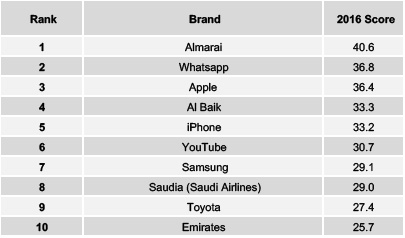
Source: Yougov Brandindex. Top ranked-brands for KSA in 2016.

The YouGov Brandindex rankings for 2016 reflect an eclectic love affair for brands. Brands were rated using BrandIndex’s Buzz score* which asks respondents, “If you've heard anything about the brand in the last two weeks, through advertising, news or word of mouth, was it positive or negative?”

The Buzz Rankings chart shows the brands with the highest average Buzz scores* between January and December 2016. According to YouGov:

1 Almarai (non-mover)

Source: YouGov Brandindex website. Al Marai makes dairy products.
Source: YouGov Brandindex website. Almarai makes food and dairy products.
The largest vertically integrated dairy producer in the Middle East ignited social media in 2016 with the launch of its film on mother’s milk and its family-focused advertising. The mother’s milk video became the second most shared video on YouTube in the world in one week and came in globally as the 7th most shared video of 2016. This also made the brand the third-most popular fast-moving consumer goods (FMCG) brand on Facebook with over 45 million views.

According to Euromonitor's Dairy in Saudi Arabia report, Almarai leads in the cheese, drinking milk as well as yoghurt and sour milk categories.

2 WhatsApp (up three places)

The world’s most popular messaging app has moved up from fifth place in 2015 to second place in 2016. The Facebook-owned app is one of the most popular ways to communicate in KSA.

3 Apple (non-mover)

The release of the new MacBook Pro, iOS 10 Software, the Apple Watch Series 2 and the iPhone 7 with wireless AirPods have not affected Apple’s rank greatly.

Source: ALBAIK Facebook page.
Source: ALBAIK Facebook page. Banner for Earth Hour 2017.

ALBAIK (non-mover)

ALBAIK has been making the headlines for its corporate social responsibility initiatives throughout 2016. The brand’s Please Park It Right community initiative received the Global SABRE Award as one of the world’s top 40 CSR programmes at end-2015. 2016 saw the kingdom’s leading quick service chicken restaurant hit the headlines for switching off its lights to mark Earth Hour and sponsoring the fourth Saudi Youth Sports Initiative aimed at enriching the lives of youth and contributing to the development of soccer and basketball in Jeddah.

5 iPhone (up one place)

The smartphone brand from Apple introduced water-resistance and an improved camera, which were welcomed by consumers.

6 YouTube (up two places)

Owing to the continued increase in content, as well as the introduction of 4K and 360° video, the world’s largest video-streaming platform continues to grow in popularity in the region.

7 Samsung (down five places)

Samsung is at seventh place after falling from second place in the 2015 rankings. Samsung has gone through a tough period with the company recall of some 2.5 million Note 7 devices following multiple battery issues worldwide, but has still maintained high levels of positive Buzz throughout 2016. The release of the Galaxy S7 and S7 Edge Pink Gold version smartphones exclusively for the Saudi market helped boost Samsung’s BrandIndex scores.

8 Saudi Airlines (new entry)

Saudi Arabia’s flagship airline has fallen from sixth place since its debut in the 2016 mid-year rankings. Saudia has announced fleet retirement and renewal for 2017, new flight routes, and the delivery of its first A330-300 regional aircraft which will boost capacity on several of the  Saudi Arabian airline's most in-demand routes. 2016 also saw the carrier win platinum status for Fast Travel implementation from the International Air Transport Association (IATA).

9 Toyota (new entry)

New launches, announcements and awards sawToyota land 9th place. In the last six months, the popular car brand achieved success at the 2016 Middle East Car of the Year (MECOTY) Awards, winning recognition for the Best Midsize Sedan and Best Midsize Truck. Toyota also chose KSA to make its GCC debut launch of the new 2016 Toyota Prius. A partnership with Uber also hit the headlines following the announcement the two brands will create new leasing options in which car purchasers can lease their vehicles from Toyota Financial Services.

10 Emirates (new entry)

Emirates has entered the Buzz Rankings in Saudi Arabia for the first time. The airline has capitalised on the positive and downplayed the negative to increase its reach across the region.

Source: Yougov Brandindex. Top Buzz improvers over 2016 for KSA.

The Buzz Improvers chart ranks the brands with the highest increase in Buzz comparing scores in years 2015 and 2016. Both scores are representative of the general population.

The top Buzz improvers were Mobily, Zain and Snapchat. Notably, KFC and Malaysian Airlines went from negative scores to positive scores in in 2016.

Other highlights included:

+Automotive brands Toyota, Mercedes Benz and BMW were in the top three. Mercedes-Benz, Audi and Mazda saw the best improvements in Buzz rankings.

+For restaurants and eateries Al Baik, Al Tazaj and Pizza Hut topped the list. KFC, McDonald's and Hardee's did best on Buzz improvements. In KFC's case, the scoring moved from negative to the low positives.

+Retailers IKEA, Panda, and Jarir were the best known brands. EXtra, Carrefour and Souq.com made the most gains for Buzz.

+The consumer electronics space was dominated by Apple, Samsung and Sony. Nikai, which makes audiovisual equipment and phablets, Black & Decker and JVC demonstrated the most Buzz improvement, the first from a negative score to a positive one.

+In the area of financeAl Rajhi BankNational Commercial Bank (NCB, Al Ahli), and Alinma Bank won out. GIBSaudi Investment Bank and Alawwal Bank made the most gains in Buzz.

+The travel category saw airlines Saudia, Emirates and Qatar Airways as its three leaders. Malaysia Airlines, Saudia and Air France/KLM grew in popularity over the last year, from negative to positive in Malaysia Airlines' case.

Interested?

Watch the Almarai mother's milk video (Arabic). At the time of writing the video had been viewed over 12 million times

Read how Almarai rode on YouTube to reach its target audience in KSA in 2016

Watch the Please Park it Right video from ALBAIK (Arabic) 

Monday, 20 February 2017

Hana Tajima's 2017 spring/summer collection is out

Source: Uniqlo website. Hana Tajima's 2017 spring/summer collection is out.Uniqlo and fashion designer Hana Tajima have launched the 2017 spring/summer collection in Singapore and Malaysia.

The Hana Tajima Lifewear collection is exclusive to Uniqlo and is inspired by the relationship between movement and form while echoing Tajima's Japanese roots and English upbringing.

Source: Uniqlo website. Hana Tajima's 2017 spring/summer collection is out.The collection features elegant, contemporary styles that are both versatile and comfortable. Pieces include long flowing skirts, tapered ankle-length pants, loose-fitting blouses, kebaya and hijab. Solid colours dominate, particular dark colours and shades of brown.

Interested?

View the Uniqlo video interview with Hana Tajima

Watch the video on creating looks with the 2017 spring/summer collection for Uniqlo

Check out the hijab tutorial with the shaped hijab with ties from the collection 

In Singapore, the collection is available at 313@Somerset, Bugis+, OneKM and online.

*Images source: Uniqlo website.

Perfetti Van Melle is 2016 gum leader in Indonesia

The positive volume growth of gum confectionery in Indonesia in 2016 was due to improved distribution of gum, especially chewing gum, as a result of the rapid expansion of modern retail outlets. Purchasers were also encouraged by the benefits of gum, including fresh breath and teeth whitening, says research consultancy Euromonitor.

PT Perfetti Van Melle Indonesia continued to lead gum with a value share of 58% in 2016, Euromonitor said. Perfetti Van Melle Indonesia has been successfully using promotions to build a wider consumer base and higher brand awareness.

Volume growth in gum is expected to remain positive over the forecast period from 2016 to 2021, with improved distribution expected to ensure product availability. Leading gum manufacturers are likely to continue price promotions and new product development, which would further boost growth in gum over the forecast period, Euromonitor said.

Interested?

Sunday, 19 February 2017

Digital brands are king in Malaysia

Source: YouGov Brandindex 2016 rankings for Malaysia are heavy on digital brands.
Source: YouGov Brandindex 2016 rankings for Malaysia are heavy on digital brands. 

The YouGov Brandindex rankings for 2016 reflect a love affair with digital brands in Malaysia. WhatsApp, Facebook and Google were in the top three , followed by e-commerce site Lazada, the Apple iPhone, and YouTube in the top seven.

Brands were rated using BrandIndex’s Buzz score* which asks respondents, “If you've heard anything about the brand in the last two weeks, through advertising, news or word of mouth, was it positive or negative?”

The Buzz Rankings chart shows the brands with the highest average Buzz scores* between January and December 2016.

Source: YouGov Brandindex. Top Buzz improvements in Malaysia for 2016.
Source: YouGov Brandindex. Top Buzz improvements in Malaysia for 2016. 

The Buzz Improvers chart ranks the brands with the highest increase in Buzz comparing scores in years 2015 and 2016. Both scores are representative of the general population.

The top Buzz improvers were Huawei, KFC and Lazada. Huawei in particular went from single-digit territory in 2015 to double digits in 2016.

Other highlights included:

+Automotive brands Toyota, Honda and BMW were in the top three.

+Quick service (QSR) restaurants and casual dining brands were all US brands, KFC, Domino's and McDonald's. KFC, McDonald's, and Texas Fried Chicken did best on Buzz improvements.

+In the area of finance, Maybank, CIMB and Public Bank won out. Insurance players Prudential, Great Eastern Life and AIA were in the lead, while AIG, Kurnia and AXA made the most gains in Buzz.

+Fashion retailers were more a mix of general goods providers which also offer fashion as well as pure fashion retailers. Uniqlo, JUSCO and Adidas were the best known brands. Adidas, FashionValet - which offers designer brands online - and Puma made the most gains for Buzz.

Telecom, Internet and pay-TV operators that were the most well-known included Digi, Celcom and U Mobile. P1 WiMax, while still in negative territory, and U Mobile did best on Buzz improvement.

+The e-commerce/m-commerce category saw e-marketplace Lazada, online fashion retailer Zalora and e-marketplace Mudah.my as its three leaders. Lazada, Fashionvalet and e-marketplace Alibaba grew in popularity over the last year.

+The mobile space was dominated by Apple's iPhone, Apple and Samsung. Huawei, Blackberry and Motorola demonstrated the most Buzz improvement, the latter two from more negative scores to less negative scores.

*All Buzz scores listed have been rounded to a single decimal place; additional precision was used internally to assign ranks.

Requests to operate Hajj flights into KSA accepted till mid-March

The General Authority of Civil Aviation (GACA) of the KSA is currently accepting requests for the operation of Hajj flights for the 2017 (1438) season.

Arrivals for Hajj flights begin 24 July, and end on 26 August. Departures begin 4 September for domestic flights, 5 September for GCC flights, and 6 September for chartered flights to other countries. The last day of the departure phase is 5 October.

Interested?

Requests to operate flights during specific times must be submitted not later than 14 March for slot allocation.

Saturday, 18 February 2017

Chocolate is the top indulgence product in Indonesia

Indonesians are now more aware of the benefits of chocolate if it is consumed in moderation, and continue to buy it as a snack or to gift on special occasions, boosting volume sales of chocolate confectionery in 2016, says research consultancy Euromonitor. In fact, chocolate confectionery is expected to continue as the most favoured indulgence product* for consumers of all ages in Indonesia, the company said.

Ceres PT has retained its clear leadership in chocolate confectionery with a value share of 52% in 2016, thanks to the company’s brand reputation, broad product offering and competitive pricing, Euromonitor said. Ceres markets several chocolate confectionery brands, including Silver Queen, Silver Queen Chunky and Delfi (tablets); Top (second leading countlines** brand); Delfi and Van Houten (boxed assortments); as well as Cha Cha and Chic Choc (chocolate pouches and bags). The company’s aggressive marketing campaigns have also contributed to its performance.

Euromonitor forecasts that chocolate confectionery is likely to post a healthy value CAGR of 6% in constant 2016 terms over the forecast period of 2016 to 2021.

Interested?

Buy the Confectionery in Indonesia report

*An indulgence product is a luxury item which the buyer does not need and may feel guilty about purchasing. 

**Confectionery term for bars of candy or chocolate, often shipped to retailers in cartons. The contents are then sold individually.

Singapore Hajj quota now 800

The KSA Ministry of Haj and Umrah has increased Singapore’s official Hajj quota* from 680 to 800 places, the Islamic Religious Council of Singapore (Muis) has reported.

Since 2012, the KSA authorities had reduced quotas for domestic and foreign pilgrims due to the major development and upgrading projects taking place in the vicinity of the Holy Mosque in Makkah, in particular the expansion of the Mataf (circumambulation) area. However, Singapore was not affected by the quota reduction.

Muis will contact eligible Hajj registrants on the waiting list regarding the additional vacancies.

Media reports from early this year have noted that various country quotas have been reinstated.

Interested?

Read about Muis' Hajj registration system

*Each country is allowed a specific number of Hajj pilgrims every year. The number is based on the formula decided by the Organisation of Islamic Conference (OIC) in 1987, or 0.1% of the Muslim population in that country.

Thursday, 16 February 2017

Office of Pilgrims Affairs, Pakistan invites bids on catering in Madinah for Hajj 2017

The Office of Pilgrims Affairs (OPAP), Consulate General of Pakistan, Jeddah in KSA has published an invitation to submit expressions of interest/bids (EOI/Bids) from the owners and their authorised attorneys of catering companies in Madinah for Hajj 2017 (1438).

The catering companies must be registered with the Ministry of Hajj and Amana Madinah. The owners of catering companies of Madinah are to offer rates for three meals as per the menus given to all eligible bidders. All owners and authorised attorneys of the catering companies must apply directly to the OPAP. Agents or suppliers are not eligible. 

Interested?

All EOIs/bids must reach OPAP, Consulate General of Pakistan, PO Box 182, Jeddah 21411 by 6 March 2017. Bids will be opened at 4.30pm on the last day in the presence of bidders or their representatives who may choose to be present. OPAP reserves the right to reject any bid without assigning any reasons.

View detailed terms and conditions

Milk and yoghurt based drinks both popular in Indonesia

Heavy advertising in mass media, more television programmes as well as magazine articles focusing on health issues have led to rising awareness among Indonesian consumers of the benefits of drinking milk over the period 2011 to 2016, says Euromonitor.

Ultrajaya Milk Industry & Trading Company remains the leading player in drinking milk products with a 23% value share in 2016. Its flagship brand is called Ultra. The company's performance in flavoured milk drinks comes as a result of heavy marketing and improved distribution, Euromonitor said. 

Although already popular for its shelf-stable milk, Ultrajaya Milk Industry & Trading is still educating Indonesian consumers about the benefits of consuming liquid milk rather than powdered or condensed milk. In 2016, the company held many below-the-line event promotions, such as Tour de farm, centring around visits to the Ultrajaya farm in Bandung. In May 2016, it also held Preschool Roadshow Ultra Mimi Carafun in the city of Medan. 

Source: Ultra Mimi website. Pictures from an Ultra Mimi Carafun Roadshow held in February 2016.
Source: Ultra Mimi website. Pictures from an Ultra Mimi Carafun Roadshow held in February 2016.

Euromonitor notes that Indonesian milk consumption per capita is lower than in other emerging countries, so there is still room to grow. 

The yoghurt market is also growing, especially among middle- and high-income consumers, particularly women, Euromonitor said, as it isbeing aggressively promoted in the mass media as offering nutritional benefits and aiding digestion. Female consumers are increasing their consumption of such products as they believe that yoghurt can help them maintain a slim figure, improve their skin and slow the ageing process, the research firm notes. Sour milk drinks, mainly targeted at children, are preferred by some parents compared to flavoured milk drinks, as they typically contain good bacteria for digestion.

In 2016, Yakult Indonesia Persada PT with dominated the yoghurt and sour milk market with its Yakult drinking yoghurt, which had a 69% value share, Euromonitor said. Yakult’s value share gain in 2016 comes down to improved distribution, via both retail channels and Yakult Ladies - Yakult employees who deliver Yakult drinks directly to customers in Indonesia. Apart from the growing number of Yakult Ladies promoting the brand not only in residential areas but also in schools, Yakult Indonesia Persada has also benefited from the rapid expansion of modern retailers in Indonesia, especially convenience stores, hypermarkets and supermarkets.

Yoghurt and sour milk products is likely to continue to benefit from growing health awareness, particularly among middle- to upper-income consumers, Euromonitor predicts. The increasing number of health-conscious consumers is expected to result in the expansion of yoghurt and sour milk products’ consumer base over the forecast period. Manufacturers are likely to continue to invest heavily in educating consumers about the health benefits of yoghurt and sour milk products.

Interested?

Read the Euromonitor report on Dairy in Indonesia

Wednesday, 15 February 2017

Abdulla Al Ghurair Foundation for Education, World Bank Group to focus on improving quality education to Arabs

The Abdulla Al Ghurair Foundation for Education, the largest privately funded foundation in the Arab world focused exclusively on education, and the World Bank Group have a new strategic partnership focused on improving the quality and relevance of education for Arab children and youth.

The partnership will be guided by the Education for Competitiveness initiative, or E4C, developed jointly by the World Bank Group and the Islamic Development Bank Group, with the support of regional and international partners. E4C offers transformative interventions to improve education systems. These include expanding early childhood development, strengthening early grade learning; promoting information for accountability, enhancing career guidance and opportunities, and boosting 21st century skills and values.

“With the support of our Chairman, Abdulaziz Al Ghurair, a renowned business leader, we are well positioned to develop programmes that respond to the needs of the job market. Through this partnership, we hope to encourage more foundations to take part in strategic efforts with governmental, multilateral, and civil society sectors to promote education innovation and achieve scale,” said Maysa Jalbout, CEO, Abdulla Al Ghurair Foundation for Education.

Youth unemployment in the Middle East and North Africa (MENA) stands at 25% for males and 47% for females—the highest of all regions across the world. While graduates cannot find jobs, more than one-third of employers in MENA identify skills shortages as a major constraint to business operation and firm growth. One of the main reasons for the skills mismatch is the quality of education. Learning outcomes in the region are among the lowest in the world as demonstrated in international assessments. In the 2015 Trends in Mathematics and Science Study (TIMSS), all MENA countries ranked below the international average, with only Dubai in the UAE scoring above the average.

“This partnership will bolster our regional efforts to achieve a high quality education and brighter future for all. Realising the promise of education for development is within our reach and our youth deserve nothing less,” said Hafez Ghanem, World Bank VP for the Middle East and North Africa.

The partnership follows the launch of a new Platform for Education announced by World Bank Group President Jim Yong Kim, which will be hosted annually at the World Government Summit in Dubai. The platform will serve as a space to share global experience on education, launch new initiatives, and spark high-level debate and exchange among leaders, experts, and policymakers.

The Abdulla Al Ghurair Foundation for Education and the World Bank Group will leverage their expertise and partnerships, and focus their E4C partnership on improving school to work transition by enhancing career guidance and opportunities, and boosting 21st century skills to Arab youth. Some concrete examples include:

• Supporting a school counselling graduate programme that will train school counselors in college preparation and career guidance.

• Providing access to career guidance materials and resources online that are customised to the needs of students in the region.

• Offering educational opportunities for Arab youth, including skills development programmes, bootcamps, internships, mentoring, and research to better prepare them for jobs demanded in the region.

Tuesday, 14 February 2017

IMF forecasts challenging year for Palestine

  • Strong revenue mobilisation efforts contributed to a marked reduction in the 2016 fiscal deficit
  • 2017 is likely to be a very challenging year for the Palestinian economy
  • Budget pressures require continued strong domestic policies, more donor support, and more predictable revenue transfers from Israel.

An International Monetary Fund (IMF) mission led by Karen Ongley visited East Jerusalem and Ramallah from January 31 to February 9, 2017 to assess recent economic developments in the West Bank and Gaza and the financial situation of the Palestinian Authority (PA).

The mission met with Prime Minister Rami Hamdallah, Finance Minister Shukry Bishara, Governor Azzam Shawwa, and other Palestinian officials. At the end of the mission, Ongley issued the following statement that outlined "increasingly difficult conditions" for the Palestinian economy.

“While we estimate that GDP growth increased from 3.5% in 2015 to 4% in 2016, this was not sufficient to generate new jobs and unemployment rose to more than 28% in September. Consumption is still the primary driver of growth, as political uncertainties and access restrictions continue to inhibit private sector investment across the West Bank. While donor-funded reconstruction in Gaza continued, aid disbursements were delayed and humanitarian conditions remain dire, particularly as the provision of public services worsens," Ongley noted in the statement.

“The Ministry of Finance and Planning managed these testing circumstances skillfully. Strong revenue mobilisation efforts contributed to a marked reduction in the 2016 fiscal deficit. In particular, discussions between the PA and government of Israel contributed to the payment of past obligations to the PA and these one-off factors helped to increase tax and non-tax receipts by about two percentage points of GDP. The sharp increase in total revenue saw the recurrent deficit decline to 5.6% of GDP in 2016 from 9.6% of GDP in 2015. However, a further decline in donor budget support contributed to a financing shortfall and the accumulation of arrears.

“Notwithstanding recent progress on the budget, 2017 is likely to be a very challenging year. We therefore welcome the prudent approach in the 2017 budget of assuming lower donor support and no additional one-off transfers from Israel. Despite efforts to bolster domestic receipts, the assumed decline in clearance revenue and other payments from Israel points to a reduction in overall revenues, while spending pressures remain. The recurrent deficit is projected to widen by about 2% of GDP and, with another 15% decline in donor budget support, this would result in a financing gap of almost 6% of GDP."

The IMG encourages the authorities "to build on recent efforts and explore mitigating options. In the near term, this could include considering contingency measures such as limiting the increase in the wage bill to inflation, as this is the largest expenditure item."

Ongley's mission statement also noted that the upcoming Public Financial Management (PFM) strategy could help to enhance the efficiency of spending and promote lasting fiscal improvements. "An action plan of well-prioritised PFM measures could also provide a strong basis for increased donor engagement and support for the government’s priorities in the context of the 2017-2022 National Policy Agenda. Other priority areas include civil service and pension reform, as adopting a strategic approach to the wage bill would free up resources for priority public investments," she stated, identifying the reversal of the decline in donor support and continued discussions with the Israel government on enhancing and improving the predictability of revenue transfers as key success factors.

Ongley disclosed that the Palestine Monetary Authority (PMA) remains committed to strengthening the anti-money laundering and combating the financing of terrorism (AML/CFT) framework, in line with international standards. "In this context, we welcome the constructive working relationship between the Palestine Monetary Authority (PMA) and Bank of Israel. Another important step is the PMA’s recently accepted request for a comprehensive AML/CFT evaluation by Middle East & North Africa Task Force (MENAFATF)*, along with plans to continue with AML/CFT-related reforms, with technical support from the IMF and other development partners," she stated in her mission report.

*MENAFATF combats laundering and terrorist financing.

19 travel agencies in Malaysia licensed to provide Hajj 2017 services

Source: TH. The PJH licence award ceremony.
Lembaga Tabung Haji (TH) has accredited 19 travel agencies for the Hajj 2017 (1438) season. the agencies received the Pengelola Jemaah Haji (PJH) licence at TH premises.

TH reminded the agencies to fulfill the services promised to pilgrims.

TH, the Pilgrims Fund Board of Malaysia, was established as an economics-based Islamic financial institution to help provide investment services and opportunities to grow funds for the Hajj while managing pilgrimage activities for the Malaysian Muslim community.

Worldreader to expand Read to Kids Program to serve Syrian and host communities in Jordan

Worldreader, a global non-profit that believes everyone can be a reader, plans to expand its Read to Kids Program to serve Syrian refugee and host communities in Jordan. The programme supports parents and caregivers to become their children's first teachers, enabling and encouraging them to read to their young children using their mobile phones.

The Read to Kids mobile reading programme in India cultivated more than 60,000 readers over nine months through support from Pearson. Worldreader is now committing to expanding into Jordan to help Syrian and Jordanian children become lifelong readers. The organisation will work with Arabic publishers and partners to digitise and disseminate high-quality Arabic children's reading books to 50,000 households across the country. The programme will also work with educators and publishers to curate a psychosocial collection of books and activities that encourages stories and reading as a safe way to explore emotions and generate healing.

"Encouraging parents to get engaged in their children's learning through reading books has been outlined as a key priority of Jordan in 2016. The research is clear on the importance of reading for brain development and long-term success in children's lives. We are pleased to work with Worldreader be able to offer this innovative programme to the people of Jordan as well as the Syrian nationals who have sought refuge within our country," said HE Dr Omar Razzaz, Jordan's Minister of Education.

Parents and caregivers will be able to access this programme from an Internet browser on their mobile phone or by downloading the Read to Kids app from the Google Play Store. The books are curated to match children's interests and developmental readiness from birth through age 12.

Worldreader plans to launch Read to Kids Jordan in late 2017. The programme will be made possible through a US$1 million grant from private philanthropic organisation Stavros Niarchos Foundation (SNF), with additional support from Jordanian social and education entities. The organisation is seeking additional funding and support from organisations wishing to help promote reading and education to refugees in Jordan.

"Worldreader is an exemplary organisation providing critical literary resources to enhance children's learning and educational development," said Andreas Dracopoulos, Co-President of the SNF. "SNF is proud to partner with Worldreader on Read to Kids Jordan, a critical initiative that aims to support early literacy programmes for 50,000 Syrian and Jordanian children, and as a foundation to continue to respond to the devastating crisis and its impact on refugee and host-community children."

"At a time when world leaders are closing their doors to refugees, conflict-affected families need every tool to ensure bright futures for their children," said David Risher, CEO and Co-founder of Worldreader. "We have seen firsthand the impact that digital reading has on children and families in India and we are proud to bring this same opportunity to all children in Jordan—including those who have been affected by the worst humanitarian crisis of our time—through the Read to Kids programme. Every child should be able to benefit from the magic of reading."

Monday, 13 February 2017

Cheese becomes popular in Indonesia

More Indonesian families, particularly in the big cities, are expected to start using cheese as a main ingredient in their meals. According to research firm Euromonitor, more consumers have started to prepare Western foods which use cheese as an ingredient by themselves at home. These include pizzas, pasta dishes, cakes, pastries and toast. Cheese has become very popular to serve with white bread as a substitute for chocolate sprinkles, jam or honey.

An increasing number of foodservice outlets and rising number of new menus using cheese by existing foodservice outlets may also prompt faster volume growth of food-service sales of cheese in the forecast period, Euromonitor said.

Kraft was named as the leading cheese brand in Indonesia in 2016, with Kraft Ultrajaya Indonesia PT commanding a 61% share of value sales. The company’s dominant position is attributed to its early entry into the Indonesian cheese market, a wide variety of other processed cheese products and aggressive marketing, using both television advertisements and below-the-line activities.

Interested?

Read the executive summary for the Euromonitor Dairy in Indonesia report, dated December 2016

Read the WorkSmart Asia blog post about popular brands in Indonesia

Sunday, 12 February 2017

YouGov BrandIndex 2016 rankings for Indonesia list Garuda in top place

Source: YouGov Brandindex. Brandindex rankings for 2016 for Indonesia.

The YouGov Brandindex rankings for 2016 show diversity in Indonesia. It's national carrier Garuda in top place, followed by Samsung and Aqua, the mineral water brand from Danone.

Brands were rated using BrandIndex’s Buzz score* which asks respondents, “If you've heard anything about the brand in the last two weeks, through advertising, news or word of mouth, was it positive or negative?”

The Buzz Rankings chart shows the brands with the highest average Buzz scores* between January and December 2016.

Source: YouGov Brandindex. Brand reputation improvements in 2016.

The Buzz Improvers chart ranks the brands with the highest increase in Buzz comparing scores in years 2015 and 2016. Both scores are representative of the general population.

The top Buzz improvers were Air Asia, CNN Indonesia and Malaysia Airlines. Air Asia in particular went from negative territory in 2015 to being seen in a significantly positive light. Malaysia Airlines, also viewed negatively in 2015, made some inroads in improvement.

Other highlights included:

+For healthcare and pharma, it was all about Tolak Angin, a herbal medicine used for flu, headache, nausea and flatulence; Panadol and cold medicine Promag.

+Aqua, Pocari Sweat and Teh Botol Sosro made the top three for beverages. Top improvers were Coca-Cola, Sprite and Kratingdaeng, an energy drink. The confectionery and snacks category was dominated by Asian brands. Euromonitor reported in December 2016 that Ceres PT, which belongs to Singapore's Petra Foodsis the market leader for chocolate with a value share of 52% in 2016. Silver Queen from Ceres is No. 1, then Beng Beng from Mayora of Indonesia and OT Group's Tango. The best buzz improvements came from Better, a biscuit brand from PT Citra Sukses Internasional, Beng Beng - which started from an already high score - and Oops, also from the OT Group.

+For dairy brands - including yoghurt and ice cream - Walls, an ice cream maker, Yakult, yoghurt based drinks, and Milo, a chocolate malt beverage from Nestlé, were in the top three. According to Euromonitor, Yakult has a 69% market share in yoghurt and sour milk products in Indonesia for 2016. Cimory, a provider of milk, soy milk and yoghurt-based drinks, Japfa's Real Good milk drinks and Qeju cheese from Dairylea were the top three winners for Buzz improvement.

+Quick service (QSR) restaurants and casual dining brands were all US brands, KFC, Pizza Hut and McDonald's. McDonald's, California Fried Chicken - better known as CFC - and Mr Baso, whose menu includes meatball (editor's note: 'meatball' is 'bakso' in Bahasa Indonesia), noodle and rice dishes, did best on Buzz improvements.

+When it comes to airlines the top three were Garuda Indonesia, Singapore Airlines, and Garuda's budget airline brand Citilink Indonesia. The top brand improvements were from Air Asia and Malaysia Airlines, followed by ANA.

+For hotels and spas Aston Hotels, Ritz Carlton and Grand Hyatt were the top three. Major Buzz improvements were experienced by the Holiday Inn Express, Cozy Spa and the Ibis.

+The personal care category had Pepsodent, Lifebuoy and Dettol in the top three places. Shinzu'i lightening skincare, Tje Fuk, also for skin lightening and Wardah, known for its halal cosmetics, saw the Buzz improvement in 2016.

+Fashion retailers were more about general goods providers which also offer fashion than pure fashion retail. Carrefour, Indomaret and e-marketplace MatahariMall were the best known brands. Robinson, Galeries Lafayette and Ikea made the most gains for Buzz.

+The e-commerce/m-commerce category saw Tokopedia, e-travel site Traveloka and Bukalapak as its three leaders. Tokopedia, Bukalapak and Blibli seem to have grown in popularity over the last year. Blibli ranked 5th in the main leaderboard.

*All Buzz scores listed have been rounded to a single decimal place; additional precision was used internally to assign ranks.

Saturday, 11 February 2017

US$40 million donation made to charity benefiting needy in Jordan

HRH Princess Haya Bint Al Hussein, wife of HH Sheikh Mohammed bin Rashid Al Maktoum, VP and PM of the UAE and Ruler of Dubai, and their children, HH Sheikha Al Jalila Bint Mohammed Al Maktoum and HH Sheikh Zayed Bin Mohammed Al Maktoum, have donated JD28 million to Tkiyet Um Ali.

The donation is made in memory of HM the late King Hussein Bin Talal and HM the late Queen Alia Al Hussein. HM King Hussein passed away on February 7 1999, while HM Queen Alia passed away on February 9 1977. Tkiyet Um Ali was originally the idea of HM the Late Queen Alia Al Hussein more than 40 years ago.

In 2003, HRH Princess Haya, who had the original concept documents, established Tkiyet Um Ali, the first non-governmental organisation to provide sustainable food support by serving hot meals and distributing food parcels, in addition to providing humanitarian food aid to Jordan's underprivileged. Tkiyet Um Ali launched a project to eradicate hunger in May 2013. Tkiyet Um Ali now feeds 18,000 households that have been identified as families who live below the hunger and poverty line.

"The donation comes at a time where food insecurity in Jordan has tripled following the Syrian Refugee Crisis," stated HRH Princess Haya, Chairperson of Tkiyet Um Ali. "We conducted recent field studies that indicate that today around 30,000 Jordanian families are food-insecure, reinforcing the urgent need to reach an additional 10,000 households." Tkiyet Um Ali aims to cover these 30,000 families across the kingdom.

"This year marks 18 years since the passing of HM the Late King Hussein Bin Talal and 40 years since the passing of HM the Late Queen Alia Al Hussein who, above all, were people who cared about humanity," stated HRH Princess Haya. "There is no more fitting way to celebrate their lives and continue their legacies by doing something they would have done themselves."

Tkiyet Um Ali is named after Her Majesty Queen Alia ('um Ali') and is inspired by an Islamic concept of providing food for the poor while demonstrating social responsibility towards those less privileged. HM Queen Alia was fondly named in Jordan as the 'mother of the poor'.

New e-book on fatwas for science, medicine and health in Singapore

Source: Muis. Cover of the book.
Fatwas of Singapore: Science, Medicine and Health by Office of the Mufti, Muis - the Islamic Religious Council of Singapore, is now available as an e-book.

A translated and adapted version of the original Malay publication titled Fatwa-Fatwa Singapura Jilid 1: Sains, Perubatan dan Kesihatan, the book is part of the Fatwa Rulings Compilation and Analysis series. The series is itself part of the Fatwa Rulings Documentation Project, which aims to increase awareness and enhance the understanding of readers on fatwas produced by Singapore's Fatwa Committee, and how the committee's development and thinking has changed since 1968.

Beyond the 29 fatwa texts related to issues of science, medicine and health, the publication also provides sociohistorical context behind the issues discussed by the fatwas. Commentaries summarise and explain revisions for fatwas, as well as distil the Islamic legal principles, concepts and thinking processes employed by the Fatwa Committee in fatwas particularly for those which involve novel ijtihād*.

The first volume also provides insights into the challenges faced by the Fatwa Committee members since its founding, and what it continues to face in ensuring that relevant fatwas are produced in the context of Singapore's technologically advanced and multicultural society.

Singapore Deputy PM Tharman Shanmugaratnam, emphasised at the Conference on Fatwa in Contemporary Societies organised by Muis that Singapore practises active and inclusive multiculturalism, that must be continually developed and deepened. "It is a whole system of laws, an activist government, committed religious and community leaders, and values and norms that have been shaped over time," he said. 

Such norms and values encourage citizens to respect different faiths and cultures and allow them each to thrive, and also to embrace each other as fellow Singaporeans. "These norms and values are not as visible, but they are at the heart of what it takes to sustain our multicultural society. They are also continuous work. Our religious and community leaders, educators and parents, and all of us as citizens, play important roles in deepening these values of respect and fellowship as citizens in our next phase of making history," he noted.

Singapore's Fatwa Committee has had a crucial role to play in the country's multicultural environment, Shanmugaratnam said, paving the way for the Central Provident Fund and insurance nominations to be accepted as valid ways of transferring wealth within Muslim families, for example.

He also lauded the Fatwa Committee's sustained engagement within the Muslim community to discuss the objectives and rationale of fatwas. "Through this engagement, the committee is able to explain why it may at times decide to depart from the positions of religious bodies elsewhere in the Islamic world. It is also how our Muslim religious leaders help engender trust and confidence in fatwas that are suited for Muslims living in Singapore. The Committee’s independent thinking, guided by their ethical and moral commitments and a keen eye on the public interest, augurs well for the future of Islam in Singapore, and also for our multiculturalism in Singapore," he said.

Dr Mohamed Fatris Bakaram, the Mufti of Singapore recounted at the same conference how the Fatwa Committee has revised fatwas as technology has advanced, revealing new implications and challenges.

He noted that "the earnestness shown by the Fatwa Committee to not only protect the community from possible harm or probable transgression of their religious injunctions that can be caused by uncertainties and sense of anxiety", and also the Committee's "desire to provide religious guidance that would propel them forward in riding the waves of scientific and technological advancements" departs from the approach still taken by many muftis or fatwa institutions, where in situations of uncertainty and probable occurence of both benefit and harm, tend in general to emphasise
the obligation to avoid harm.

"A legal maxim widely utilised to justify this approach is dar' al-mafasid muqaddam 'ala jalb al-masalih (درء المفاسد مقدم على جلب المصالح), or 'the evasion of harms is to take precedence over establishing benefits'. This legal maxim is useful, as the failure to eliminate dangers or harms would normally impede the realisation of benefits in the lives of individuals and communities."

Rather than exclude new developments, Dr Mohamed Fatris said Muslims must "develop a high degree of confidence to not only be consumers of these scientific achievements, but as active contributors that effectively take part in their further developments", quoting a saying from the Prophet Muhammad (ﷺ) that "the best of peoples are those who bring the most benefits to others (أَحَبُّ النَّاسِ إِلَى اللَّهِ أَنْفَعُهُمْ لِلنَّاسِ)".

"In the midst of uncertainties from uncharted perils of cloning, the Fatwa Committee decided to stay true to the spirit of bolstering scientific discoveries, that has long been the tradition of Islamic scholarship that shaped its history for centuries. This is evident in the fatwa on cloning issued in February 2000, where the Committee laid an important foundation in addressing issues of new scientific discoveries. In the concluding part of the fatwa text, the Fatwa Committee advises the Muslim community against assuming that there exists a contradiction between Islam and new scientific discoveries," he said, noting that scientific discoveries are meant for "establishing general benefit and good".

While acknowledging that the commitee is bounded by principles of the shari'ah, Dr Mohamed Fatris also said, "A dignified and responsible fatwa authority is one that provides guidance to real challenges faced by the community in their respective world, within the temporal space and physical environment that they are in."

Interested?

View the Muis video about how fatwas have evolved in Singapore (subtitles in English for parts in Malay)

*Ijtihad (اجتهاد‎‎) refers to the reasoning or analytic process of answering a question in the Islamic legal context.

posted from Bloggeroid