Showing posts with label Quran. Show all posts

Tuesday, 11 October 2022

Divine renames app to 'Islam Divine'

Divine, the community project that leverages space technologies to broadcast the Quran from space,  today announced that it has renamed its mobile app to Islam Divine to make it easier to be found by users on the Apple App Store and Google Play Store.

Formerly known as Divine Live, Islam Divine features an enhanced user interface (UI) that includes a day/night switch, wallpapers, and colours inspired by Islamic art. 

For those new to Islam, or keen in accessing more information on it, the developers have added a chat, where users can ask questions on Islam. More information has also been added on the daily obligatory prayers.

Users who are more well-versed in Islamic teachings can now save and copy content from the Quran, du'a' and hadith (prayers and associated accounts) on the app. A new bookmarking feature allows users to save their spot in the religious text.

Divine was founded in 2021 to dispel misconceptions and stereotypes of the teachings of the Quran and to present a better understanding of what the Quran is for young and new Muslim communities, and the world.

By hosting information in terrestrial servers in space, Divine is able to transmit the teachings of the Quran to a wider audience due to the large coverage area afforded by the satellite. The content is transmitted from space to several platforms built for the Divine project, including the Divine official site; as well as the Islam Divine app.

Divine is operated and managed by Eurasian Space Ventures (ESV), a private company registered in Kazakhstan which aims to serve as an international hub for space projects and related organisations looking to capitalise on the well-established space infrastructure and ecosystem in the country. It is an initiative under the I AM PART OF global charity foundation established by entrepreneur Shukhrat Ibragimov.

Sunday, 17 April 2022

Ramadhan talent competition in KSA focuses on Quran, adhan

Source: Syaq.

Over 40,000 people from 80 countries have entered Scent of Speech (عطر الكلام), a global talent competition focused on reciting the Quran and delivering the adhan (أذان الصلاة).

Organised by the KSA entertainment authority, the competition explores different cultures through the diversity of performance. The first-place winner for Quran recitation receives US$1.3 million, while the top prize for the adhan category is US$533,000.

The competition is broadcast on official state TV during Ramadhan. A total of 36 candidates reached the finals from Britain, Canada, KSA, Iraq, Egypt, Algeria, Iran, Malaysia, Indonesia and Turkey: 18 in each category.

A panel of 13 international judges will decide on the winners.

Details:

Watch

Tuesday, 14 July 2020

MAIWP launches Quran reading classes

MAIWP, the Federal Territories Islamic Religious Council of Malaysia, in collaboration with the Institute of Al-Quran Studies (IPaQ), has launched the Jom Celik Al-Quran (Let's Read the Quran) programme to help ensure that Muslims, especially in the Federal Territories*, can read the Quran, particularly in reciting surahs (chapters).

MAIWP Chairman, Dato 'Sri Syed Hussien AlHabshee said during the launch that he had received a lot of positive feedback about the programme, and hoped that the initiative could be expanded to other states.

Three tiers of study will be implemented, beginning with a basic class focusing on those who cannot recite the Quran. The Abahata al-Jabari** study method for recitation will be used.

An intermediate course will focus on those who have been able to recite the Quran but never finished reading it. This course will guide and improve their recitation skills. Students will be able to successfully finish reading the Quran after completing the 90-hour course.

The most advanced class is the Instructor Training Course (TOT) which will equip teachers with the skills to teach in institutions under MAIWP.

Each course will extend over three months. No fee is charged for the asnaf or beneficiaries of zakat, while for the B40 group - the bottom 40% of households in terms of income - will be charged RM30. For those who can afford it, the fee is RM300.

Actor Adam Corrie Abdullah was appointed as the MAIWP ambassador for his contribution in the field of d'awah (دعوة‎), or educating others about Islam. He said that it is a big responsibility and pledged to do his best.

*The Federal Territories of Malaysia comprise Kuala Lumpur, Putrajaya and Labuan.

**According to Noor Jamaliah Ibrahim, Mohd Yakub @ ZulkifliMohdYusoff, and Mohd Yamani IdnaIdris from the Centre of Quranic Research, published in QURANIC VERSE RECITATION RECOGNITION ENGINE FOR SELF LEARNING OF AL-JABARI METHOD: A REVIEW in the proceedings of The 3rd Annual International Quranic Conference (2013), the Al-Jabari method was was developed in Bandung, Indonesia by Dr H. Yusuf Sodik, and introduced to Malaysia in 2012. They called it an effective and faster way of learning to read and write Quran, with a better understanding of tajweed (تَجْوِيدْ‎) rules - the proper way to recite the Quran - that can be achieved in 30 hours.

Sunday, 19 August 2018

1.3 million Qurans to be given to Hajj pilgrims

King Fahd’s Quran Printing Complex, located in Madinah, KSA will be distributing 1,383,610 copies of the Quran and Quran translations as a gift from King Salman of KSA to Hajj pilgrims.

The Quran gift will be distributed from August 23 till 30 to pilgrims departing through local airports in Jeddah, Madinah, and seven other main ports of land, sea, and air.

King Fahd Printing Complex has also been distributing copies of Hajj rituals through the Prince Mohammed bin Abdulaziz International Airport in Madinah. The distribution began in July and ended 14 August, with 389,186 copies handed out.

Tuesday, 10 July 2018

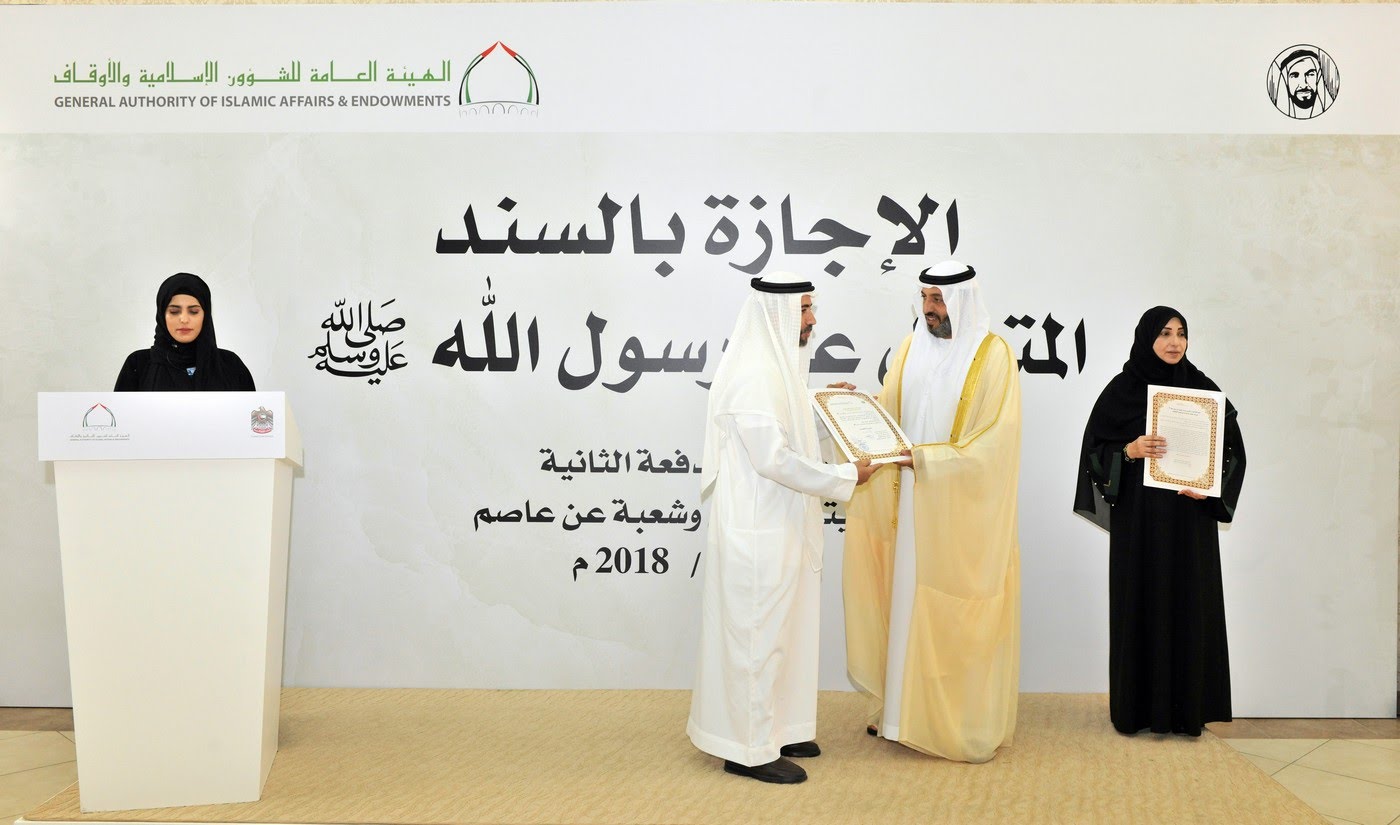
Awqaf marks second huffadh graduation

The UAE General Authority of Islamic Affairs & Endowments (Awqaf) has held a graduation ceremony for the second cohort of huffadh (حُفَّاظ, Quran memorisers) who have sought licensing with sanad (السند, a sound chain of authorities for narration) linked back to the Messenger of Allah (ﷺ)* for the Hafs and Shu'bah from 'Aasim** Quran recitation methods. 

Dr Mohammed Matar al Kaabi, Awqaf’s Chairman, presented certificates to 139 male and female graduates at the ceremony. Dr al Kaabi pointed out that it is well-known that the strongest and most authentic chain of authority in transmitting the holy Quran is the one in which the chain of narration is mutawatir (المتواتر, continuous and therefore authentic) in 10 readings, generation after generation, linking all the way back to the Prophet's companions (الصحابة, the people who knew him when he was alive and intentionally spent time with him) and finally to the Messenger of Allah (ﷺ).

“To achieve such a superior goal, the Awqaf launched the initiative of Licensing with Sanad to the Messenger of Allah (ﷺ), which is considered as the first of its kind at the level of the Muslim world. The aim is to achieve its strategy, vision, mission and values. Thanks to Allah, the initiative has proved fruitful and, today, we are celebrating the graduation of the second batch in the readings reported by Hafs and Shu'bah from Aasim and chain back to the Messenger of Allah (ﷺ),” Dr al Kaabi said.

The initiative, he added, will always constitute a platform for excellence and innovation so as to become a sustainable approach that is conducive to nurturing generations from the UAE who will, by Allah’s grace, raise the flag of knowledge and Quran as source of support, noble values and excellence.

Omar al Derei, Member of the Emirates Fatwa Council, addressed the graduates saying, “Awqaf, by Allah’s favour, is determined to draw new roadmaps for reviving this science and qualifying our great memorisers in the field of the seven and 10 readings of the Quran, both minor and major. Thus, we are hopeful that this project will be groundbreaking in serving the Quran, perfection of its memorisation and its narration based on the chains of authority that come down from the Prophet (ﷺ). In return, such efforts will be concerted to form a unique contemporary gold chain that serves to further regulate the care that the UAE attributes to the holy Quran.” 

Source: Awqaf. Dr Mohammed Matar al Kaabi, Awqaf’s Chairman, presented certificates to graduates at the ceremony.
Source: Awqaf. Dr Mohammed Matar al Kaabi, Awqaf’s Chairman, presented certificates to graduates at the ceremony. 

As agreed by the scholars specialised in this field, “reading is a followed Sunna”, which means that the recitation in its transmission, backup and narration goes back to the Prophet (ﷺ), al Derei added.

“Amongst the benefits of the science of readings is that it laid down the foundation for some fine sciences; which are now called the phonological features, a specialisation that is considered as rare in current age. This leads to the fact that such science that gathers us today is the origin of the Islamic sciences, arts and knowledge and the cause of their spread, superiority and brilliance. The ultimate goal is serve, preserve and protect the Quranic texts and make best use of them,” concluded al Derei.

*Another way of referring to the Prophet Muhammad (ﷺ).

**The popular Hafs method of recitation is from Abu ‘Amr Hafs Ibn Sulayman Ibn al-Mughirah Ibn Abi Dawud al-Asadi al-Kufi, or Hafs, who lived from the years 706 to 796. The competing Shu'bah method is from his fellow student Abu Bakr Shu‘bah Ibn ‘Ayyash Ibn Salim al-Kufi an-Nahshali (711 to 809), or Shu'bah. Both men learned Quranic recitation from ‘Aasim Ibn Abi al-Najud al-'Asadi. The 'Aasim method is considered one of seven methods of recitation, which together with another three make up the 10 main methods of recitation. Some differences between the Hafs and Shu'bah recitation methods

Friday, 25 May 2018

Quran competitions at Katara

Source: Katara. A hundred contestants are vying for five prizes in the second Katara Prize for Quran Recitation.

The second Katara Prize for Quran Recitation, conducted by Katara Cultural Village, hosts 100 contestants from across the world. The contestants were selected from a total of 1,429 submissions.

Five winners will be announced on 26 Ramadhan. The first prize winner will get cash prize worth QR500,000 while the second and third prizes carry cash prizes of QR400,000 and QR300,000, respectively. Winners of the fourth and fifth positions will get QR200,000 and QR100,000, respectively.

Winners will be selected based on their recitation style, voice quality and tajweed (تجويد‎) rules, among other factors.

Katara will produce a CD containing the full Quran as recited by winner of the first prize in the competition. It will be recorded at the Katara studios.

Meanwhile, the seventh Holy Quran Memorisation Competition for children is on-going. This will continue until May 31.

Fifty children aged 10 to 12 years are participating. Orientation sessions for the participants included lessons in selected verses from the Quran and hadiths, prayer, Islamic history and Islamic etiquette. Winners will be awarded prizes at the end of the competition.

The sessions for boys are taking place at the main mosque in Katara and for girls at the Golden Mosque in Katara after asr prayers from Sunday to Thursday over two weeks. The annual competition aims to keep children attached to the Islamic identity and values, through the study, memorisation and recitation of the Quran.

Tuesday, 2 January 2018

KSA distributes over 250,000 copies of Quran in a month

King Fahd Complex for Printing the Holy Quran in Madinah, KSA has distributed 263,430 copies of the Quran, in addition to other materials to various agencies, embassies and consulates internationally in the third month of the Islamic calendar for the year 1439.

According to a report issued by the Complex that was mentioned by the Saudi Press Agency, the total distribution of the Complex since its inception in 1405 until the end of the month of Rabi'I* 1439
amounted to 301,738,624 copies.

*ربيع الأوّل

Friday, 1 December 2017

The rare manuscripts and printed books of the Malay world

Tales of the Malay World banners outside the National Library Building.
Banners outside the National
Library Building.
Malay has been the language of trade, diplomacy, religious discourse, and literature for maritime Southeast Asia for centuries. Tales of the Malay World: Manuscripts and Early Books, an exhibition by the National Library Board (NLB) of Singapore, explores traditional paper-based Malay literature, from handwritten manuscripts to early lithographed books.

Rarely seen items - there are only about 10,000 Malay manuscripts that survive today - provide glimpses into the society that produced and read these literary works. Jawi, a modified Arabic script was used. Islam influenced the Malay written literary tradition. Loan words include "kalam" for pen, from the Arabic qalam (قلم) .

The exhibition gives a window into the society of the past, including lesser-known stories of women authors and 19th-century lending libraries in the Malay world. It also showcases the dramatic impact of printing on the manuscript tradition, and Singapore’s role as the early Malay/Muslim printing hub for the region.

Illuminated religious works generally came from Aceh, Indonesia and literary works from the Straits Settlements and Batavia (Jakarta). The Kampong Glam area was an important hub for Islamic scholars and hujjaj. This led to early printing works in Singapore to be mostly religious. The 1860s, when Malay/Muslim printing began in Singapore, put more texts into the hands of the public and spelt the demise of the handwritten manuscript tradition. 

Printers originally started printing lithographs that reproduced the look and feel of a manuscript. A lithograph is a printing method that relies on the fact that greased areas will repel ink. Benjamin Keasberry's press was particularly admired for the way it mimicked handwritten calligraphy. By the 1900s Singapore printing had declined and Malay books came in from Cairo, Bombay (Mumbai, India), Makkah in KSA and Istanbul, Turkey instead.

Images of rare books projected onto a book-shaped form at the exhibition.

The exhibition features rare manuscripts on loan from the UK and the Netherlands, shown in Singapore for the first time. Many exhibits are on loan from the British Library and the Royal Asiatic Society of Great Britain and Ireland; most date back to the 1800s. Some exhibits come from Sir Stamford Raffles' collection. Sir Thomas Stamford Raffles founded Singapore.

Highlights include:

- A manuscript (copied in 1710) of one of the oldest existing syair (narrative poem), which tells of the war (1666–69) between the Dutch and Makassar; 

- The earliest manuscript on the exploits of the legendary Malay hero, Hang Tuah; 

- A copy of Taj al Salatin - Crown of Kings, which details the ideal behavior of kings, nobility and their subjects. The copy, on loan from the British Library is illuminated in gold, similar in style to a Quran, with is unusual given that most manuscripts were meant to be transmitted orally and therefore did not need any decoration.

- An 1811 letter from the sultan of Pontianak in Kalimantan to Sir Stamford Raffles.

- The earliest-known book from a Malay/Muslim printer in Southeast Asia, a Quran printed in 1854. 

- Possibly the second-earliest lithographed Quran printed in Singapore, dated 1869. As with other Southeast Asian Qurans, this Quran has got illuminated page spreads at the beginning, end and middle of the book. The pages were coloured in by hand. Qurans worldwide typically only have decorations at the beginning of the book.

Source: NLB. The Hikayat Nabi Yusuf.

The finest examples of manuscript illumination in Southeast Asia are found not in literary or historical works, but in copies of the Quran. Sumptuously illuminated Qur’ans were produced in certain artistic centres such as Terengganu and Patani on the east coast of the Malay peninsula, Aceh on the northern tip of Sumatra, and across the archipelago from Java to Sulawesi and the island of Sumbawa.

Almost without exception, these exquisite works of art were anonymous, for Malay artists did not traditionally sign their artworks. However, in one finely illuminated Malay literary manuscript from the British Library currently on display in this exhibition – a copy of the Hikayat Nabi Yusuf, (The Story of the Prophet Joseph), written in Perlis, Malaysia in 1802 – the artist has inscribed his own name, and his comments and annotations shed valuable light on the mechanics of the book trade in the Malay peninsula in the early 19th century. 

Advertisement on the lift doors at the National Library Building featuring the Hikayat Abdullah, the first Malay work authored by a local - Abdullah bin Abdul Kadir.
Advertisement on the lift doors at the National Library Building featuring the Hikayat Abdullah, the first Malay work authored by a local - Abdullah bin Abdul Kadir. 

Associated events include:

I Can Compose and Recite Syair! workshop
3 February 2018, 9.30am – 11am
Level 5, Imagination Room
Facilitators: Dr Sa’eda Buang and Dr Kartini Anwar
Syair is a form of traditional Malay poetry that is made up of quatrains. Each line of every stanza in syair contributes to the formation of a unified idea or story.

This workshop, conducted in English and Malay, is focused on composing at least two verses of syair. Participants must understand and be able to speak simple Malay. 

Participants will be introduced to the functions and basic features of syair. They will also encounter various melodious forms of syair recitations based on the content and intent of the syair.

Register.

Guided tours and curator’s tours

What kinds of stories were popular in the early Malay world? How was the manuscript tradition different from printed books? Join the National Library's guided tours to learn about these and more.

2017 | 8 December
2018 | 5 January, 2 February

Meeting Point: Level 10, Gallery entrance
Time: 7pm – 8pm
The tours will be conducted in English
Free admission

Register for the curator’s tour on 8 December 2017.
Register for the curator’s tour on 5 January 2018.
Register for the curator’s tour on 2 February 2018.

Public Tours

Every Saturday* and Sunday** until 25 February 2018

Time: 1pm – 2pm
Meeting Point: Level 10, Gallery entrance
Led by docents
Free admission, first-come first-served basis 

A  chart of Jawi, a version of the Arabic script that accommodates sounds used in Malay.
A  chart of Jawi, a version of the Arabic script that accommodates sounds used in Malay but not in Arabic such as "ng" (ڠ), hard "g" as in "girl" (ݢ), and "ny" as in "near" (ڽ). There is also a character for "v" which acts like a و but with a dot on top.

Pencils and paper were available for those who wanted to try writing their names in Jawi script.

Details:

Tales of the Malay World: Manuscripts and Early Books runs till 25 February 2018 
Level 10, Gallery, National Library Building
100 Victoria Street

Admission is free.

View electronic versions of the exhibits

*Except 23, 30 December 2017 and 17 February 2018
**Except 24, 31 December 2017 and 18 February 2018

Wednesday, 29 November 2017

Muis announces National Quranic Reading & Memorization competition 2018

The Islamic Religious Council of Singapore (Muis) has announced a Quranic Reading & Memorization competition 2018 for Singaporeans and permanent residents.

The national competition, comprising the 51st Tilawah (recitation) and 9th Tahfiz (memorisation) competitions, aims to discover new talent in the field of proper (tarteel) reading, recitation and memorisation of  the Quran; identify people to potentially represent Singapore at the international level, and raise local standards as well as encourage interest in the Quran among the Muslim  community.

There will be three competition categories, for children, youths and adults respectively.

Category
Semifinals
Finals
Tilawah
Children
13 January 2018
10.30 am
Mujahidin Mosque
17 March 2018
2pm
MUIS, 273 Braddell Road
Youths
27 January 2018
10.30 am
Assyafaah Mosque
18 March 2018
Time : 10am
MUIS
Adults
10 February 2018
10.30 am
An-Nahdhah Mosque
17 March 2018
10am
MUIS
Tahfiz
24 and 25 February 2018
8.00am
Darul Aman Mosque

Judging criteria for recitation and memorisation are as follows:

In the Tilawah category


Criteria
Scoring
1
Pronunciation  (tajwid)
30 marks
2
Fluency (fasahah)
25 marks
3
Song (lagu)
25 marks
4
Voice  (suara)
20 marks

Total
100    marks


In the Tahfiz category:

Criteria
Scoring
Memorisation (hafadhan)
60
Pronunciation (tajwid)
30
Fluency (fasahah)
10

Each participant will be tested on three questions.

Children
1 minute per question
Youths
1.5 minutes per question
Adults
2 minutes per question


The champion qari and qariah (male and female Quran reciter) will each receive a challenge trophy. Finalists will receive a certificate of participation and cash prizes.

Details:

Competitors should complete the official entry form, which can be obtained from participating mosques:

An-Nahdhah Mosque, 9A Bishan Street 14
Assyafaah Mosque, 1 Admiralty Lane
Darul Aman Mosque, 1 Jalan Eunos
Mujahidin Mosque, 590 Stirling Road
An-Nur Mosque, 6 Admiralty Road
Kampung Siglap Mosque (Secretariat), 451 Marine Parade Road

Online forms are also available from the MUIS website and the Masjid Kampung Siglap website.

A non-refundable registration fee of S$15 is required. Payment and submission of completed registration forms together with a recent colour passport sized photograph can only be made in person, at Kampung Siglap Mosque.

Participants are required to provide valid email address and telephone number for communication. All information prior to the competition shall be provided/ communicated through email.

Opening hours for the Kampung Siglap Payment Counter are:

Monday–Saturday
8.30am-5.30pm

Sunday
8.30am -12.30 pm

Closed on public holidays and during fardh prayers.

A briefing for participants will be held on 6 January 2018 at 10am at An-Nur Mosque.

*Terms and conditions for participating in international competitions.

 Travel expenses and accommodation will be covered by the organiser in the event if the participant is selected to represent the country at an international event or competition.

 Participants representing the country at the event or international competition will be accompanied by an official, if permitted by the organising committee/country. The organiser is responsible for appointing such officers.

 Participants who wish to bring along their family members should abide to the terms and conditions by the organiser.

 All travel arrangements and expenses for family members should be borne by the participants themselves (such as air tickets, accommodation and personal expenses).

 Family members accompanying participants are not allowed to live/stay together with the participants during the event.

Wednesday, 14 June 2017

Al-Ahdaf Academy offers weekly Quran recitation and Arabic language course for kids

Source: Al-Ahdaf Academy Facebook page. Poster for the Q&A Course.

Al-Ahdaf Academy in Singapore has a Quran & Arabic (Q&A) Course that equips children with the knowledge and skills necessary for Quran recitation and the Arabic language, estimating that a child will be able to read the Quran within six months. Arabic language and conversation will be taught once students are able to read simple Arabic sentences.

Interested?

The course is for children aged five to 12 years old, with classes grouping children of similar age together. Sessions* are held weekly:

Every Saturday,  9.30am to 11.30am
S$80/month

(During Ramadhan 2017)
Every Monday and Wednesday, 9.30am to 11.30am or 11.30am to 1.30pm
S$140/month

(After Ramadhan)
Every Tuesday and Thursday or Monday and Wednesday, 4pm to 6pm
S$140/month

Email alahdaf.arabiyyah at gmail.com with enquiries

*A one-time registration fee of S$20 will be charged. S$20 discount will be given for siblings who register together.

Friday, 2 June 2017

Al-Mukminin mosque offers childminding during taraweeh, lunchtime Quran coaching

Al-Mukminin mosque in Singapore has introduced two new services for Ramadhan this year.

Parents can now perform teraweeh at Al-Mukminin mosque while entrusting their children aged two to six to the mosque's childminding service. This free babysitting service is brought to parents by youth volunteers from the Mukminin Youth Ambassadors and will be provided on the Fridays, Saturdays and Sundays of Ramadhan.

Interested?

Register
Source: Al-Mukminin Mosque website. Childminding service on selected days over Ramadhan for the teraweeh period.

The mosque is also offering Quran coaching during lunchtime. The new initiative, Lunchtime Quran Coaching, pairs members of the public with a qualified asatizah (Islamic teacher) to guide them on the right way to recite the Quran.

Call +65 6567 7777 to book a slot.

Source: Al-Mukminin Mosque website. Coaching on the Quran during Ramadhan.

Saturday, 20 May 2017

Singapore participates in international Quran competitions

The Islamic Religious Council of Singapore (Muis) has sent a number of representatives to various competitions in May.

Muhammad Huzaifah, Abdillah Ammar and Muhammad Nurdarwis, who are attending Skolah Ugama Radin Mas, competed in the 8th annual Prince Sultan Bin Abdulaziz Alu Su'ud Competition On The Memorization of Quran And Hadith For South East Asian And Pacific Countries. They were accompanied by their teacher Ustaz Amirullah throughout the competition, which was held in Jakarta, Indonesia.

President Joko ‘Jokowi’ Widodo said Muslims have and continue to show to the world that Islam is a peace-loving religion that rejects slander and violence. “(We have become) a role model in managing diversity and plurality and other countries learn from Indonesia,” the President said on the Prince Sultan bin Abdulaziz Alu Su’ud Quran and Hadith recitation competition.

“Keep practicing and motivating yourself to make achievements in future endeavours. And above all, keep spreading and practicing the teachings of the Holy Quran outside this competition,” the President said.

Indonesian Minister of Religious Affairs Lukman Hakim Saifuddin called the event a symbol of friendship for Muslims and for the Indonesian people. He shared that 83 competed on Quran recitation and 13 on hadith recitation.

The champions of The National Musabaqah Tilawah & Tahfiz Al-Quran (MTTQ) which was held last March, Ust Nor Muhammad and Usth A'tiiqah Suhaimi, separately represented Singapore in the 59th International Al-Quran Recital And Memorisation Assembly in Kuala Lumpur, Malaysia. They were accompanied by Cikgu Fadzuli Bajuri, a senior qari* who has represented Singapore in multiple international Quran competitions himself.

Hashtag: #officeofmuftisg

*Qari (قَارِئ‎‎) - a person who recites the Quran as it should be recited, with the rules of tajweed (تجويد‎‎).

Sunday, 14 May 2017

Registration open for Katara Quran Memorization sessions

Source: Katara Twitter account. Poster for the Katara Quran Memorization sessions.

Stemming from its keenness to raise the young generation and enforce their bond with their Islamic identity and principles of their religion, the Cultural Village Foundation-Katara is organising its 6th consecutive edition of the Quran Memorization Sessions, during Ramadhan.​

The event is open to children born between 2003 and 2010​.

Katara is part of a vision to position Qatar as a cultural beacon in the Middle East through activities around theatre, literature, music, visual art, conventions and exhibitions.

Interested?

The sessions will run from May 28 to June 15, from 8.30pm to 9.30pm, at the Katara Masjid. Registration is open from May 14 to 18. Register

Check directions

Download the Katara mobile app

Hashtags: #Katara, #Quran

Saturday, 8 April 2017

Singapore represented at ASEAN Quran recital competition

The Islamic Religious Council of Singapore (Muis) has sent representatives to participate in a Quran memorisation and recital competition in Malaysia. Ustazah Nurul ‘Izzah Binte Khamsani and Ustaz Syarafuddeen Bin Mazlan Abdullah will be representing Singapore in the ASEAN Al-Quran Recital Competition.

posted from Bloggeroid

Monday, 15 August 2016

Eighty radio episodes about the Hajj rituals and virtues

The General Authority of Islamic Affairs & Endowments of the UAE (Awqaf), in collaboration with the Abu Dhabi Holy Quran radio station, the most popular state radio station in the UAE, has recorded 80 radio episodes about Hajj rituals and virtues.

The episodes include the legacy of the Hajj, the Hajj mission, Hajj verses and guidance, the Hajj of the prophet (ﷺ), fiqh (Islamic jurisprudence) of women in Hajj and the daily broadcast Yastaftoonak (asking for fatwas).

The episodes were prepared and recorded by a group of the most prominent male and female preachers of the Awqaf. The radio will start airing these episodes starting 20 Dhulqa'adah, during the preparation phase for travelling to the holy sites.

Saturday, 4 June 2016

Boubyan Bank organises Quran Memorisation Competition

Boubyan Bank is organising the second Qur’an Memorization Competition, which is open to all children with priority given to those from customers.

The competition has categories for children aged seven to 12, and for teens aged 13 to 17, divided by gender. Cash prizes range from KD100 to KD350.

The younger ones will compete on Surah An-Naziat while the teens are to memorise Surah An-Najm. Participants should follow Quran recitation rules (tajweed). Male contestants will recite on June 12 and 13 and females on June 14 and 15. Each session will take place after tarawih prayers, at 10pm.

Interested?

Register by 6 June 2016
posted from Bloggeroid

Wednesday, 23 March 2016

Illustrating the trends in Quranic commentary worldwide

Source: OUP. Book cover for The Qur'an and its Readers Worldwide.
Source: OUP.
The OUP/Institute of Ismaili Studies has published The Qur'an and its Readers Worldwide: Contemporary Commentaries and Translations, edited by Suha Taji-Farouki (ISBN: 9780198754770) as part of its Qur'anic Studies Series.

Some 80% of Muslims in the contemporary world speak languages other than Arabic, the language of the Quran. To respond to the needs of their communities, Muslim scholars and laypersons must increasingly explain and communicate the meanings of the Quran in their own languages — including through the medium of Quran commentary and translation.

The Qur'an and its Readers Worldwide provides an introduction to this rich and expanding field. It brings together a selection of Quran commentaries and translations produced across the twentieth century to the present day, and ranging in provenance from the regions of the traditional Islamic heartlands to the new loci of global Islam. Individual chapters examine works in Arabic, Bosnian, Chinese, English, German, Malay, Persian, Swahili, Turkish and Urdu, each viewed in terms of the impact of modernity on the encounter with the Quran.

Through these case studies this book illustrates the defining trends in Quran commentary worldwide, addressing evolving questions of authorship, message, intended readership and media of communication. It also samples debates concerning Quranic meaning in translation.

Taji-Farouki is Senior Lecturer in Modern Islam at the Institute of Arab and Islamic Studies, the University of Exeter. She was formerly at the University of Durham, and has held Visiting Fellowships in London, Berlin, Oxford and Amman.

Interested?
The hardback costs £60.

Saturday, 9 January 2016

Annual National Quranic Reading and Recitation competitions open for applications in Singapore

The Islamic Religious Council of Singapore (Muis) has opened registration for the Annual National Quranic Reading (Tilawah) and Recitation (Tahfiz) competitions.

Both competitions aim to discover new talent in the field of reading and reciting the Quran, raise the quality of Quranic reading and recitation, and encourage an interest in both practices. Competitors may represent Singapore for international Quran competitions.


Competitors are judged on their pronunciation, fluency, song and voice for the Tilawah competition and on recitation, pronunciation and fluency for the Tahfiz competition.


Singaporeans or permanent residents of Singapore may participate.

Interested?


For the Tilawah competition, semifinals for the child category will be held on 13 February, with the finals on 23 April. Youth competitors undergo semifinals on 27 February, and finals on 24 April. There will be a preliminary round for adults on 12 March, followed by semifinals on 19 March and finals on 23 April. The Tahfiz competition will be held over 2 and 3 April. All sessions will be held at Muis Hub.

A registration fee of S$10 is required for each competition. Completed forms and registration fee can only be made at the An-Nur Mosque payment counter, which is open 830am to 5pm on weekdays and 8am to 1pm on weekends. Download an application form 

Wednesday, 23 December 2015

Virtual Collection of Asian Masterpieces adds more masterpieces, highlights Silk Road

The Virtual Collection of Asian Masterpieces (VCM) has grown by five members in the past year, it was revealed at the annual meeting of the Trustees of the VCM at the Asian Civilisations Museum in Singapore on 19 and 20 November, 2015.

Jointly led by Jos Takema, Project Manager of the National Museum of World Cultures in the Netherlands and Yun Hye Chung of the National Museum of Korea, the VCM now boasts 135 member museums from 35 countries and 183 new masterpieces for a total of 2,514 available online.

In December, the VCM introduced a new highlight on the Silk Road. A dedicated Silk Road button on the VCM Search for Masterpiec es page provides instant access to relevant masterpieces. Pictured is a folio from an 8th century large Quran from the collection of the Asian Civilisations Museum (copyright Asian Civilisations Museum, Singapore), which turned up during the search. 

According to the VCM, the museum acquired this folio in 1999. It is likely from a monumental Quran in Tashkent, Uzbekistan attributed to the Caliph Uthman (reign 644 to 656) and might have been carried along the Silk Route. The item has been carbon-dated, and there is a 68% probability of a date between 640 and 705 and 95% probability of a date between 595 and 855. 

The VCM website development is sponsored by NAVER, Korea's top search portal. The VCM also began new social media initiatives on Facebook and Instagram this year.

The VCM was originally a project of ASEMUS - the Asia Europe Museum Network. It features online versions of masterpieces of Asian origin from the collections of contributing museums to promote mutual understanding and appreciation between peoples of various and different cultures. Each museum contributes a selection of 25 masterpieces from their own collections.

Saturday, 28 November 2015

Bahrain sweeps single and team categories in Quran and hadith competition

The Kingdom of Bahrain’s delegation came in first for both the single and teams’ categories in the 27th GCC Quran and Hadith Competition, which recently concluded in Qatar, reported the Bahrain News Agency.

Bahrain's Minister of Youth and Sports Affairs Hesham bin Mohammed Al-Jowdar noted that the achievement is the result of the leadership’s keenness in supporting Bahraini youth in Quran memorisation and recitation. The delegation in turn confirmed that they hope to participate in future competitions.