Showing posts with label museum. Show all posts

Monday, 27 October 2025

Center for Islamic Civilization preps for grand opening

Source: Center of Islamic Civilization website. Image of the centre.


Unique in the region, the Center for Islamic Civilization, whose opening is planned soon, is both a declaration of identity and an invitation to the world to see how the crossroads of Central Asia contributed to the formation of world civilisation. 

Conceived by President Shavkat Mirziyoyev in 2017, the new cultural landmark of Tashkent has a mission to preserve, study, and share the intellectual and artistic heritage of Islamic civilization. During his most recent visit to the site, President Mirziyoyev reviewed the finishing touches and said: "This centre will serve our people for centuries, and each of its patterns will go down in history."  

President Mirziyoyev has also described the project as a cultural and spiritual initiative: "Through the Center for Islamic Civilization, we want to show that our sacred religion is a religion of goodness, humanism, and enlightenment." 

Speaking in September 2025 at the UN General Assembly, the president noted that by consistently pursuing a policy of tolerance in society, Uzbekistan will actively continue its efforts to study the ideas of Islamic enlightenment and promote them worldwide. He also announced that the Center for Islamic Civilization will soon open.

The Center for Islamic Civilization is located in the historic heart of Tashkent, next to the iconic Hazrati Imam. The US$200 M three-storey building measures 145 m by 115 m. 

The building's centrepiece is the Uthman Quran – one of the world's oldest Quranic manuscripts. The significance of the manuscript is reflected by its inclusion in UNESCO's Memory of the World Register, a global initiative to preserve and promote heritage and artifacts of global significance. Displayed in an octagonal hall beneath the building's 65m high central dome, it will set the tone for the entire museum – as a place of faith, scholarship, and enlightenment.

Four thematic galleries will surround this core: 

- Pre-Islamic Heritage: from Khwarezm and Bactria to Sogdiana and Chach (6th century BC), exploring urbanisation, metallurgy, and Zoroastrian traditions.

- The First Renaissance (8th–13th centuries): This space captures the golden age when outstanding and inspiring scholars such as al-Khwarizmi, al-Fergani, Ibn Sina, and al-Biruni transformed mathematics, astronomy, medicine, and philosophy. Their discoveries have helped future generations worldwide. 

Artifacts such as Abu Rayhan al-Biruni's globe are being reconstructed at the complex. "We know that Abu Rayhan (al-Biruni) once made a globe, but it has not survived to our time. However, the coordinates of this globe have been preserved in his works. Together with our international partners, we have now reconstructed this globe. In his writings, (he) provided the coordinates of 600 cities of his time and we have managed to include 150 of them in this reconstruction. Thus, we have been able to recreate the globe of Abu Rayhan Beruni, which was previously considered lost," disclosed the VP of the Academy of Sciences of Uzbekistan, Professor Bahrom Abduhalimov.

This gallery also reflects the role of hadith studies and Islamic theology in the development of the spiritual and intellectual life of the region. It was during this period that Imam al-Bukhari, Imam at-Tirmidhi, and other outstanding muhaddiths collected and systematised authentic hadiths of the Prophet Muhammad, laying the foundation of Islamic legal and ethical thought. 

Theologians and thinkers such as al-Maturidi developed kalam (عِلْمُ الْكَلَامِ), rational theology, harmoniously combining faith and reason. Their works contributed to the formation of a mature theological school that deeply influenced Islamic thought and remains relevant to this day. 

- The Second Renaissance (15th century): The subsequent Timurid era comes alive in a gallery recreating Ulugh Beg's observatory. Scholars and philosophers who made great discoveries in the history of civilisations are honoured. Digital projections will emphasise Samarkand's status as the intellectual capital of the Muslim world. 

- Modern New Uzbekistan is the foundation of a new Renaissance, combining heritage, the visionary reform programme of President Mirziyoyev, and a new strategic course for Uzbekistan, showcasing education, interfaith dialogue, and sustainable development. Here, history meets innovation, reflecting Uzbekistan's pioneering vision of a human-centred future.

The opening of the Center this autumn (roughly Q3-Q4) will mark the culmination of Uzbekistan's repatriation programme. This summer, fragments of 9th-century Kufic Qurans, Timurid ceramics, and original manuscripts by Ibn Sina and al-Biruni were returned from private European collections. Indian daggers, jade handles, rare Sogdian fabrics—which now form the largest collection of their kind in the world—as well as the largest collection of Central Asian coins globally, were also returned. This includes 21 fragments of fabric in various sizes, four complete caftans, and silver vessels crafted by Sogdian masters.

In May, a lost collection of Seljuk jewelry that was up for auction at Christie's was recovered from London. It included 35 items — rings, earrings, bracelets, chains and clasps. They will be displayed alongside Rumi's "Masnavi" miniatures, as well as personal clothing and weapons of the Baburids. Among them is Babur's own mantle, adorned with calligraphic inscriptions of Quranic verses.

"This step demonstrates the President's commitment to his words and promises, his consistent dedication to investing effort and attention in the development of education, science, and culture, creating new opportunities for international dialogue and cooperation," Firdavs Abdukhalikov, Director-General of the Center said. 

"This is a priceless contribution to the preservation and study of Uzbekistan's cultural heritage, which will inspire our people for centuries." 

The main museum covers about 15,000 sqm. The Center for Islamic Civilization will further house a research centre, library, restoration laboratories and a digital archive of 25,000 storage units, allowing scholars to conduct new research. 

A children's museum — the first in the region — will additionally bring history to life through "living portraits" of great thinkers. The portraits will be interactive, and able to answer visitors' questions.

Firdavs added: "The Center for Islamic Civilization (CIC) places Uzbekistan alongside the world's greatest cultural institutions. Like the Louvre in Paris, it will become a national symbol of pride and identity. Like the Smithsonian Institution in Washington, it will combine a museum and a major research complex. And like the Arab World Institute in Paris, it will present Islamic civilization as a dynamic force of creativity and dialogue. 

"But the CIC will be unique: it combines a museum, science, and innovative technologies, a library, and educational centers in a single space created in the heart of the Islamic world. It will inspire a new generation of researchers, scientists, and thinkers."  

Sara Noshadi, Head of the UNESCO Office in Uzbekistan shared that she has visited the Center several times, since 2022. "Seeing the tremendous progress and the pace of development over this period has brought me great joy," she said.

"It is truly gratifying to witness the Center entering a new phase of its activity, with new directions being opened. I believe this initiative represents an exceptional effort in Uzbekistan to integrate science, culture, and religious heritage."

Saturday, 24 September 2022

Qatar's Museum of Islamic Art reopens

Qatar Museums has announced an exchange of exhibitions, programmes, and scholarly cooperation with New York City's Metropolitan Museum of Art, on the occasion of the reopening of Doha's reinstalled and reimagined Museum of Islamic Art. 

As part of the institutions' collaboration, works from The Met's collection will go on view in Doha on October 26 in the inaugural special exhibition Baghdad: Eye's Delight at the Museum of Islamic Art.

Thursday, 14 June 2018

Eid al-Fitr hours reported for Sultan Armed Forces Museum, Oman

The Sultan Armed Forces (SAF) Museum, the only military museum in Oman, will be open for all citizens and residents in the sultanate of Oman over the Eid al-Fitr holidays, the Oman News Agency has reported.

It will be open: 

16 June 
9 am to 1.30 pm 

17 and 18 June
7.30 am to 1.30 pm 

The Museum will then resume receiving visitors from 23 June, opening from 9 am to 2 pm, and from 3 pm to 6 pm. 

It will be open from Sunday through Thursday of each week thereafter, from 7.30 am to 1.30 pm.

The museum is at Fort Al Falaj House in Ruwi, Muscat. The museum accommodates weapons, clothing, instruments, and other defence systems that chart the development of the Omani armed forces from pre-Islamic Oman until the Renaissance period, when HM ascended the throne. 

Outdoor exhibits include military equipment which have been used in the Sultan's Armed Forces, such as vehicles, tanks and aircraft and ships.

Friday, 18 May 2018

Family activities organised for Ramadhan at the Museum of Islamic Art

The Museum of Islamic Art (MIA) in Doha, Qatar will be offering a wide selection of activities for the whole family every night for the first two weeks of Ramadhan.

Activities include lectures and poetry recitals for adults, the MIA Bazaar and walk-in craft activities for children and families.


Lectures on Ramadhan will be in Arabic and English. Events begin at 9pm. Speakers include:

19 May - Nasser Al Hajri
The History of Marriage in the Islamic World

20 May - Khalifa Al Said

Ramadan in the Past

21 May - Dr Fetih Ahmed

Ramadan and Community Development

(Note: this lecture will begin at 10 pm)

22 May

Poetry Evening with the Mauritanian Community

26 May - Dr Moein Sadek

Title to be confirmed - check MIA's Ramadhan page online for updates

27 May - Dr Tara Desjardins

Feasting in Islamic Art

Family activities will take place every night from 8:30 pm – 10:30 pm:

- Make Ramadhan-themed crafts such as mosque lamps, moon and stars

- Listen to storytelling sessions with MIA's library team

- Take a special Ramadhan-themed guided tour

- Borrow a Ramadan Family Backpack and explore the galleries as a family


The finale for MIA's Ramadhan celebrations will be Garangao on 28 May 2018. Garangao marks the mid-point of Ramadhan and is an occasion where children celebrate with sweets after sunset.
The evening will include activities, storytelling and traditional gift-giving.

During Ramadhan, the MIA Bazaar in MIA Park will open from 7 pm to midnight, selling foods and handicrafts for all the family from over 100 different stalls.

The museum itself has also announced Ramadhan hours:

Morning sessions Saturday - Thursday 9 am to 2 pm
Evening sessions Saturday - Friday 8 pm to 12 am
Friday mornings closed

Sunday, 4 June 2017

Al Faisal Museum for Arab Islamic Art opens in KSA

Source: King Faisal Center for Research and Islamic Studies. Poster for the Al Faisal Museum for Arab Islamic Art.
Source: King Faisal Center for Research and Islamic Studies (KFCRIS) website. Poster for the Al Faisal Museum for Arab Islamic Art.   

The Al Faisal Museum for Arab Islamic Art in KSA, launched 1 June, is open to the public from now till 20 September 2017.

Located at King Faisal Centre for Research and Islamic Studies (KFCRIS), the museum was set up to increase the public's awareness of the inspirational aspects of Islamic civilisation and art. The museum also aims to encourage Muslim youths' engagement with their history in order to connect their past to their future.

The collection contains over 200 objects representing various Muslim communities over the previous centuries. Display objects are characterised by the geographic, material and historical breadth they represent. Chronologically, the collection begins from the 2nd century AH* and extends till the 14th century AH (2017 corresponds to the year 1438 AH). 
 
The types of objects included are decorative arts, weaponry, manuscripts, scientific equipment and coinage. In terms of material, the collection is predominantly made up of metalwork and ceramics, but also includes several examples of woodwork and textile.

Interested?

Check the location in Riyadh, KSA

*Anno Hegirae, or the years counted from the year the Hijrah occured, 622.

Tuesday, 30 May 2017

Learn more about Islamic bookbinding at the Islamic Arts Museum of Malaysia

Source: IAMM. The Islamic Bookbinding exhibition runs till the end of the  year.
Source: IAMM. The Islamic Bookbinding exhibition runs till the end of the
year.
The Islamic Arts Museum of Malaysia (IAMM) has just launched an exhibition on Islamic bookbinding. The Islamic Bookbinding exhibition showcases over 70 artefacts that portray the elements of book bindings from around the Islamic world. 

The art of book binding was not only concentrated in refining the design of the covers but also focused on other elements such as the doublure (inner cover) and the flap, a feature associated specifically with Islamic bindings.

Books in the exhibition are both bound and unbound. Some are kept in wooden boxes, wrapped in leather, or bound in codex form. Covers are typically of leather, lacquerwork or textiles as well as mediums such as metal and precious gems. There are also additional housings such as boxes, pouches and slipcases.

In conjunction with the exhibition, IAMM has also organised a workshop on Islamic bookbinding intended primarily for conservators, from 24 to 28 July 2017. The Workshop on Islamic Bookbinding: Understanding book structures and bindings of Islamic Manuscripts by Dr Karin Scheper will show attendees how manuscripts were bound in the Islamic world, focusing on the predominant structure but also explaining region-specific characteristics and varieties, and the strengths and functionality of the bookbinding method.

Dr Scheper is a leading authority on the subject, having carried out research on the Leiden University collection of Islamic manuscripts while working, at the same time, as a conservator at the University Library. Her book, The Technique of Islamic Bookbinding (Brill 2015), won her the 2017 De la Court – award of the Royal Netherlands Academy of Arts and Sciences (KNAW).

The workshop will consist of both theoretical and practical components and covers the composite structure and use of materials that will be beneficial for conservation, the development of conservation strategies and the preparation of bound manuscripts for exhibitions. Under the guidance of Dr Scheper, attendees will make a model of a bound manuscript, allowing them to practice original techniques of sewing, end-banding and covering a text block.

Interested?

Islamic Bookbinding
Special Gallery 2
IAMM
10am to 5pm (Ramadhan); 10am to 6pm (after Ramadhan)
Till 31 December 2017 - the museum will be closed for the Eid al Fitr holidays from 24 to 27 June.

The workshop has a limited number of places for conservators, and early registration is advised. Register

A special catalogue to commemorate this exhibition is available at the museum shop.

Sunday, 19 March 2017

Museum of Islamic Art focuses on carpets in new exhibition

Imperial Threads: Motifs and artisans from Turkey, Iran and India will run at the Museum Of Islamic Art in Doha, Qatar till 4 November 2017.

This exhibition will focus on the exchange of artistic and material cultures between the Ottoman, Safavid, and Mughal empires. Highlighting MIA's masterpiece carpets, among other artworks from Turkey, Iran and India, these objects will be contextualised within the historical circumstances of politics and artistic production of their time, primarily from the 16th to the 18th centuries.

Interested?

Watch the introductory video on Imperial Threads

Attend events inspired by Imperial Threads:

School workshops
Every Sunday, Monday, Wednesday to 9 November 2017, 8:30am to 10:30am (1.5 hours)

School workshops based on the themes of the exhibition are available throughout the exhibition for group plus of up to 25 students. To book, please contact +974 4422 4268 or email educationmia at qm.org.qa

Introduction to Carpet Weaving
19 to 23 March, 4pm to 8pm

A practical course to learn the principles of traditional carpet design as well as essential weaving techniques with Shorsh Saleh, lecturer at the Princes School of Traditional Arts in the UK.

posted from Bloggeroid

Tuesday, 6 December 2016

Rekhta Foundation virtual exhibits highlight life of poets

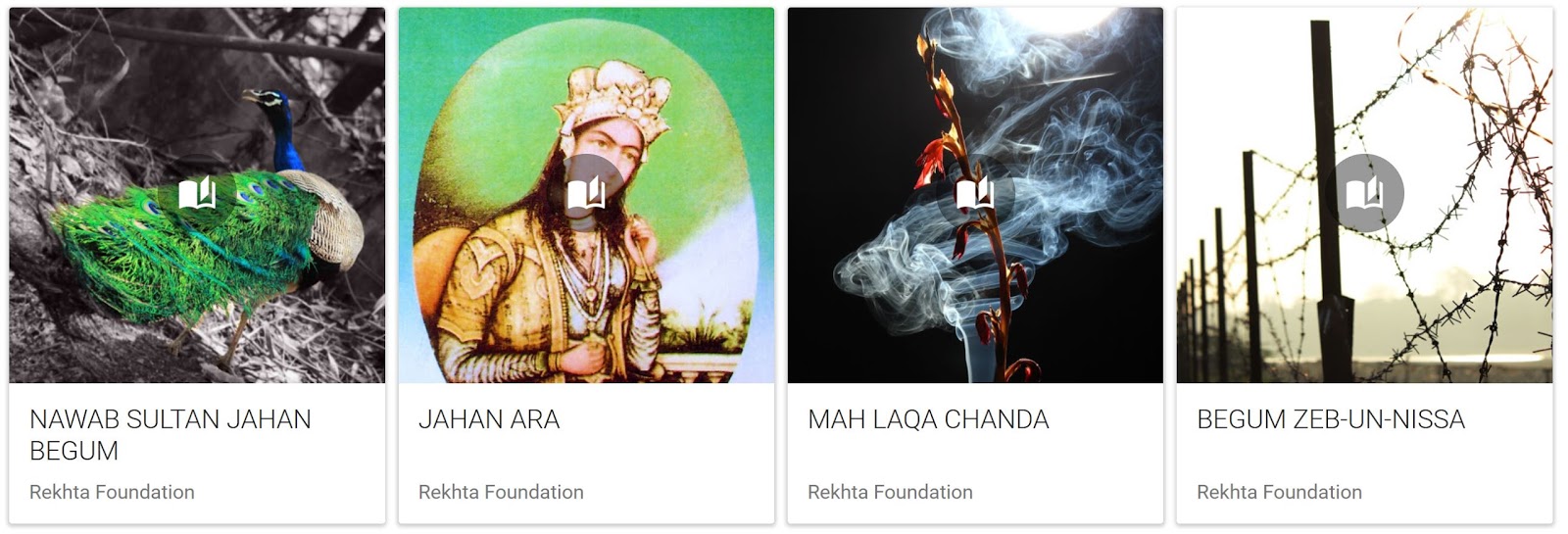
Source: Google Arts & Culture, Rekhta Foundation page. Exhibits feature Nawab Sultan Jahan Begum, Jahan Ara Begum and Begum Zeb-Un-Nissa.

Google Arts & Culture features content from over 1000 leading museums and archives who have partnered with the Google Cultural Institute to bring the world's treasures online. One such partner is the Rekhta Foundation, from Noida, India.

The foundation is the largest online repository of Urdu poetry in the world. The website displays works of over 2,100 well-known and lesser known poets from the 13th century to the present day, and includes over 25,000 nazms and ghazals (Editor's note: types of Urdu poetry) in Persian, Devanagari and Roman scripts.

Exhibits on the Rekhta Foundation site on Google Arts & Culture include a focus on the life of Nawab Sultan Jahan Begum, one of the rulers of Bhopal, the present-day capital of the state of Madhya Pradesh in India. The exhibit describes the life of Nawab Sultan Jahan Begum and how she advanced infrastructure, architecture, arts and education.

Another online exhibit is on Jahan Ara Begum, Shah Jahan's daughter. Shah Jahan is famous for building the Taj Mahal for his wife Mumtaz Mahal, while Jahan Ara Begum is known for her wisdom and her contribution to Sufism. Her Sufi mentor, Mulla Shah, wanted to name her his successor, but the rules of the order disallowed it. She is known for authoring several books, including a biography of Mulla Shah titled Ṣaḥibia and a biography of Khwaja Moin-ud-din Chisti, the philosopher who established the Chisti order of Sufism, titled Munis-ul-Arwah (The Companion Spirits).

Begum Zeb-un-Nissa, Jahan Ara Begum's niece and the eldest daughter of Aurangzeb, has her own section. She wrote poetry, and was imprisoned for the last 20 years of her life by her father.

Monday, 5 December 2016

Southeast Asian calligraphy from students of Bil'eed AlHameedy


Source: Sharjah Museums Department. Calligraphy from the students of Bil'eed AlHameedy.
Source: Sharjah Museums Department.
The Sharjah Calligraphy Museum is hosting Letters & Ornamentation from Southeast Asia, an exhibition for the students of the Moroccan calligrapher Bil'eed AlHameedy from Indonesia, Malaysia, China and the Philippines. Each artist has contributed up to five pieces of his or her best work.
AlHameedy is also hosting calligraphy workshops in conjunction with the exhibition.

Interested?
 
The exhibition continues till 3 March 2017.

The Sharjah Calligraphy Museum is in the Hamad Al Midfaa building in the Sharjah Heritage Area (Heart of Sharjah). Tickets are AED5 for those aged 13 and above. Entry is free for children aged 12 and below. Family tickets cost AED10.

Opening hours:
Saturday to Thursday 8am to 8pm
Friday 4pm to 8pm

Call +971 6 569 4561 with enquiries
Hashtag: #SharjahCalligraphyMuseum

Thursday, 1 December 2016

Qatar Museums releases new collection of publications at Doha International Book Fair

Qatar Museums (QM) has launched 10 new publications at the 27th Doha International Book Fair. The book releases are part of the organisation’s commitment to educate the community on arts, heritage and creativity and develop an engaged cultural audience, the Qatar News Agency has reported.

The new books include: 

The Qatari Kitchen, by cooking and etiquette expert Aisha Mohamed Al Tamimi. an illustrated book showing historical culinary artefacts from private collections. The book provides a glimpse into the past and also shows how these utensils can still be used today.

Two additions to the The Adventures of Faisal series by Dr Fatima Hassan Al Sulaiti were also introduced. Written and illustrated as a comic, this series is designed to inspire young readers about the importance of Qatar’s history and historical sites. One adventure will chart Faisal’s journey into Souq Waqif and the other will be set in Katara.

Spring Prince, by Turkish children’s author Melike Gunyuz, is an illustrated book for children that aims to inspire readers to follow their dreams.

Shamma Al Kuwari 's The Eye Loves What It Sees brings to life the treasures showcased at the Museum of Islamic Art.

In collaboration with Ludion Press, QM presents Al Rasm Ala Aljaleed, an Arabic edition of the Belgian children’s book Painting on Ice, itself inspired by the work of Belgian artist Luc Tuymans.

Ismail Azzam, a book put together by Bahaa Abudaya, Ala Bashir, Faraj Daham and Hadi Yasem, showcases the work of Iraqi artist Ismail Azzam in a series of photorealistic portraits of 15 artists from the Middle East and North Africa, created using the reverse charcoal technique.

Following the success of the What About the Art? Contemporary Art from China exhibition of 15 contemporary Chinese artists curated by New-York based Chinese artist Cai Guo-Qiang, QM presents a book that features in-depth interviews with the artists, plus essays by Cai and scholars Jerome Silbergeld, Terry Smith and Wang Hui. The book which has the same title as the exhibition, presents a fascinating insight into contemporary art in China today.

Obaidi: In Conversation with Hans Ulrich Obrist features work from Fragments, an exhibition on artist Mahmoud Obaidi. In this exhibition, the artist retraces the 'organised chaos' that led to the destruction of Iraq, and presents a response to witnessing the city of Baghdad fall piece by piece. The book also includes a look into the artist’s practice and an extended interview with curator Hans Ulrich Obrist.

Noof Ibrahim Al Abdulla, Director of Publications at Qatar Museums, said: "This is the largest selection of publications that we have released to date at the Fair, which invite visitors to explore art, culture and heritage. Through these fantastic publications, readers will be able to explore our incredible permanent collections, discover our current and previous exhibitions, and engage with our nation’s culture and heritage. "

Interested?

Fragments is open till 30 Janaury 2017 at Qatar Museum Gallery Katara, building 10.

Tuesday, 22 November 2016

Louvre Abu Dhabi announces site-specific artworks from Penone, Holzer

Source: Louvre Abu Dhabi. The museum city.

The Louvre Abu Dhabi has commissioned two internationally-acclaimed artists to create site-specific artworks that will be displayed in the museum when opening in 2017. French architect Jean Nouvel’s ‘museum city’ with its streets, plazas and waterways will feature artworks exhibited both inside the galleries as well as outside.

Italian artist Giuseppe Penone and American artist Jenny Holzer have worked closely with the Louvre Abu Dhabi team to develop sculptures and installations reflecting the universal stories of the museum and in harmony with the iconic building. These are the first of a number of commissions for Louvre Abu Dhabi which will through a diversity of artists, reflect the universal nature of the museum.

Penone is one of the youngest members of the Arte Povera movement*. He has created Germination, a four-part installation that reveals the artist’s fascination with the use of organic materials, such as trees, to highlight the connection between man, nature and art. The central element of the installation is Leaves of Light, a bronze tree which interacts with Nouvel’s architectural design through mirrors placed on its branches reflecting the Rain of Light. Soaring towards the dome covering the museum’s outdoor walkways, the tree becomes a symbol of life, as shared by all cultures.

Through an exceptional collaboration with the workshops of Sèvres – Cité de la céramique, a museum in France, Penone has also created several works including Propagation, a wall of porcelain tiles representing concentric circles drawn by hands. The lines of the drawing germinate from Sheikh Zayed’s fingerprint to show how a simple action can create an infinite space.

Holzer, whose work has been widely exhibited at international exhibitions, has created three engraved stone walls of texts from important historical sources from across the world. These walls will feature excerpts from historian Ibn Khaldun's Muqaddimah (مقدّمة ابن خلدون) - a work on universal history - from the Atif Efendi Library collection in Istanbul, Turkey; the Mesopotamian bilingual (Acadian /Sumerian) Creation Myth tablet from the Vorderasiatisches Museum in Berlin, Germany, and the 1588 annotated edition of philosopher Michel de Montaigne's Essais - a collection of essays on various topics - from the Bordeaux Municipal Library in France.

Works from the permanent collection will be displayed alongside these commissions in the outdoor areas of the museum. Recreating the atmosphere of an Islamic courtyard, an Ottoman octagonal fountain and pavement (18th century, Damascus, Syria) will be integrated in a contemporary scenography flooded with light.

Overlooking the Arabian Gulf, Louvre Abu Dhabi features a series of white buildings inspired by the madinah (city) and low-lying Arab settlements. Visitors can wander from the indoor galleries to the open-air areas of the museum, which are cooled by traditional Arabic architectural techniques. The museum will also offer temporary exhibitions, a children’s museum, restaurants, a shop, promenades and gardens.

*Arte povera makes use of common materials or materials of no value to create art.

Sunday, 20 November 2016

Yassmin Abdel-Magied will read from her book at the IMA

Source: IMA website. Poster for the event.
Yassmin Abdel-Magied will read from her book, Yassmin's Story: Who do you think I am?, at the Islamic Museum of Australia (IMA) this December. The reading, titled Burkinis, Burnouts and Boys, will be followed by an intimate conversation with the audience facilitated by IMA host Amna lqbal.

Abdel-Magied was born in Sudan and raised in Australia.  She is the Founder and Chair of Australia-based Youth Without Borders.

Interested?

The reading is on December 7 from 11am to 12:30pm. at the Islamic Museum of Australia, 15 Anderson Road, Thornbury, VIC 3071, Australia. Visit islamicmuseum.org.au or call 1300 915 171 for bookings and enquiries 

Watch Abdel-Magied on video explaining why she wrote a memoir at 24

Buy the book

Hashtags: #MorningTea, #IMA, #YassminsStory

Wednesday, 2 November 2016

VCM adds works from National Museum of Kazahstan to e-collection

The Virtual Collection of Asian Masterpieces (VCM) welcomes the National Museum of the Republic of Kazakhstan as a new participating museum.

Created under the Cultural Heritage State Program on behalf of the President of the Republic of Kazakhstan Nursultan Nazarbayev, the museum aims to be the hub for analysis, comparison, reflection, discussion, and evaluation of statements on the historical and cultural heritage of Kazakhstan. 
 
The VCM is a project of the Asia-Europe Museum Network (ASEMUS) to foster mutual understanding among people from diverse cultural backgrounds. By presenting a collection of Asian masterpieces through the web, the VCM provides an opportunity for everyone to appreciate the arts, regardless of financial or geographical circumstances, and promotes communication among participating museums all around the world by introducing their collections online. 
 
Interested?
 
Explore the masterpieces of the National Museum of the Republic of Kazakhstan

Thursday, 27 October 2016

Rare Ottoman artifacts from Hungary on exhibit in Sharjah

Source: Sharjah Museums Department. The opening ceremony.
Running until January 19, 2017 at the Sharjah Museum of Islamic Civilization, Spectacle and Splendour – Ottoman Masterpieces from the Museum of Applied Arts in Budapest features more than 50 spectacular Ottoman artefacts preserved in Hungary since the 16 th and 17th centuries.

The collection of luxury textiles, ceremonial weapons, saddle cloths, silk garments and rugs is being shown in the Arab world for the very first time. At the same time, the exhibition marks the first ever collaboration between the Sharjah Museum of Islamic Civilization and the Museum of Applied Arts in Budapest - established in 1872 and one of the oldest and most important museums of its kind.

The exhibition was inaugurated by HE Abdallah Al Owais, President of the Department of Culture and Information, Sharjah. The exhibition was attended by Manal Ataya, Director General of Sharjah Museums Department, Dr Ulrike Al-Khamis Strategic Advisor - Islamic and Middle Eastern Arts Sharjah Museums Department, Dr Viktória Horváth, a representative from the Ministry of Foreign Affairs and Trade of Hungary, Dr Zsombor Jékely, Deputy Director, Budapest Museum of Applied Arts, and HE Osama Naffa, Ambassador of Hungary to the UAE.

Ataya, Director General of Sharjah Museums Department, said: “This fascinating exhibition project with the Budapest Museum of Applied Arts yet again underscores our ongoing commitment to establishing ties with the world’s most prestigious institutions to bring exceptional collections to Sharjah and to foster intercultural dialogue through art and culture.

“The exhibition also provides a unique and unprecedented opportunity to learn about a fascinating period in Islamic and European history and to embark on  a journey of discovery into a period of outstanding aesthetic sensibility and remarkable workmanship.”

Spectacle and Spendour captures a particular period in Ottoman and Hungarian history when parts of the country, mainly the central and southern regions, were under Ottoman rule. During this time, it was common among the Hungarian elite to acquire the finest items from Ottoman workshops in order to display their power, authority and sophistication.

Each of the artefacts in the exhibition provides visitors with a gateway into the history of the Ottoman empire and its interaction with Eastern Europe, in particular Hungary and Transylvania. At the same time, they touch on key aspects of Islamic civilisation at large, such as the symbolic importance of textiles and carpets, the exchange of diplomatic gifts, and horsemanship. The rare pieces also offer a window into the powerful and sophisticated lives of Ottoman and Hungarian elites some 500 years ago, as well as giving a unique insight into methods of workmanship perfected by local craftsmen at the time.

Many of the masterpieces on display entered Hungary as early as the 16th century as tokens of diplomacy, through trade or as war booty.  Some items were made in Hungary itself, the result of skills being transferred between different regions of Ottoman rule.

Highlights of the collection include a silk upper coat made for a young child, probably using the fabric of a Turkish ceremonial robe received as a diplomatic gift. Its intricate floral pattern was popular in the later 16th century. The cut of the garment displays Turkish influence on Hungarian aristocratic costume of the time, such as the long, narrow ceremonial sleeves reaching down to the bottom of the costume.

A collection of Ottoman ceremonial saddle cloths that were used in both Hungary and Transylvania, which is now part of central Romania provide examples of exceptionally skilled workmanship in decorating velvet and silk satin cloths with intricate silver wire embroidery.

The weapons on display include a gem-studded dagger, most probably made in an imperial Ottoman workshop. Making gifts of ceremonial weapons was a fashionable custom among European rulers as well as Ottoman Turks in the 16th and 17th centuries.

The rare ceremonial maces included in the exhibition are examples of symbols of power and wealth in Hungary and Transylvania around the 17th century. The quality of its material and ornamentation reflected the rank of its owner. The most prestigious are gilded, gem-studded maces, often of Ottoman Turkish origin.

The collection of ornamental rugs includes examples that were originally laid on the hot floors of Turkish baths, but were brought to regions of Hungary including Transylvania to decorate the walls of noble homes. They were also hung in carriages.

“This exhibition is designed to appeal to a wide range of audiences, from those interested in Islamic art and culture to contemporary art and design practitioners,” said Ataya. “We hope visitors will be inspired by the aesthetic subtlety of the designs and the way weavers, dyers, embroiderers and metalworkers went about their craft with such skill and dedication.

“We thank our Hungarian colleagues for their outstanding support and commitment in staging this fascinating exhibition in Sharjah and hope that it will contribute positively to intercultural dialogue and an ever deeper appreciation of Islamic art and culture among our visitors.”

Saturday, 8 October 2016

Museum of Islamic Art focus on China in new exhibit

 Source: MIA Facebook page. The Treasures of China exhibition is on till 7 January 2017.
Source: MIA Facebook page. The Treasures of China exhibition is on till 7 January 2017. 

The Museum of Islamic Art (MIA) in Doha, Qatar is running the Treasures of China exhibition till 7 January 2017.

The famous terracotta warriors of Xian, China from the first emperor’s terracotta army are on show as part of the exhibition. Divided into The Birth of Civilisation, Ceremonies and Kingdoms, Splendid Unification, Prosperity and the Silk Road and Porcelain, Imperial China and the Royal Arts, the exhibition involves all major historical periods of ancient China and displays 116 pieces dating from the Neolithic period to the Qing dynasty, the last dynasty before China became a republic.

Islam arrived in China within 20 years of the Prophet Muhammad's death, according to Wikipedia.

The museum plans to feature carpets next year in Imperial Threads: Motifs and artisans from Turkey, Iran and India in 2017. From 15 March 2017 to 4 November 2017 visitors to the MIA can study the exchange of artistic and material cultures between the Ottoman (Turkey), Safavid (Iran), and Mughal (India) empires. Exhibits from the museum's collection will be contextualised within the politics and artistic production of their time, primarily from the 16th to the 18th centuries.

Interested?

Plan your visit

Hashtag: #TreasuresofChina

Monday, 25 July 2016

Museum of Islamic Art honours Muhammad Ali

Source: Museum of Islamic Art Facebook page. View of boxing gloves.

Muhammad Ali: Tribute to a Legend is an exhibition dedicated posthumously to world boxing legend Muhammad Ali (1942 to 2016). The temporary exhibition is curated by Qatar Museums’ 3-2-1 Olympic and Sports Museum and will present a collection of artefacts from the boxing legend’s career, including photography from Ali’s outdoor exhibition bout at the Doha Stadium in 1971; memorabilia spanning his journey to the 1960 Rome Olympics; Ali’s world title winning bout against Sonny Liston in 1964 and his final world title winning fight against Leon Spinks in New Orleans in 1978.

The museum has also developed augmented reality features for its app that can be used with the Muhammad Ali exhibition.

Interested?

The exhibition, at the Eastern Gallery, 4th Floor, Museum of Islamic Art, runs till the end of July. Admission is free.

View the video on the augmented reality app 

Download the augmented reality app for iOS 

Hashtag: #LegendAli

posted from Bloggeroid

Sunday, 3 July 2016

IAMM's Capture the Spirit of Ramadan exhibition is ending soon

This year will be the third consecutive year for the Capture the Spirit of Ramadan* exhibition at the Islamic Arts Museum Malaysia. The 30-day exhibition showcases selected photos from the submissions of the annual International Ramadan Photography Competition (IRPC).

The IRPC has become an international platform that entices photographers across the globe to seek new perspective of the month of Ramadhan, in which fasting, the fourth pillar of Islam, is performed. The free competition accepts photographs taken during the month of Ramadhan that year, and submitted by the end of Ramadhan. The exhibition draws the attention to colourful scenes of the spiritual, cultural and architectural diversities that tell stories about Ramadhan around the world.

The Spirit of Ramadan offers a competitive platform for photographers around the globe to share positive imagery of Islam. It is the world’s largest modern collection of Islamic-themed photographs from over 60 countries in the culture, architecture and spirituality categories.

The initiative includes the publication of the world’s first photography book and magazine on Ramadan as well as this world-touring exhibition which debuted in Kuala Lumpur at the Islamic Arts Museum Malaysia under the auspices of His Royal Highness the Sultan of Selangor in 2014.

The Spirit of Ramadan initiative is a non-profit, non-partisan social responsibility project by award-winning creative firm Studio Basel and its branding agency, Extreme Imagination. The Spirit of Ramadan was founded in 2011 by Dr Basel Almisshal, an architect, artist and United Nations Photographic Council member. The photo competition, also known as Capture the Spirit of Ramadan or the IRPC, boasts a prestigious rotating jury panel including National Geographics’ Steve McCurry; World Press Photo judge and founder of Asia’s largest photography festival, Dr Shahidul Alam; British photographer Peter Sanders; and White House Special Representative to Muslim communities and Harvard Fellow Farah Pandith.

Interested?

Ramadhan ends around 5 July, 2016.

*There is another website called www.capturethespiritoframadan.org which appears to be a fake site. It is associated with a Facebook page titled Capture The Spirit of Ramadan. There does not appear to be a 2016 competition according to the Spirit of Ramadan website, nor on the Spirit of Ramadan Facebook page.

Saturday, 2 July 2016

IAMM exhibition of Dala'il al-Khayrat to run till end-2016

Source: IAMM. The exhibition catalogue.
The Islamic Arts Museum Malaysia (IAMM) is running an exhibition on one of the the most important manuscripts in the Islamic world till 31 December, 2016. Dala’il al-Khayrat: Prayer Manuscripts From The 16th To 19th Centuries highlights Dala’il al-Khayrat copies from its land of origin, Morocco, as well as from places as far as East Turkistan and China.

The Dala’il al-Khayrat is a collection of prayers asking for blessings for the prophet Muhammad () and is meant to be read a section a day. It has inspired calligraphers, illuminators and painters of court ateliers to produce illustrated and illuminated manuscripts that reflect the history and the diverse art form of the Islamic world.

The exhibition begins with the history of Dala’il al-Khayrat and its author, Imam Al-Jazuli, whose ancestry has been traced to Imam Hassan ibn Ali, the grandson of the Prophet Muhammad (). Visitors will then discover the contents of Dala’il Al-Khayrat, the eight ahzab (days of recitation) and other main elements of the book. There is also a special section on how to distinguish the regional characteristics of Dala’il al-Khayrat, through masterpieces from North Africa, Central Asia, Turkey, the Indian Subcontinent, China and Southeast Asia.

Among the highlights of the exhibition are Moroccan copies of Dala’il al-Khayrat and also a rare one-page Dala’il Al-Khayrat, signed by Alhafiz Mahbub Muhammad. The illustrated pages which feature Makkah and Madinah among others, inspired by Imam Al-Jazuli's description of Al-Rawdah Al-Mubarakah (the Blessed Garden) in which the Prophet Muhammad () is buried, together with his two companions Abu Bakr and Umar (رضي الله عنهم).

This exhibition is accompanied by a catalogue (RM98) that is available in the museum shop.

Interested?

An English version is available for download (PDF)
Audio links are available on Wikipedia

Saturday, 18 June 2016

Sharjah Museum Department shares Ramadhan opening times for its facilities

The Sharjah Museums Department has updated its website for Ramadhan opening hours for the facilities under its purview. A selection are featured here:

Al Eslah School Museum

This museum focuses on the UAE educational system. Highlights from the collections include:
  • A shoulder bone of a dead camel, used for writing in the semi-formal education system around 1956.
  • An inkwell and a pen from copper made in 1940; they were purchased from India.
  • A student’s bag used to carry books, made in 1939.
  • A teacher’s bag, made in 1935, from natural raw leather. It was used to carry the teacher’s tools and supplies, such as papers, pens, chalk and other items.
View online collection

Interested?

The museum is opposite Bayt Al Naboodah Museum, next to Arsah Souq in the heart of Sharjah.
Entry is free.

Ramadhan hours:
Saturday to Thursday: 9am to 2pm
Closed on Friday

Opening hours are otherwise:
Saturday to Thursday: 8am to 8pm
Friday: 4pm to 8pm

Al Mahatta Museum

This is the site of the first airport in the UAE, built in 1932 and then turned into a museum highlighting the history of flight in the UAE and the surrounding region. Highlights from the collection include:
  • Hanno passenger plane - a model of the first plane to land in Al Mahatta airport, in 1932. It was used to transport passengers. 
  • Aircraft black box
  • Turboprop engine with a propeller: One of six CFM International models of aircraft engines, produced by CFM56-5 Company. This engine was made specifically for the twin-engine Airbus that travels short to medium distances.
  • The first cinema in the Arabian Gulf: Sharjah Cinema, the first cinema in the Gulf region, was inaugurated in 1945 in at the original Sharjah airport (Al Mahatta). Cinema-goers used to sit on empty kerosene steel drums half filled with sand.
View the online collection

Interested?

The museum is in the Al Mahatta area, opposite Al Qasimya District in Sharjah, behind The General Directorate of Residency and Foreigners Affairs. Free entry to children under 13 years; anyone over 13 years, AED5.

Ramadhan hours:
Saturday to Thursday: 9am to 2pm
Closed on Friday

Opening hours are otherwise:
Saturday to Thursday: 8am to 8pm
Friday: 4pm to 8pm

Bait Sheikh Saeed Bin Hamad Al Qasimi in Kalba

This heritage house in the UAE in Kalba on the east coast of the Arabian Gulf was the residence of Sheikh Saeed and his family. Sheikh Saeed ruled and signed several agreements from within this house which was built between 1898 and 1901 in the Emirati architectural style. Today, Bait Sheikh Saeed houses Islamic collectibles that have significant importance. Some highlights from the collection:
  • A rifle decorated with metal plates, given away by His Highness Sheikh / Haitham bin Saqr bin Sultan Al Qassimi, Deputy Head of the Office of HH the Ruler of Kalba. Displayed in the Sheikh’s room.
  • Alyazrh, an irrigation tool that consists of four pillars made of palm trunks used to support a pulley. It has a leather bucket belted with a rope; a bull pulls the other end of the rope as the farmer walks it up and down the passageway to pull out the bucket after it is filled with water, then turns it over to pour out the water for crop irrigation. 
  • Quran manuscript: A complete copy of the Quran inlaid with gold that has been preserved for nearly 700 years. The first edition was published in Beirut in 1982.
View the online collection

Interested?

Bait Sheikh Saeed bin Hamad Al Qasimi is near Al Kalba fort, directly on the east coast of the Arabian Gulf, in Kalba. Free entry to children under 13 years; anyone over 13 years, AED3.

Ramadhan hours:
Saturday to Thursday: 9am to 2pm
Closed on Friday

Opening hours are otherwise:
Saturday to Thursday: 8am to 8pm
Friday: 4pm to 8pm

Sharjah Aquarium

Covering an area of 6,500 m², it consists of two floors equipped with 20 aquariums, each filled with approximately 1.8 million litres of water.

Interested?

Sharjah Aquarium is in the Al Khan Old area. Free entry to both Sharjah Aquarium and the Sharjah Maritime Museum for children under 2 years; children aged 2 to 12, AED15; anyone over 13 years, AED25. Family tickets for two adults and 3 children: AED70.

Ramadhan hours:

Monday to Saturday: 9am to 2pm, and 9:30pm to 11:30pm
Friday: 9:30pm to 11:30pm
Sunday: closed

Opening hours are otherwise:
Saturday to Thursday: 8am to 8pm
Friday: 4pm to 10pm
Sunday: closed

Sharjah Archaeology Museum

This museum sheds light on the lifestyle of people in the region from the stone age till the rise of Islam. Highlights from the collection include:
  • Ceramic dome (900 to 600 BC) with holes and a statue of a bull; it was probably a censer’s lid. It was discovered at the Muweilah archaeological site, which dates back to the Iron Age. This dome provides a proof of commercial relations with Yemen BC. 
  • Golden bridle (150 BC to 200 AD): found buried with the remains of a horse and a camel in Mleiha by a local excavation team. This item represents the wealthy lifestyle some of the Mleiha inhabitants enjoyed during that period.
  • Ceramic camel statue (900 to 600 BC): Also found in Muweilah, this item shows man had domesticated camels in 1,000 BC. 
  • Ivory comb placed inside an alabaster bowl (2,200 to 2,000 BC): both were found in a cemetery in Tell Abraq. The tulip flower adorning the comb shows that it was made in Central Asia, although the ivory was probably taken from an Indian elephant.
View the online collection

Interested?

This museum is in the Helwan area between the Children Center-Helwan, and Sharjah Science Museum on Sheikh Rashid Bin Saqr Al Qasimi Road leading to Sharjah Media Corporation, Sharjah TV. Free entry to children under 13 years; anyone over 13 years, AED5.

Ramadhan hours:
Saturday to Thursday: 9am to 2pm
Closed on Friday

Opening hours are otherwise:
Saturday to Thursday: 8am to 8pm
Friday: 4pm to 8pm

Sharjah Art Museum

Visit one of the largest art exhibitions in the Gulf region, which contains permanent collections of contemporary art from some of the most famous artists in the Middle East, including Abdulqader Al Rais, Louay Kayali, Bashir Sinwar, Faiq Hassan, Mohammed Yusuf and Ismail Fatah Al-Turk. The three-storey museum showcases more than 500 artworks. An Art Library houses over 4,000 titles in Arabic, English and other languages, along with visual and audio materials. Highlights of the collection include:
  • Works by Palestinian artist Suleiman Mansour, revolving around the Israeli–Palestinian conflict and the occupied Palestinian territories.
  • Paintings by the Iraqi artist Jamil Hamoudi, one of the pioneers of modern Iraqi arts.
  • Paintings by the Kuwaiti artist Thuraya Al-Baqsami, entitled Min Wahi Failaka (inspirations from Failaka).
View the online collection

Interested?

The museum is in the Arts Area, Al-Shuwaihiyeen, near Al-Corniche post office - the heart of Sharjah. Free entry.

Ramadhan hours:

Saturday to Thursday: 9am to 2pm, and 9:30pm to 11:30pm
Friday: closed

The museum will also be closed during the evening shift of the last 10 days of Ramadhan.

Opening hours are otherwise:
Saturday to Thursday: 8am to 8pm
Friday: 4pm to 10pm

Sharjah Calligraphy Museum

The house of Hamad Al Midfaa in the Sharjah Heritage Area (heart of Sharjah) has been turned into a museum displaying the evolution of Arabic calligraphy. Highlights from the collection include:
  • Three historic paintings in the Kufic style by calligraphers from Al Kufa; these artworks depict the three stages of the emergence of calligraphy with the Kufic script*
  • The Al-Hulia Al-sharifa, by Iraqi calligrapher Ziad Al Muhandis and considered the largest in the Islamic world to date at 280 by 300cm. A description of the Messenger of Allah, the prophet Muhammad (peace be upon him), in the Thuluth font in 1420.
  • Sixteen katateeb boards, a gift from Sudan. These are used for teaching Quran, Islam, and how to read and write. Two of the boards show a drawing of a mosque, indicating that the students who used them have read the Quran, either partly or wholly.
View the online collection

Interested?

The museum is at Calligraphy Square, in the heart of Sharjah. Free entry to children under 13 years; anyone over 13 years, AED5.

Ramadhan hours:
Saturday to Thursday: 9am to 2pm
Closed on Friday

Opening hours are otherwise:
Saturday to Thursday: 8am to 8pm
Friday: 4pm to 8pm

Sharjah Classic Cars Museum

The Sharjah Classic Cars Museum displays vintage classic cars in addition to classic motorcycles and bicycles. The oldest car showcased in the museum dates back to 1917. Here, visitors will be able to get an up close look at classic car models and their specifications including Rolls Royce, Ford, Mercedes, Chevrolet, Bentley and many others. Highlights from the collection include:
  • A 1915 Dodge model, the oldest car in the Sharjah Classic Cars Museum. 
  • A 1969 Mercedes-Benz 600 Pullman: only 2,677 vehicles were manufactured. This bulletproof car belongs to HH Dr Shaikh Sultan Bin Mohammad Al Qasimi, Ruler of Sharjah. Since the seventies, the Mercedes 600 was only made upon request, averaging just 25 cars yearly. The last car was manufactured in 1981. This car has unique specifications, including hydraulic seat adjustment, as well as window and door controls. 
  • A 1957 Bedford Model, which was used in the UAE for military purposes. Bedford RL trucks rolled off the production line in 1969. This British-made truck is six-cylinder, and has a maximum speed of over 112 km/h. The last Bedford car was manufactured in 1985.
View the online collection

Interested?

The museum is on Airport Road between the 4th and 5th intersections, next to Sharjah International Airport and opposite Sharjah Discovery Centre. Free entry to children under 13 years; anyone over 13 years, AED5.

Ramadhan hours:
Saturday to Thursday: 9am to 2pm
Closed on Friday

Opening hours are otherwise:
Saturday to Thursday: 8am to 8pm
Friday: 4pm to 8pm

Sharjah Discovery Centre

Sharjah Discovery Centre helps children aged three to 12 years explore science and technology in a safe, colourful environment. In the Water World, children can race in the small boats pool, learn about jellyfish, and design fountains. At the Sharjah Kids International Airport, they can place carry-on baggage under the X-ray device for inspection, and explore famous landmarks including the Eiffel Tower in Paris and Big Ben in London. Body World teaches anatomy, and lets children test their strength and reflexes. Build Town, Drive Town, Sports World, TV Studio, Supermarket and the Storyteller Area make up the remaining zones.

Interested?

Sharjah Discovery Centre is along Sharjah Airport Road between interchanges 4 and 5, opposite Sharjah Classic Cars Museum and Sharjah Airport. Free entry to children under two years; children between two and 12, AED5; anyone over 13 years, AED10.

Ramadhan hours:
Saturday to Thursday: 9am to 2pm
Closed on Friday

Opening hours are otherwise:
Saturday to Thursday: 8am to 8pm
Friday: 4pm to 8pm

Sharjah Heritage Museum

This museum features the lifestyle, habits and crafts shaped by the diverse environments which Emirati people have lived in, from marine and coastal environments to mountainous and agricultural areas. The museum also highlights authentic Arab hospitality, celebrations, sciences and livelihoods. Highlights from the collection include:
  • A rectangular wooden loom used to make pillows, tents and rugs. 
  • Aftakh: A golden toe ring worn by women.
  • Soieih abaya: A mantle for the head, made of wool and golden yarn.
  • Glass baby bottle in a crescent shape, with two teats, one for the day and the other for bedtime.
View the online collection

Interested?

The museum, in Bait Saeed Al Taweel Al Shamsi, is located opposite Al-Arsah souq, next to Bayt Al Naboodah and the theatrical association in the Heart of Sharjah. Free entry to children under 13 years; anyone over 13 years, AED5.

Ramadhan hours:
Saturday to Thursday: 9am to 2pm
Closed on Friday

Opening hours are otherwise:
Saturday to Thursday: 8am to 8pm
Friday: 4pm to 8pm

Sharjah Fort

Interested?

Free entry to children under 13 years; anyone over 13 years, AED5.

Ramadhan hours were not listed. Opening hours are:
Saturday to Thursday: 8am to 8pm
Friday: 4pm to 8pm

The following museums have been closed for restoration:

Bait Al Naboodah, a traditional Emirati house which has been turned into a museum reflecting the lifestyle and values of Emirati ancestors.

Majlis Al Midfa, a meeting place owned by Ibrahim bin Mohammed al Midfa, a prominent intellectual figure who contributed to the cultural development in the UAE, particularly Sharjah.

*According to the Sharjah Museum of Calligraphy, Kufic was known in the third century AH as Kufic al yabis (stiff) as it was written without any dots or nunation, the adding of the 'n' sound to the end of a vowel. Abu al-Aswad Al-Du'ali is credited with inventing a system of placing dots above selected letters of Quran verses to distinguish different consonants. He also replaced nunation with red dots.
 

The difficulty of distinguishing between similar letters such as (ب [b], ت [t], ث [th]) inspired Nasr bin Asim and Yahya bin Ya’amr to invent the ala’ajam (إِعْجَام) in the fifth century AH, the addition of dots to letters in order to differentiate the consonants. 

Khalil ibn Aḥmad Al-Farahidi is credited with the current standard for Arabic diacritics; he replaced the red nunation, used by Al-Du'ali with the Arabic diacritics (short vowel marks) used today. These are the fathah (فَتْحَة), representing an 'ah' sound; dammah (ضَمَّة), an 'oo' sound; maddah (مَدَّة), representing a glottal stop followed by a long 'ah'; kasrah (كَسْرَة), an 'ee' sound; sukun (سُكُون), representing the lack of a vowel to follow; and tanwin (تَنْوِين) for nunation, ending a vowel with an 'n' sound.

Thursday, 9 June 2016

IDAM in Doha offers Ramadan Experience Menu

Source: Museum of Islamic Art website. View from IDAM.
Source: Museum of Islamic Art website.

Enjoy Arabian ambience at IDAM in Doha with the Ramadan Experience Menu, QR285. IDAM is Alain Ducasse’s first restaurant in the Middle East. Philippe Starck designed the décor for this restaurant, which has seating for 60.

The experience begins with the Mezze Collection, a selection of three dishes, followed by a choice of two main dishes featuring the finest imported produce or a local fish. Choose dessert from the sweet trolleys, which include contemporary signatures with an Arabic twist and local desserts revisited. A

Dedicating special attention to crafting non-alcoholic beverages, the barman works alongside the chef in creating the perfect drink to complement the menu. The use of local flavours bursting with fresh chamomile and rosemary, spices, and fruit offers a whole new tasting experience.

IDAM means 'generosity'. IDAM's menu is about refined Mediterranean cuisine with a touch of influence from the Middle East: tender octopus, potatoes infused with saffron, marinated bonito from the Arabian Gulf, lemon and gold caviar; the local catch with crunchy-creamy Egyptian rice, roasted blue lobster, “zaalouk” squash with stuffed squash blossom; camel calf, foie gras with truffles, souffléed potatoes, pastille milk dessert, tea and mint granite.

Interested?

IDAM is at the Museum of Islamic Art, 5th Floor, Corniche Promenade, Doha, Qatar. It is open Wednesdays to Mondays (closed Tuesdays), 6pm to 11pm. Call +974 4422 4488 to make a reservation.

Download iftar menus for
1 June - 13 June (PDF)
15 June – 20 June (PDF)
22 June – 27 June (PDF)
29 June – 4 July (PDF)

posted from Bloggeroid