Showing posts with label fasting. Show all posts

Thursday, 10 May 2018

International SOS gives Ramadhan advice

International SOS is raising health and travel awareness among organisations around the world regarding Ramadhan, which is expected to start mid-May and end around mid-June. Fasting hours during Ramadhan this year will average around 13 hours in Dubai, UAE and 12 hours in Kuala Lumpur, Malaysia.

International SOS Medical Director Dr Issam Badaoui said: “Each year, we remind organisations and fasting individuals that there are simple steps they can take to ensure they have a healthy, productive month. Practically, the advice we offer should be applied throughout the year, as part of a balanced, active lifestyle, and the good news is we are noticing a growing interest in both nutrition and exercise.

"At International SOS, we are keen to champion wellness and ultimately contribute to the prevention of avoidable, lifestyle-related noncommunicable diseases such as type 2 diabetes - and what better time to encourage the adoption of sustainable, wholesome habits than during the holy month of Ramadhan.”

International SOS’s top five tips for employees observing the fast this Ramadhan are:

1. Do not skimp on rest and sleep

2. Stagger your hydration

3. Beware excess salt and sugar

4. Do more in the morning

5. Don’t stop exercising

In addition, individuals suffering from chronic illnesses should consult their doctors on how to manage regular medication and to ensure it is safe for them to fast. International SOS also reminds its travelling members and employees going on business trips to Muslim countries to be mindful of the following public and business etiquette tips:

1. Do not eat, drink or smoke in public

2. Dress modestly

3. Be mindful of workplace etiquette, particularly of business hours and not having meetings around lunch or coffee

4. Check food and entertainment schedules

5. Respect local public etiquette

Explore:

Get country-specific advice about business travel

Wednesday, 31 May 2017

Qatar Airways offers iftar meal boxes for fasting passengers over Ramadhan

Passengers who are fasting while flying on Qatar Airways during Ramadhan will be offered an iftar meal box infused with a traditional Middle Eastern twist, the airline has reported. 

Qatar Airways’ iftar boxes feature a Ramadan Kareem* logo extending best wishes to all passengers during the month. First and Business Class passengers travelling on selected flights will be offered iftar boxes containing either a chicken or vegetarian sandwich wrap, hummous, crudités, mini Arabic bread, mixed nuts, baklava, dates, an Alpen fruit and nut bar, fresh laban and water. Passengers travelling in Economy Class will be offered an iftar meal box containing a vegetarian sandwich wrap, Walker biscuit, dried fruits, dates, mixed nuts, fresh laban and water.

Qatar Airways Group CEO HE Akbar Al Baker said: “This year, we continue our tradition of offering our passengers a delicious way to break their fast while flying. The holy month of Ramadhan is an important period for a vast number of our passengers, and we continue to offer them the high standards of service they have become accustomed to. We invite our passengers to embrace this special time of year by enjoying our special iftar boxes. On behalf of Qatar Airways, we extend to all warmest wishes for a Ramadhan kareem.”

In the Middle East, this year’s iftar boxes will be distributed on Qatar Airways flights to Abu Dhabi, Dubai, Ras Al Khaimah and Sharjah in the UAE; Abha, Dammam, Gassim (Buraidah), Hofuf, Jeddah, Madinah, Riyadh, Taif and Yanbu in KSA; Amman in Jordan, Bahrain; Basra, Baghdad, Erbil, Najaf and Sulaymaniyah in Iraq; Kuwait; Muscat and Salalah in Oman; as well as Mashad and Shiraz in Iran. Qatar Airways cabin crew will make an on-board announcement and will serve the iftar boxes at the appropriate time during the flight, alleviating customers from having to calculating the time.

Source: Qatar Airways. Iftar meal boxes are available to those fasting in Ramadhan.

*This greeting for Ramadhan wishes Muslims a month filled with abundance. 'Kareem' means 'generous'. 

Monday, 23 May 2016

Why you can't believe the studies on fasting during Ramadhan

Fasting during the month of Ramadhan not only refers to the restriction of food and beverages between the hours of sunrise and sunset, but also to the restriction of other appetites, such as sexual abstinence and refraining from negative behaviour such as swearing and lying.

Various researchers have studied fasting at Ramadhan, and generally found that while the body does face challenges during the month, things go back to normal after Ramadhan is over:

Sports

A study in 2009 on middle distance runners established that nightly sleeping time and energy intake were lower on day 21 of Ramadhan than before fasting began. Fatigue had also increased by the end of the month. The researchers noted that metabolic, hormonal, and inflammatory measurements rose over the month, but had gone back to pre-Ramadhan levels seven days after fasting had been completed.

Another 2009 study on elite judokas also noted a rise in fatigue but also 'little effect' on aerobic performance and on very short duration sprinting and jumping test performance, and concluded that experienced athletes can maintain both sufficient energy intake and normal training loads during Ramadhan.

Aerobic exercise

This 2012 study systematically studied what happens to various components of blood and urine for a group of fasting men while they exercised, compared to a control group who had eaten. While there were changes for fasting the authors said that aerobic training in a fasted state lowers body weight and body fat percentages, whereas 'fed' aerobic training only decreases only body weight.

Physical work

Fasting labourers studied in Germany in a 1991 study were found to suffer the symptoms of 'moderate to severe' dehydration, from tachycardia (rapid heartbeat), severe headaches, dizziness, nausea, vomiting and circulatory collapse (low blood pressure, cold extremities). Ramadhan 1990 and 1991 occurred around March, when it would presumably have been fairly cool weather. Sunrise to sunset would have been about 12 hours, according to calculations from Chennai IQ.

Pregnancy
A 2008 study in the Journal of Obstetrics and Gynaecology Research has found that fasting during Ramadhan does not have adverse effects on intrauterine fetal development or the fetus' health. The researchers studied 36 healthy ladies who had uncomplicated pregnancies of at least 20 weeks' gestation and compared them to a control group of pregnant ladies who were not fasting. The study found that fasting of a mean of 18 days did not affect the babies' growth, though the fasting ladies had lower blood glucose levels. It is not clear whether results would be different if the ladies had actually completed the entire month of fasting, which would last 29 or 30 days.

Chronic kidney disease

A 2007 study from the Saudi Journal of Kidney Diseases and Transplantation studied 15 patients with chronic kidney disease (CKD) who did not yet require dialysis against healthy counterparts both before Ramadhan and after it. Researchers established that N-acetyl-beta-D-glucosaminidase (NAG) levels rose for the fasting CKD patients, indicating kidney damage.

Diabetes type I and II

Suggested insulin regimens are provided in this 2008 study for those with well-controlled diabetes type I. Even then, frequent testing is suggested to determine if blood glucose is too high or too low for fasting to continue.

Another 2010 study showed that providing some training on physical activity, meal planning, glucose monitoring, hypoglycaemia (low blood sugar), dosage and timing of medications to people with diabetes type II can have a beneficial effect. Researchers divided the diabetes patients into two groups, those, who had received the training and those which had not. There was an average weight loss of 0.7 kg after Ramadhan in the trained group, whereas the untrained group gained an average of 0.6 kg. There were also more hypoglycaemic events in the untrained group.

Weight gain is common enough. Two-thirds of a population of Saudi families in Jeddah (59.5%) surveyed reported weight gains after Ramadhan in 2011, attributing it variously to foods rich in fat and carbohydrates such as dates and rice; relative lack of physical exercise, and basically, eating more.

Not everyone gains weight however. One population of ladies in Jordan saw weight and BMI decrease 'significantly' during fasting in 2004, although the average energy and nutrient intake and physical activity was roughly the same before and during Ramadhan. Another Moroccan population of 32 men had lower cholesterol during Ramadhan compared to before it, it was reported in 1997. Triglyceride levels - high triglycerides are an indicator of possible heart disease - also fell. The reductions of both components in the blood were maintained a month after Ramadhan. Meanwhile body weight declined by 2.6% at the end of Ramadhan.

While these studies indicate what could happen for Ramadhan none of them can actually be directly extrapolated to current-day fasting. Other than the fact that the studies are typically done on relatively small populations and should be extended to larger populations, they are usually not repeated over several years. Ramadhan is at a different time of the year every year, so the duration of fasting, ambient temperatures and humidity would vary if it occurs in winter compared to in summer. This means research for Ramadhan in 2000 would actually be studying very different conditions compared to Ramadhan in 2005.

Finally, most of the studies say little about the actual calorie intake of those studied, which could affect the results a great deal. While many would assume that fasting means eating much less, it is quite possible to gain weight during Ramadhan instead. The pre-dawn meal, suhoor, is encouraged but ultimately optional; if taken, it can range from a light meal to a heavy one. The breaking of the fast, or iftar, can be equally light, or feature very rich spreads of Ramadhan delicacies. Some people may also make up for the mid-day meal with a full meal in between iftar and suhoor, or reduce activity while fasting. The end-result could be the ingestion more calories per day than outside of Ramadhan. 

Monday, 22 June 2015

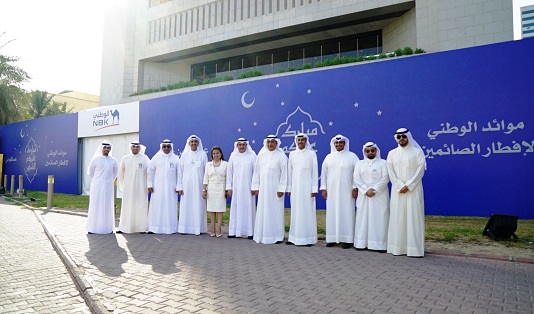
NBK announces its iftar tent is open

Source: NBK.  Picture taken on the occasion of the opening of the annual iftar tent.

The National Bank of Kuwait (NBK) has opened its annual iftar tent near the Grand Mosque in the Sharq area to offer fasters iftar banquets during Ramadhan. The iftar tent is part of NBK`s annual Ramadan programme, Do Good Deeds in the Holy month of Ramadan. 

Talal Al Turki, NBK Public Relations Officer said: “NBK staff volunteers finalised all necessary arrangements for Ramadan tent to receive fasting people on the eve of the first day of Ramadhan. NBK staff volunteers will manage and supervise the fast-breaking. The distribution scale of NBK iftar banquets this year also includes hundreds of fast-breaking meals via special convoys to numerous mosques, hospitals and crowded locations in Kuwait.” 

Thursday, 11 June 2015

NBK hosting iftar meals all across Kuwait

The National Bank of Kuwait (NBK) has shared that its annual Doing Good Deeds programme for this year's Ramadhan will include hosting iftar banquets that will be held near the Grand Mosque. 

Fast-breaking meals will also be offered at various mosques and other locations throughout Kuwait. NBK will also distribute iftar meals via special convoys that will tour the more crowded areas in the country. NBK staff volunteers will manage and supervise the fast-breaking banquets.

Abdelmohsin Al Rushaid, NBK Public Relations Manager said: “NBK will ramp up its charitable activities as a good corporate citizen of Kuwait. NBK hopes to encourage a greater sense of community and charity during Ramadhan and encourages its customers and staff to participate by ‘doing good deeds’ all month long.

“It is a well rooted tradition that has been carried out by NBK each year in its efforts to continuously have an active role in the Kuwait society. NBK believes in the power of doing good.”

The NBK Ramadan Social Program will also include several visits by volunteers to NBK Children’s Hospital and other social institutions.