Singapore's Fatwa Committee has provided guidance on the religious justifications in view of the congregational worship with limited prayer spaces, in line with mosques reopening for congregational prayer, but with a maximum of 50 congregants per session.
Fatwas issued to guide the implementation of Phase 2 of Singapore's COVID-19 post-circuit breaker response include:
- Safe distancing between congregants during prayers
- Holding multiple sessions for Friday prayers
- Groups excused from performing Friday prayers and the religious ruling for those unable to attain prayer slots
Details:
Read the fatwas in English or Malay.
Read the Suroor Asia blog post on how Singapore is managing congregational prayer during COVID-19.
Showing posts with label fatwa. Show all posts
Showing posts with label fatwa. Show all posts
Monday, 22 June 2020
Tuesday, 13 November 2018
Contemporary Irsyad Series address questions by Muslims in modern times
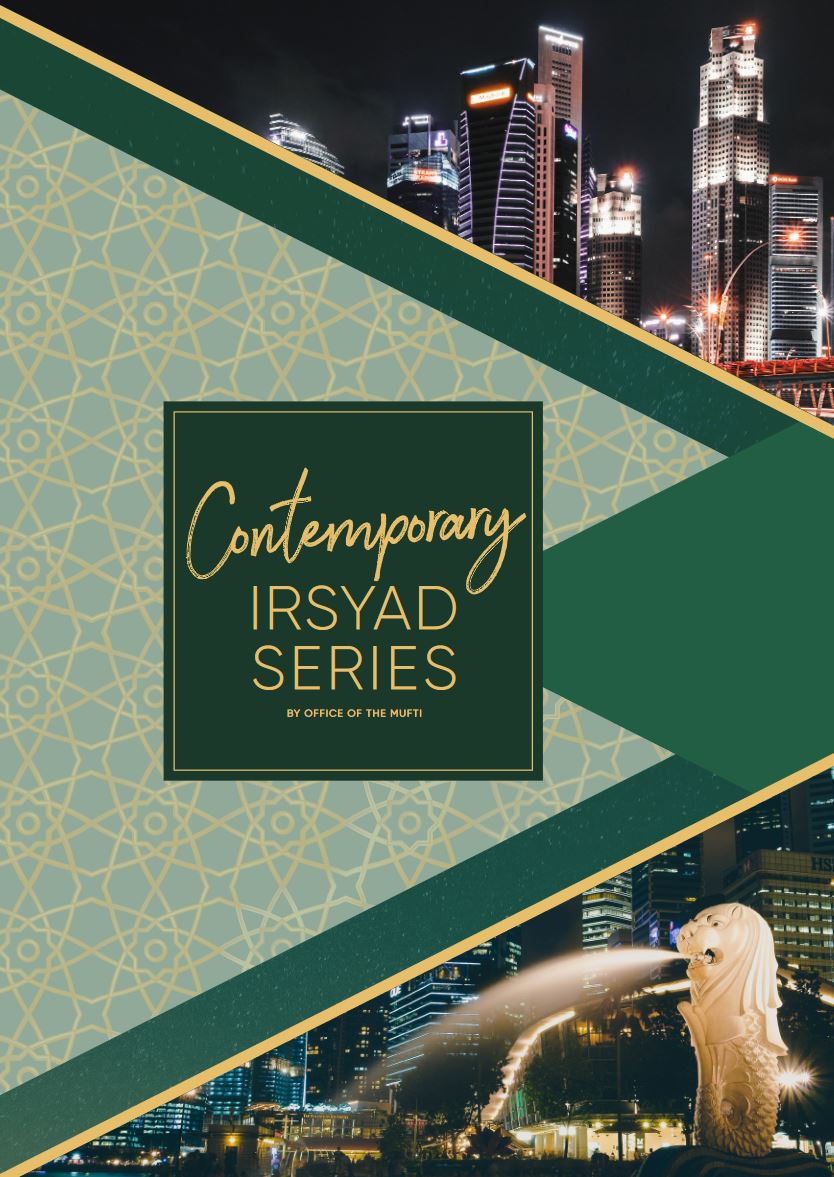 |
| Source: Muis. Cover for volume 1 of the Contemporary Irsyad Series. |
In the foreword, Dr Mohamed Fatris Bakaram, Mufti of Singapore, notes that Singapore is secular, multiracial and multireligious, with complex economic structures and advanced technology. "There is
a compelling need for us to be discerning – we have to stay true to the higher objectives of our religion and the broader jurisprudential and ethical frameworks, without necessarily attempting to force fit historical solutions to our current challenges and issues," he states.
Volume 1 focuses on questions of rituals, prayers and fasting, food, and interacting with other faiths.
Details:
Read volume 1 (PDF)
Hashtag: #BeingMuslimandSingaporean
Thursday, 24 May 2018
Dubai government announces AI-backed charity and fatwa projects
As part of its contribution to the Dubai 10X initiative, which aims to place Dubai, UAE 10 years ahead of other cities, the Islamic Affairs & Charitable Activities Department, in corporation with Dubai Future Foundation, has developed two artificial intelligence (AI) projects - the Virtual Charity Foundation and Virtual Ifta.
Through the two projects, the Department seeks to create a flexible and intelligent environment to enhance charitable activities; strengthen the Department's efforts to deliver and document fatwas; and serve the community through innovative services.
The projects are two among several Dubai 10X proposals launched by HH Sheikh Hamdan bin Mohammed bin Rashid Al Maktoum, Crown Prince of Dubai, Chairman of The Executive Council of Dubai and Chairman of DFF’s Board of Trustees, at the 6th World Government Summit held in Dubai in February 2018.
HE Dr Hamad bin Al Shaikh Ahmed Al Shaibani, Director General of the Islamic Affairs & Charitable Activities Department, said: "As part of its participation in the Dubai 10X initiative, the Department has developed interactive smart platforms using advanced artificial intelligence technologies to enhance philanthropy and create a new method for delivering fatwas. These projects are in line with the Dubai government’s objective of promoting innovation in all sectors to enable Dubai to establish global leadership in shaping the future.”
The Virtual Charity Foundation is the world’s first charity institution that allows donations to be routed directly from donor to beneficiary with the use of AI and Blockchain technology. The global charity platform utilises Blockchain and AI to facilitate direct communication between the donor and beneficiary, thus eliminating the need for counterparties and significantly reducing waiting periods for the beneficiary. The initiative aims to protect the identity of beneficiaries as well as open new ways for community groups from around the world to search and identify charitable aid opportunities. Beneficiaries may also submit cases for review remotely, through AI applications.
The second initiative, Virtual Ifta, uses AI-backed decision-making and big data to streamline the process of disseminating fatwas. Fatwas are rulings by authorities on points of Islamic law. Virtual Ifta aims to facilitate a more instant experience and reduce duplications by removing the need for muftis to answer for the same questions repeatedly. The platform also allows muftis to instantly answer a vast range of queries posed by millions of people around the world.
Through the two projects, the Department seeks to create a flexible and intelligent environment to enhance charitable activities; strengthen the Department's efforts to deliver and document fatwas; and serve the community through innovative services.
The projects are two among several Dubai 10X proposals launched by HH Sheikh Hamdan bin Mohammed bin Rashid Al Maktoum, Crown Prince of Dubai, Chairman of The Executive Council of Dubai and Chairman of DFF’s Board of Trustees, at the 6th World Government Summit held in Dubai in February 2018.
HE Dr Hamad bin Al Shaikh Ahmed Al Shaibani, Director General of the Islamic Affairs & Charitable Activities Department, said: "As part of its participation in the Dubai 10X initiative, the Department has developed interactive smart platforms using advanced artificial intelligence technologies to enhance philanthropy and create a new method for delivering fatwas. These projects are in line with the Dubai government’s objective of promoting innovation in all sectors to enable Dubai to establish global leadership in shaping the future.”
The Virtual Charity Foundation is the world’s first charity institution that allows donations to be routed directly from donor to beneficiary with the use of AI and Blockchain technology. The global charity platform utilises Blockchain and AI to facilitate direct communication between the donor and beneficiary, thus eliminating the need for counterparties and significantly reducing waiting periods for the beneficiary. The initiative aims to protect the identity of beneficiaries as well as open new ways for community groups from around the world to search and identify charitable aid opportunities. Beneficiaries may also submit cases for review remotely, through AI applications.
The second initiative, Virtual Ifta, uses AI-backed decision-making and big data to streamline the process of disseminating fatwas. Fatwas are rulings by authorities on points of Islamic law. Virtual Ifta aims to facilitate a more instant experience and reduce duplications by removing the need for muftis to answer for the same questions repeatedly. The platform also allows muftis to instantly answer a vast range of queries posed by millions of people around the world.
Saturday, 11 February 2017
New e-book on fatwas for science, medicine and health in Singapore
 |
| Source: Muis. Cover of the book. |
A translated and adapted version of the original Malay publication titled Fatwa-Fatwa Singapura Jilid 1: Sains, Perubatan dan Kesihatan, the book is part of the Fatwa Rulings Compilation and Analysis series. The series is itself part of the Fatwa Rulings Documentation Project, which aims to increase awareness and enhance the understanding of readers on fatwas produced by Singapore's Fatwa Committee, and how the committee's development and thinking has changed since 1968.
Beyond the 29 fatwa texts related to issues of science, medicine and health, the publication also provides sociohistorical context behind the issues discussed by the fatwas. Commentaries summarise and explain revisions for fatwas, as well as distil the Islamic legal principles, concepts and thinking processes employed by the Fatwa Committee in fatwas particularly for those which involve novel ijtihād*.
The first volume also provides insights into the challenges faced by the Fatwa Committee members since its founding, and what it continues to face in ensuring that relevant fatwas are produced in the context of Singapore's technologically advanced and multicultural society.
Such norms and values encourage citizens to respect different faiths and cultures and allow them each to thrive, and also to embrace each other as fellow Singaporeans. "These norms and values are not as visible, but they are at the heart of what it takes to sustain our multicultural society. They are also continuous work. Our religious and community leaders, educators and parents, and all of us as citizens, play important roles in deepening these values of respect and fellowship as citizens in our next phase of making history," he noted.
Singapore's Fatwa Committee has had a crucial role to play in the country's multicultural environment, Shanmugaratnam said, paving the way for the Central Provident Fund and insurance nominations to be accepted as valid ways of transferring wealth within Muslim families, for example.
He also lauded the Fatwa Committee's sustained engagement within the Muslim community to discuss the objectives and rationale of fatwas. "Through this engagement, the committee is able to explain why it may at times decide to depart from the positions of religious bodies elsewhere in the Islamic world. It is also how our Muslim religious leaders help engender trust and confidence in fatwas that are suited for Muslims living in Singapore. The Committee’s independent thinking, guided by their ethical and moral commitments and a keen eye on the public interest, augurs well for the future of Islam in Singapore, and also for our multiculturalism in Singapore," he said.
Dr Mohamed Fatris Bakaram, the Mufti of Singapore recounted at the same conference how the Fatwa Committee has revised fatwas as technology has advanced, revealing new implications and challenges.
He noted that "the earnestness shown by the Fatwa Committee to not only protect the community from possible harm or probable transgression of their religious injunctions that can be caused by uncertainties and sense of anxiety", and also the Committee's "desire to provide religious guidance that would propel them forward in riding the waves of scientific and technological advancements" departs from the approach still taken by many muftis or fatwa institutions, where in situations of uncertainty and probable occurence of both benefit and harm, tend in general to emphasise
the obligation to avoid harm.
"A legal maxim widely utilised to justify this approach is dar' al-mafasid muqaddam 'ala jalb al-masalih (درء المفاسد مقدم على جلب المصالح), or 'the evasion of harms is to take precedence over establishing benefits'. This legal maxim is useful, as the failure to eliminate dangers or harms would normally impede the realisation of benefits in the lives of individuals and communities."
Rather than exclude new developments, Dr Mohamed Fatris said Muslims must "develop a high degree of confidence to not only be consumers of these scientific achievements, but as active contributors that effectively take part in their further developments", quoting a saying from the Prophet Muhammad (ﷺ) that "the best of peoples are those who bring the most benefits to others (أَحَبُّ النَّاسِ إِلَى اللَّهِ أَنْفَعُهُمْ لِلنَّاسِ)".
"In the midst of uncertainties from uncharted perils of cloning, the Fatwa Committee decided to stay true to the spirit of bolstering scientific discoveries, that has long been the tradition of Islamic scholarship that shaped its history for centuries. This is evident in the fatwa on cloning issued in February 2000, where the Committee laid an important foundation in addressing issues of new scientific discoveries. In the concluding part of the fatwa text, the Fatwa Committee advises the Muslim community against assuming that there exists a contradiction between Islam and new scientific discoveries," he said, noting that scientific discoveries are meant for "establishing general benefit and good".
While acknowledging that the commitee is bounded by principles of the shari'ah, Dr Mohamed Fatris also said, "A dignified and responsible fatwa authority is one that provides guidance to real challenges faced by the community in their respective world, within the temporal space and physical environment that they are in."
Interested?
View the Muis video about how fatwas have evolved in Singapore (subtitles in English for parts in Malay)
*Ijtihad (اجتهاد) refers to the reasoning or analytic process of answering a question in the Islamic legal context.
Singapore's Fatwa Committee has had a crucial role to play in the country's multicultural environment, Shanmugaratnam said, paving the way for the Central Provident Fund and insurance nominations to be accepted as valid ways of transferring wealth within Muslim families, for example.
He also lauded the Fatwa Committee's sustained engagement within the Muslim community to discuss the objectives and rationale of fatwas. "Through this engagement, the committee is able to explain why it may at times decide to depart from the positions of religious bodies elsewhere in the Islamic world. It is also how our Muslim religious leaders help engender trust and confidence in fatwas that are suited for Muslims living in Singapore. The Committee’s independent thinking, guided by their ethical and moral commitments and a keen eye on the public interest, augurs well for the future of Islam in Singapore, and also for our multiculturalism in Singapore," he said.
Dr Mohamed Fatris Bakaram, the Mufti of Singapore recounted at the same conference how the Fatwa Committee has revised fatwas as technology has advanced, revealing new implications and challenges.
He noted that "the earnestness shown by the Fatwa Committee to not only protect the community from possible harm or probable transgression of their religious injunctions that can be caused by uncertainties and sense of anxiety", and also the Committee's "desire to provide religious guidance that would propel them forward in riding the waves of scientific and technological advancements" departs from the approach still taken by many muftis or fatwa institutions, where in situations of uncertainty and probable occurence of both benefit and harm, tend in general to emphasise
the obligation to avoid harm.
"A legal maxim widely utilised to justify this approach is dar' al-mafasid muqaddam 'ala jalb al-masalih (درء المفاسد مقدم على جلب المصالح), or 'the evasion of harms is to take precedence over establishing benefits'. This legal maxim is useful, as the failure to eliminate dangers or harms would normally impede the realisation of benefits in the lives of individuals and communities."
Rather than exclude new developments, Dr Mohamed Fatris said Muslims must "develop a high degree of confidence to not only be consumers of these scientific achievements, but as active contributors that effectively take part in their further developments", quoting a saying from the Prophet Muhammad (ﷺ) that "the best of peoples are those who bring the most benefits to others (أَحَبُّ النَّاسِ إِلَى اللَّهِ أَنْفَعُهُمْ لِلنَّاسِ)".
"In the midst of uncertainties from uncharted perils of cloning, the Fatwa Committee decided to stay true to the spirit of bolstering scientific discoveries, that has long been the tradition of Islamic scholarship that shaped its history for centuries. This is evident in the fatwa on cloning issued in February 2000, where the Committee laid an important foundation in addressing issues of new scientific discoveries. In the concluding part of the fatwa text, the Fatwa Committee advises the Muslim community against assuming that there exists a contradiction between Islam and new scientific discoveries," he said, noting that scientific discoveries are meant for "establishing general benefit and good".
While acknowledging that the commitee is bounded by principles of the shari'ah, Dr Mohamed Fatris also said, "A dignified and responsible fatwa authority is one that provides guidance to real challenges faced by the community in their respective world, within the temporal space and physical environment that they are in."
Interested?
View the Muis video about how fatwas have evolved in Singapore (subtitles in English for parts in Malay)
*Ijtihad (اجتهاد) refers to the reasoning or analytic process of answering a question in the Islamic legal context.
posted from Bloggeroid
Tuesday, 17 January 2017
UAE's Awqaf shares website visit details for 2016
The UAE General Authority of Islamic Affairs and Endowments (Awqaf) has reported that its website has attracted more than 7,855,727 visitors in 2016, an estimated increase of more than 45% compared to 2015, when the website recorded around 5.4 million visits. The achievement comes on the heels of the
initiative of HH Sheikh Mohammed bin Rashid Al Maktoum, VP and PM of the UAE and ruler of Dubai, to support m-government
and innovation.
According to statistics issued by Awqaf's IT department, fatwa (فتوى) topped the list of preferred services, registering and increase of 55% in the number of visits, followed by Friday sermons and prayer timings. The statistics also revealed that visitors to the website came from 217 countries around the world.
Dr Mohammed Matar al Kaabi, Awqaf's Chairman said, "This significant rise in the number of visitors to the website is due to many reasons, including credibility and public trust in the moderate religious discourse adhered to by the UAE, which is the state of tolerance, moderation and respect of peoples' cultures and civilisations, this being the essence of authenticity and modernity."
"Another factor lies in the regular update of the website's content in both Arabic and English and addition of new electronic services that ensured users quick and effective access, and allows positive interaction with the users through multiple channels of communication."
In early January, Awqaf disclosed that its Official Fatwa Centre has answered more than 2.8 million queries since its inception. Some 2.4 million were answered over the phone, 282,000 via an SMS service, and over 64,000 queries were answered on Awqaf's website. All responses are archived and can be accessed online.
Dr al Kaabi noted that the centre was set up to enhance the practice of religious fatwa reference in the UAE, and is manned by trusted muftis (مفتي, an Islamic scholar qualified to provide authoritative opinions in the Islamic context, or fatwas) and scholars who are known for their moderate and tolerant approach as well as high academic qualifications. He added that the centre is now a reliable point of reference for religious queries from the public. "This is because religious fatwas are meant to offer a jurisprudential point of view, clarifying all its relevant terminologies, principles and objective. Such a task can only be done by scholar who are versed in Islamic fiqh (فقه, or Islamic jurisprudence)," Dr al Kaabi said.
The Official Fatwa Centre's muftis answer the public's queries in Arabic, English and Urdu. A group fatwa mechanism is followed to combat one-sided opinions. To achieve this, the centre offers a fatwa consultation service in addition to the possibility of referring a query to another mufti. A mufti can also avoid answering a query about which they do not have sufficient knowledge and mark it for the centre's supervisor to call the fatwa seeker and answer his/her query.
According to statistics issued by Awqaf's IT department, fatwa (فتوى) topped the list of preferred services, registering and increase of 55% in the number of visits, followed by Friday sermons and prayer timings. The statistics also revealed that visitors to the website came from 217 countries around the world.
Dr Mohammed Matar al Kaabi, Awqaf's Chairman said, "This significant rise in the number of visitors to the website is due to many reasons, including credibility and public trust in the moderate religious discourse adhered to by the UAE, which is the state of tolerance, moderation and respect of peoples' cultures and civilisations, this being the essence of authenticity and modernity."
"Another factor lies in the regular update of the website's content in both Arabic and English and addition of new electronic services that ensured users quick and effective access, and allows positive interaction with the users through multiple channels of communication."
In early January, Awqaf disclosed that its Official Fatwa Centre has answered more than 2.8 million queries since its inception. Some 2.4 million were answered over the phone, 282,000 via an SMS service, and over 64,000 queries were answered on Awqaf's website. All responses are archived and can be accessed online.
Dr al Kaabi noted that the centre was set up to enhance the practice of religious fatwa reference in the UAE, and is manned by trusted muftis (مفتي, an Islamic scholar qualified to provide authoritative opinions in the Islamic context, or fatwas) and scholars who are known for their moderate and tolerant approach as well as high academic qualifications. He added that the centre is now a reliable point of reference for religious queries from the public. "This is because religious fatwas are meant to offer a jurisprudential point of view, clarifying all its relevant terminologies, principles and objective. Such a task can only be done by scholar who are versed in Islamic fiqh (فقه, or Islamic jurisprudence)," Dr al Kaabi said.
The Official Fatwa Centre's muftis answer the public's queries in Arabic, English and Urdu. A group fatwa mechanism is followed to combat one-sided opinions. To achieve this, the centre offers a fatwa consultation service in addition to the possibility of referring a query to another mufti. A mufti can also avoid answering a query about which they do not have sufficient knowledge and mark it for the centre's supervisor to call the fatwa seeker and answer his/her query.
Subscribe to:
Posts (Atom)