Showing posts with label YouGov. Show all posts

Friday, 1 March 2019

KSA ladies choose Apple as their favourite brand

Apple has beat dairy brand Almarai to become the top brand in the 2019 Women’s Choice Brand Rankings* by YouGov MENA for KSA. With new iPhones and Apple watches last year, the brand generated a lot of noise and has strengthened its appeal among women, YouGov said.

Almarai increased the price of milk in the past year, which generated substantial resentment among consumers. They took to social media to call for boycotts of the brand. Almarai’s perception among women in KSA declined subsequently, pulling it down from 1st to 5th place this year.

Source: YouGov. 2019 Women's Choice Rankings for KSA: top 10.

The rankings were compiled using the Impression score from YouGov’s daily brand tracker, BrandIndex, asking respondents the question “Which of the following brands do you generally have a positive/negative feeling about?” over the past 12 months.

Apple’s smartphone brand, iPhone, is now in 2nd place.

Fast food restaurant chain Al Baik climbed from 7th in last year's YouGov BrandIndex Women's Rankings to 3rd this year.

Dettol has moved up to 6th from 8th last year while Fairy and Alrajhi Bank are new entrants at 8th and 9th respectively. Galaxy (the chocolate brand) made a re-entry into the list at 10th. It had dropped out last year.

Technology brands did not do well. Both WhatsApp and YouTube saw a decline in their rankings, slipping down to 4th and 7th respectively in 2019.

YouGov also revealed the 10 brands that made the largest improvement to their Impression scores over the past 12 months. Telco mada is the most improved brand of the past year among women with a change in score of +11.5, going from an Impression score of 23.2 in last year's YouGov BrandIndex Women's Rankings to 34.7 this year.

Food and beverage brands seem to be resonating well with women in LKSA. Some of the top brands such as Maestro Pizza (+8.7), Coca-Cola (+8.2), Pepsi (+7.4), Kinder (+7.0) and Tasali (+5.9) are in the list of the top 10 improvers.

Source: YouGov. 2019 Women's Choice Rankings for KSA. The brands that improved the most year on year.

Chinese tech giant Huawei is also becoming popular amongst women and has shown a marked improvement in its score (+7.9), becoming the fourth best improver of 2019.

*The 501 brands in KSA in the YouGov BrandIndex were ranked using the Impression score, which asks respondents, “Overall, of which of the following brands do you have Positive/Negative impression?” Scores are net scores, calculated by subtracting the percentage of negative responses from the percentage of positive responses for each brand.

The Women’s Rankings chart shows the brands with the highest average Impression scores between February 1, 2018 and January 31, 2019. The Impression Improvers chart ranks the brands with the highest increase in Impression comparing the scores for the 12 months ending January 31, 2019 and the 12-month period ending January 31, 2018. To be included, the year-over-year variance must be positive. Scores are representative amongst women.

All Impression scores listed have been rounded to a single decimal place; however, YouGov also used additional precision to assign ranks.

All brands had to be tracked for at least six months to be included in the rankings. They had to be tracked for at least six months in the prior year’s period (as well as be currently tracked) to appear in the movers' tables.
Tuesday, 21 February 2017

Food, tech top KSA's list of favourite brands in 2016

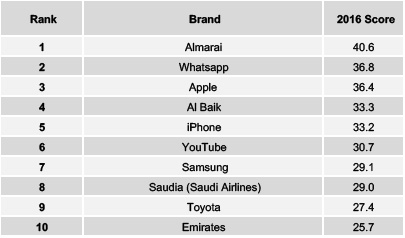
Source: Yougov Brandindex. Top ranked-brands for KSA in 2016.

The YouGov Brandindex rankings for 2016 reflect an eclectic love affair for brands. Brands were rated using BrandIndex’s Buzz score* which asks respondents, “If you've heard anything about the brand in the last two weeks, through advertising, news or word of mouth, was it positive or negative?”

The Buzz Rankings chart shows the brands with the highest average Buzz scores* between January and December 2016. According to YouGov:

1 Almarai (non-mover)

Source: YouGov Brandindex website. Al Marai makes dairy products.
Source: YouGov Brandindex website. Almarai makes food and dairy products.
The largest vertically integrated dairy producer in the Middle East ignited social media in 2016 with the launch of its film on mother’s milk and its family-focused advertising. The mother’s milk video became the second most shared video on YouTube in the world in one week and came in globally as the 7th most shared video of 2016. This also made the brand the third-most popular fast-moving consumer goods (FMCG) brand on Facebook with over 45 million views.

According to Euromonitor's Dairy in Saudi Arabia report, Almarai leads in the cheese, drinking milk as well as yoghurt and sour milk categories.

2 WhatsApp (up three places)

The world’s most popular messaging app has moved up from fifth place in 2015 to second place in 2016. The Facebook-owned app is one of the most popular ways to communicate in KSA.

3 Apple (non-mover)

The release of the new MacBook Pro, iOS 10 Software, the Apple Watch Series 2 and the iPhone 7 with wireless AirPods have not affected Apple’s rank greatly.

Source: ALBAIK Facebook page.
Source: ALBAIK Facebook page. Banner for Earth Hour 2017.

ALBAIK (non-mover)

ALBAIK has been making the headlines for its corporate social responsibility initiatives throughout 2016. The brand’s Please Park It Right community initiative received the Global SABRE Award as one of the world’s top 40 CSR programmes at end-2015. 2016 saw the kingdom’s leading quick service chicken restaurant hit the headlines for switching off its lights to mark Earth Hour and sponsoring the fourth Saudi Youth Sports Initiative aimed at enriching the lives of youth and contributing to the development of soccer and basketball in Jeddah.

5 iPhone (up one place)

The smartphone brand from Apple introduced water-resistance and an improved camera, which were welcomed by consumers.

6 YouTube (up two places)

Owing to the continued increase in content, as well as the introduction of 4K and 360° video, the world’s largest video-streaming platform continues to grow in popularity in the region.

7 Samsung (down five places)

Samsung is at seventh place after falling from second place in the 2015 rankings. Samsung has gone through a tough period with the company recall of some 2.5 million Note 7 devices following multiple battery issues worldwide, but has still maintained high levels of positive Buzz throughout 2016. The release of the Galaxy S7 and S7 Edge Pink Gold version smartphones exclusively for the Saudi market helped boost Samsung’s BrandIndex scores.

8 Saudi Airlines (new entry)

Saudi Arabia’s flagship airline has fallen from sixth place since its debut in the 2016 mid-year rankings. Saudia has announced fleet retirement and renewal for 2017, new flight routes, and the delivery of its first A330-300 regional aircraft which will boost capacity on several of the  Saudi Arabian airline's most in-demand routes. 2016 also saw the carrier win platinum status for Fast Travel implementation from the International Air Transport Association (IATA).

9 Toyota (new entry)

New launches, announcements and awards sawToyota land 9th place. In the last six months, the popular car brand achieved success at the 2016 Middle East Car of the Year (MECOTY) Awards, winning recognition for the Best Midsize Sedan and Best Midsize Truck. Toyota also chose KSA to make its GCC debut launch of the new 2016 Toyota Prius. A partnership with Uber also hit the headlines following the announcement the two brands will create new leasing options in which car purchasers can lease their vehicles from Toyota Financial Services.

10 Emirates (new entry)

Emirates has entered the Buzz Rankings in Saudi Arabia for the first time. The airline has capitalised on the positive and downplayed the negative to increase its reach across the region.

Source: Yougov Brandindex. Top Buzz improvers over 2016 for KSA.

The Buzz Improvers chart ranks the brands with the highest increase in Buzz comparing scores in years 2015 and 2016. Both scores are representative of the general population.

The top Buzz improvers were Mobily, Zain and Snapchat. Notably, KFC and Malaysian Airlines went from negative scores to positive scores in in 2016.

Other highlights included:

+Automotive brands Toyota, Mercedes Benz and BMW were in the top three. Mercedes-Benz, Audi and Mazda saw the best improvements in Buzz rankings.

+For restaurants and eateries Al Baik, Al Tazaj and Pizza Hut topped the list. KFC, McDonald's and Hardee's did best on Buzz improvements. In KFC's case, the scoring moved from negative to the low positives.

+Retailers IKEA, Panda, and Jarir were the best known brands. EXtra, Carrefour and Souq.com made the most gains for Buzz.

+The consumer electronics space was dominated by Apple, Samsung and Sony. Nikai, which makes audiovisual equipment and phablets, Black & Decker and JVC demonstrated the most Buzz improvement, the first from a negative score to a positive one.

+In the area of financeAl Rajhi BankNational Commercial Bank (NCB, Al Ahli), and Alinma Bank won out. GIBSaudi Investment Bank and Alawwal Bank made the most gains in Buzz.

+The travel category saw airlines Saudia, Emirates and Qatar Airways as its three leaders. Malaysia Airlines, Saudia and Air France/KLM grew in popularity over the last year, from negative to positive in Malaysia Airlines' case.

Interested?

Watch the Almarai mother's milk video (Arabic). At the time of writing the video had been viewed over 12 million times

Read how Almarai rode on YouTube to reach its target audience in KSA in 2016

Watch the Please Park it Right video from ALBAIK (Arabic) 

Sunday, 19 February 2017

Digital brands are king in Malaysia

Source: YouGov Brandindex 2016 rankings for Malaysia are heavy on digital brands.
Source: YouGov Brandindex 2016 rankings for Malaysia are heavy on digital brands. 

The YouGov Brandindex rankings for 2016 reflect a love affair with digital brands in Malaysia. WhatsApp, Facebook and Google were in the top three , followed by e-commerce site Lazada, the Apple iPhone, and YouTube in the top seven.

Brands were rated using BrandIndex’s Buzz score* which asks respondents, “If you've heard anything about the brand in the last two weeks, through advertising, news or word of mouth, was it positive or negative?”

The Buzz Rankings chart shows the brands with the highest average Buzz scores* between January and December 2016.

Source: YouGov Brandindex. Top Buzz improvements in Malaysia for 2016.
Source: YouGov Brandindex. Top Buzz improvements in Malaysia for 2016. 

The Buzz Improvers chart ranks the brands with the highest increase in Buzz comparing scores in years 2015 and 2016. Both scores are representative of the general population.

The top Buzz improvers were Huawei, KFC and Lazada. Huawei in particular went from single-digit territory in 2015 to double digits in 2016.

Other highlights included:

+Automotive brands Toyota, Honda and BMW were in the top three.

+Quick service (QSR) restaurants and casual dining brands were all US brands, KFC, Domino's and McDonald's. KFC, McDonald's, and Texas Fried Chicken did best on Buzz improvements.

+In the area of finance, Maybank, CIMB and Public Bank won out. Insurance players Prudential, Great Eastern Life and AIA were in the lead, while AIG, Kurnia and AXA made the most gains in Buzz.

+Fashion retailers were more a mix of general goods providers which also offer fashion as well as pure fashion retailers. Uniqlo, JUSCO and Adidas were the best known brands. Adidas, FashionValet - which offers designer brands online - and Puma made the most gains for Buzz.

Telecom, Internet and pay-TV operators that were the most well-known included Digi, Celcom and U Mobile. P1 WiMax, while still in negative territory, and U Mobile did best on Buzz improvement.

+The e-commerce/m-commerce category saw e-marketplace Lazada, online fashion retailer Zalora and e-marketplace Mudah.my as its three leaders. Lazada, Fashionvalet and e-marketplace Alibaba grew in popularity over the last year.

+The mobile space was dominated by Apple's iPhone, Apple and Samsung. Huawei, Blackberry and Motorola demonstrated the most Buzz improvement, the latter two from more negative scores to less negative scores.

*All Buzz scores listed have been rounded to a single decimal place; additional precision was used internally to assign ranks.

Sunday, 12 February 2017

YouGov BrandIndex 2016 rankings for Indonesia list Garuda in top place

Source: YouGov Brandindex. Brandindex rankings for 2016 for Indonesia.

The YouGov Brandindex rankings for 2016 show diversity in Indonesia. It's national carrier Garuda in top place, followed by Samsung and Aqua, the mineral water brand from Danone.

Brands were rated using BrandIndex’s Buzz score* which asks respondents, “If you've heard anything about the brand in the last two weeks, through advertising, news or word of mouth, was it positive or negative?”

The Buzz Rankings chart shows the brands with the highest average Buzz scores* between January and December 2016.

Source: YouGov Brandindex. Brand reputation improvements in 2016.

The Buzz Improvers chart ranks the brands with the highest increase in Buzz comparing scores in years 2015 and 2016. Both scores are representative of the general population.

The top Buzz improvers were Air Asia, CNN Indonesia and Malaysia Airlines. Air Asia in particular went from negative territory in 2015 to being seen in a significantly positive light. Malaysia Airlines, also viewed negatively in 2015, made some inroads in improvement.

Other highlights included:

+For healthcare and pharma, it was all about Tolak Angin, a herbal medicine used for flu, headache, nausea and flatulence; Panadol and cold medicine Promag.

+Aqua, Pocari Sweat and Teh Botol Sosro made the top three for beverages. Top improvers were Coca-Cola, Sprite and Kratingdaeng, an energy drink. The confectionery and snacks category was dominated by Asian brands. Euromonitor reported in December 2016 that Ceres PT, which belongs to Singapore's Petra Foodsis the market leader for chocolate with a value share of 52% in 2016. Silver Queen from Ceres is No. 1, then Beng Beng from Mayora of Indonesia and OT Group's Tango. The best buzz improvements came from Better, a biscuit brand from PT Citra Sukses Internasional, Beng Beng - which started from an already high score - and Oops, also from the OT Group.

+For dairy brands - including yoghurt and ice cream - Walls, an ice cream maker, Yakult, yoghurt based drinks, and Milo, a chocolate malt beverage from Nestlé, were in the top three. According to Euromonitor, Yakult has a 69% market share in yoghurt and sour milk products in Indonesia for 2016. Cimory, a provider of milk, soy milk and yoghurt-based drinks, Japfa's Real Good milk drinks and Qeju cheese from Dairylea were the top three winners for Buzz improvement.

+Quick service (QSR) restaurants and casual dining brands were all US brands, KFC, Pizza Hut and McDonald's. McDonald's, California Fried Chicken - better known as CFC - and Mr Baso, whose menu includes meatball (editor's note: 'meatball' is 'bakso' in Bahasa Indonesia), noodle and rice dishes, did best on Buzz improvements.

+When it comes to airlines the top three were Garuda Indonesia, Singapore Airlines, and Garuda's budget airline brand Citilink Indonesia. The top brand improvements were from Air Asia and Malaysia Airlines, followed by ANA.

+For hotels and spas Aston Hotels, Ritz Carlton and Grand Hyatt were the top three. Major Buzz improvements were experienced by the Holiday Inn Express, Cozy Spa and the Ibis.

+The personal care category had Pepsodent, Lifebuoy and Dettol in the top three places. Shinzu'i lightening skincare, Tje Fuk, also for skin lightening and Wardah, known for its halal cosmetics, saw the Buzz improvement in 2016.

+Fashion retailers were more about general goods providers which also offer fashion than pure fashion retail. Carrefour, Indomaret and e-marketplace MatahariMall were the best known brands. Robinson, Galeries Lafayette and Ikea made the most gains for Buzz.

+The e-commerce/m-commerce category saw Tokopedia, e-travel site Traveloka and Bukalapak as its three leaders. Tokopedia, Bukalapak and Blibli seem to have grown in popularity over the last year. Blibli ranked 5th in the main leaderboard.

*All Buzz scores listed have been rounded to a single decimal place; additional precision was used internally to assign ranks.

Wednesday, 2 November 2016

Muslims in Malaysia want halal-certified eateries

Muslims are often unsure of patronising cafes and restaurants which do not have formal halal certification as there is always the possibility that ingredients used in the food may not be halal. A recent controversy about Auntie Anne's, the pretzel chain, erupted in October 2016 when customers heard that its application for halal certification had been rejected.

A representative from Auntie Anne's then said that the Islamic Development Council JAKIM  had taken issue with the menu, which includes pretzel dogs (items containing sausages), and had requested that the item be renamed, further fanning discussion; but JAKIM later went on record to say that Auntie Anne's paperwork had been incomplete, and it had nothing to do with its pretzel dogs.

YouGov, the global market research firm, conducted an online survey from 21 to 24 October 2016 to investigate how Malaysians feel about halal certification and hotdogs. Of the 941 people polled in Malaysia, over 60% are Muslim. It found that:


Source: YouGov infographic. Ninety percent of Muslims only patronise halal-certified restaurants.

Nine out of 10 of Muslim respondents say they only visit halal certified restaurants when they dine out. This result shows the importance for halal certification when it comes to attracting Muslim customers, YouGov noted.

Asked whether Muslims felt that there are enough halal-certified restaurants, 71% said that there are enough such restaurants in the country whereas 20% feel that there could be more.

As for the term 'hotdogs', 'sausages' was considered a better alternative. Over half of all respondents prefer 'sausages' (52%) while 13% of respondents prefer 'pretzel sausages' and 12% preferred 'frankfurters'.

As for Auntie Anne's, its submission for halal certification continues to be under processing. A letter on its Facebook page states that food ingredients used in the preparation of menu items are all halal-certified.

Source: Auntie Anne's Malaysia Facebook page. Letter assuring customers that it uses halal-certified food ingredients and is looking to become halal certified.

Interested?

View the complete infographic

*Data from the research was collected among YouGov’s panelists during 21 to 24 October 2016 and was weighted to be representative of the online population. The sample size was 941 with 53% male and 47% female.

Wednesday, 17 August 2016

Hari Raya is family time in Indonesia and Malaysia

The majority of Muslims in three Southeast Asian countries celebrated Hari Raya Aidilfitri* (Eid al-Fitr outside Southeast Asia) in 2016, according to an online survey* by YouGov conducted in early July 2016 in Indonesia, Malaysia and Singapore.

Indonesia has the highest percentage of Muslims** (88%) among the three countries, and 76% of the respondents said they planned to celebrate Hari Raya Aidilfitri this year. In Malaysia, where six out of 10 people are Muslim, 65% of respondents said they plan to celebrate Hari Raya. In Singapore, where 16% of the population is Muslim, 27% of respondents planned to celebrate Hari Raya, suggesting that a proportion of non-Muslims are also celebrating the holiday.

Among those who planned to celebrate Hari Raya, the top three activities in Indonesia and Malaysia were being with family and loved ones (95% in Indonesia and 93% in Malaysia), visiting relatives and friends (72% in Indonesia and 76% in Malaysia), and attending communal prayers at the mosque (76% in Indonesia and 64% in Malaysia). In Singapore, being with family and loved ones is the top activity (74%) and visiting relatives and friends (54%) remains one of the most common ways to celebrate Hari Raya. Less than 40% of respondents plan to attend communal prayers at the mosque (36%), which would also align with the trend of non-Muslims celebrating the holiday. People in Singapore like feasting with traditional delicacies (53%), sending greetings to relatives and friends (43%), or giving children token sums of money (38%).

Source: YouGov infographic. Worship is the top value underlying Hari Raya for Indonesians, whereas empathy for the poor is the top value for Malaysia and Singapore.


In Indonesia and Malaysia, a significant number of respondents (20% in Indonesia and 13% in Malaysia) like Hari Raya because it is a time to reflect and remind themselves of the important values of life. Over half of the respondents in Indonesia think worship (56%) is the most important, then comes to steadfastness (15%), and empathy for the poor (11%); while respondents from Malaysia think empathy for the poor is the most important (28%), followed by patience (18%) and worship (16%). In Singapore, 28% respondents think empathy for the poor is the most important, then it is worship (19%) and patience (10%).

Ketupat and lontong, unwrapped.
Lontong on the upper left and ketupat in the middle.

Home-made beef rendang.


Festive foods include ketupat (rice cooked in a wrap woven from coconut leaves) is the favourite food during Hari Raya period for respondents from Indonesia; while rendang (meat cooked with spices and coconut milk until almost dry) is the favourite food during Hari Raya among respondents from both Malaysia and Singapore.

For Hari Raya this year, over half of respondents in Malaysia (51%) plan to go back to their hometown for celebration, and over 70% of them (74%) visit their hometown every year during this period of time. In terms of transportation, over 70% of respondents (72%) drive their own car / motorcycle to visit their hometown. Almost one in five fly home (19%). In Indonesia, four out of 10 respondents (41%) plan to go back to their hometown this year for Hari Raya and over half of respondents (53%) visit their hometown every year during this period of time. Most people drive their own car / motorcycle (44%) or fly (28%) to visit their hometown. In Singapore, which is a city-state, fewer than 10% of respondents (9%) plan to go back to their hometown during this period of time. Over 60% of them said they are already in their hometown.

Interested?

View the complete infographic

*Data was collected among YouGov’s panelists from 2 July to 8 July 2016 and was weighted to be representative of online population. Sample size: Indonesia, Malaysia and Singapore (Total n = 3,020; with Indonesia: 1,015; Malaysia: 1,004; Singapore: 1,001)

**Figures from http://www.muslimpopulation.com/asia/

posted from Bloggeroid

Saturday, 5 December 2015

YouGov probes haze-related behaviour in Southeast Asia

Many Southeast Asian countries experienced significant haze – caused primarily by forest fires burning in the region - this year. According to a YouGov survey*, there was high awareness of the haze issue in Southeast Asia within the region.

Almost eight in 10 (78%) Asian people say they are aware of the haze caused by Indonesian landscape fires. Awareness was lowest in Hong Kong (at 48%) and Mainland China (at 44%), but in the three countries most affected by the haze (Indonesia, Malaysia, and Singapore), only 2% of respondents in each location claim not to know about the haze.

Mask-makers did well during this period. Two-thirds (65%) of those in Indonesia, Malaysia and Singapore wore a mask when the haze was present. Among those who chose not to wear a mask during the haze, 39% say that they don’t find it necessary, 38% think it’s uncomfortable to wear masks, and 18% think that the mask cannot protect them from the pollution anyway.

Among those who are aware of the haze, 58% of them think palm oil companies setting their plantations on fire are a cause of the fires in Indonesia. Some 48% think the fires are caused by farmers setting their plantations on fire. And 44% think that dry weather causes the Indonesian fires.

When asked who they think is responsible for the resulting haze from the fires, with multiple answers possible, 63% of respondents said the palm oil plantation companies. An almost equal number, 62%, think it is the Indonesian Government. A smaller number, 18%, think it is the brands which use palm oil in their products that are responsible for the haze.

Two in every three people in Asia (67%) think the Indonesian government has not done enough to solve theproblem of the haze, believing the government can do more to reinforce the law regarding the use of fire to clear land for oil plantations. Within Indonesia itself, responses on this aspect are quite diverse: 45% believe the Indonesian government can do more to solve the haze problem, but 44% think their goverment has done enough by enacting legislation that prohibits illegal forest fires to clear land for farming.

YouGov also asked Asian respondents if any other regional country governments (or other parties) can do more to help solve the haze problem. Two thirds (65%) of Asian respondents think governments in other countries can do more in terms of investment in monitoring and enforcing existing bans on the use of fire as a method for land preparation. About half (51%) agree that companies using palm oil in their products should be able to verify that the palm oil used does not contribute to deforestation. 42% agree that consumers should also let manufacturers know that they want to know if the palm oil used in their products is grown on plantations free from deforestation.

Source: YouGov infographic.

One-in-five people (20%) in Indonesia, Malaysia and Singapore suffered health problems due to the haze. More than half (57%) of Indonesian, Malaysian, and Singaporean respondents said they stay at home more when there is haze. Only 13% said the haze had not affected their lifestyle in any way.

For 69% of people in Indonesia, Malaysia and Singapore, outdoor activities became less attractive. Four in 10 (41%) of them also said they spend less on travel and holidays because of the haze.

While 43% of respondents in the three countries most affected by haze haven’t had any visible health impact as a result of the haze, about one in three (32%) have suffered some haze-related health problems that they addressed themselves, while one in five (20%) suffered haze-related health problems for which they had to see a doctor.

When asked “If haze did not affect your country, how concerned would you be regarding this issue?”, more than half (52%) of respondents in these countries says that they would still care. Only 5% claim they would not care at all.

Upon hearing that the haze would continue on until early next year, 66% of respondents are disappointed, 54% are angry and 53% say they want to do something to help. Some 22% say in this situation, they will be resigned to fate.

Regarding the Pollutants Standard Index (PSI) readings or equivalent produced by the national environment authorities, 57% of respondents in Asia sees the readings as ‘somewhat’ or ‘very’ trustworthy. A quarter do not trust the readings and the remainder do not look at the PSI readings at all.

The haze has changed the travel behaviour of people in Asia Pacific. Almost seven in 10 (68%) say they would only visit cities/countries that remain unaffected by the haze. Only 7% of respondents would still visit the affected cities/countries and think the haze is not a problem. Another 18% would still visit the affected cities/countries due to business travel, family visits, or because they already paid for the trip.

In fact, regardless of the haze, Singapore is among the top five countries in the Asia Pacific region where respondents would want to visit the most:

1. Japan (50%),
2. Australia (43%),
3. New Zealand (38%),
4. Singapore (33%), and
5. Thailand (25%).

However, the above ranking doesn’t stay the same in some countries. In Mainland China, half of the respondents (50%) want to visit Singapore most, while over 50% of Malaysians want to travel to Australia most.

Interested?

View the full infographic

*YouGov polled 7,536 respondents online across Asia Pacific from 17 to 23 November 2015. All data was collected from YouGov panellists and weighted to be representative of the online population.