Showing posts with label 2016. Show all posts

Monday, 16 October 2017

IFSB releases Q416, Q117 PSIFIs data

The Islamic Financial Services Board (IFSB) is pleased to announce the dissemination of country-level data on financial soundness and growth of the Islamic banking systems for Q416 and Q117 from 17 IFSB member jurisdictions. This seventh dissemination completes the availability of quarterly data from Q413 to Q117.

Acting Secretary-General of the IFSB Zahid ur Rehman Khokher stated: “I am pleased that the dissemination of the IFSB’s Prudential and Structural Islamic Financial Indicators (PSIFIs) database project has reached 14 quarters, and that it will soon be extending to four new jurisdictions. This means that in 2018, the PSIFIs database will comprise data from 21 contributing countries, bringing the coverage of the data to over 95% of the global Islamic banking activity, an increase from the existing 90%.

"The IFSB also plans to release sector level balance sheets of entire jurisdictions for the Islamic banking market starting early next year.” 

Khokher further mentioned that “following the approval of the IFSB Council to extend the coverage of this project to the takaful and Islamic capital market sectors, the IFSB has completed a comprehensive survey on the selection of soundness indicators for these two sectors, and is in the midst of updating the PSIFIs Compilation Guide.” The survey was conducted among the IFSB’s member regulatory and supervisory authorities.

This seventh dissemination is part of the IFSB’s PSIFIs project, which currently compiles data from 17 member countries – Afghanistan, Bahrain, Bangladesh, Brunei, Egypt, Indonesia, Iran, Jordan, Kuwait, Malaysia, Nigeria, Oman, Pakistan, KSA, Sudan, Turkey, and the UAE.

With the launch of Phase IV of the project in early 2017, four new regulatory and supervisory authorities joined the PSIFIs project, making a total of 21 participating jurisdictions. The IFSB is now in the process of collecting Islamic banking data on trial basis from these new contributors: the Qatar Central Bank, the Bank of England, the Central Bank of Lebanon (Banque du Liban) and the Palestine Monetary Authority.

Key PSIFI indicators include:

Growth of Islamic banking

Based on the available data, the total assets of the Islamic banking industry grew from US$1,391 billion in Q116 to US$1,480 billion in Q117 (calculated from country-wise aggregated data converted into US dollar terms using end-period exchange rates). Total funding/liabilities increased from US$1,283 billion in Q116 to US$1,362 billion in Q117. 

Financing by Islamic banks from the jurisdictions participating in the PSIFIs project reached US$967 billion in Q117 from US$882 billion in Q116. The data on financing by type of sharī`ah-compliant contracts reveals that five major financing contracts used by the Islamic banking industry as of Q117 were: murābahah (36.2%), commodity murābahah/tawwaruq (21.5%), ijārah/ijārah muntahia bittamlīk (13.4%), bay` bithaman ajil (8.4%), and salam (5.5%).

Capital adequacy

Capital adequacy provides an important indication of the health and financial soundness of the banking industry in a jurisdiction. As of the 1st quarter of 2017, the weighted-average capital adequacy ratio and weighted-average tier 1 capital ratio from available data of full-fledged Islamic banks of 13 jurisdictions were 12.5% and 9.9% respectively, while these ratios were 11.9% and 9.6% at the same period of the previous year (Q116) respectively.

Asset quality

On asset quality indicators, gross non-performing financing ratio (gross non-performing financing to total financing) showed an improvement with a decrease from 5.9% in Q116 to 5.2% in Q117. The improvement is also apparent in the net non-performing financing to capital ratio which decreased sharply from 38.1% in Q116 to 22.6% in Q117.

Earnings

Islamic banks and Islamic windows in the PSIFIs member countries generally maintained comparable rates of return on assets (ROA) and return on equity (ROE) during the periods under report. Overall, the ROA and ROE were 1.76% and 12.80% in Q117 as compared to 1.30% and 12.57% in Q116  respectively.

Liquidity

On the liquidity indicators, the liquid assets ratio (liquid assets to total assets) decreased over the period from 35.7% in Q116 to 34.5% in Q117, while liquid assets to short-term liabilities ratio increased from 13.9% in Q116 to 14.6% in Q117. Four PSIFIs member countries reported the newly introduced Liquidity Coverage ratio (LCR) which all exceeded the 100 percent benchmark.

Size of Islamic banking

The number of full-fledged Islamic banks and Islamic windows of conventional banks in 17 countries stood at 172 and 83 in Q117 as compared to 170 and 85 in Q116 respectively. At the end of Q117, a total of 382,331 staff members were working in 29,667 branches of full-fledged Islamic banks, an increase of 826 staff members but a decrease of 224 branches over the year from Q116.

The task force for the PSIFIs project includes representatives from 21 participating regulatory and supervisory authorities that work as coordinators for regular submission of data of the respective countries and work with the IFSB during the due processes of data collection, compilation, revision, and approval. Three international organisations – the International Monetary Fund (IMF), Islamic Development Bank (IDB) and the Asian Development Bank (ADB) are also members of the Task Force.

The first set of PSIFIs data was released on 27 April 2015 covering the period of December 2013. The second, third, fourth, fifth, and sixth sets of data released on 24 November 2015 and 14 March 2016, 1 July 2016, 28 November 2016 and 15 May 2017 respectively.

Explore:

The PSIFIs Database (data with metadata) is available on the PSIFIs portal at the IFSB website.

Tuesday, 27 June 2017

Dates are big business in Dubai

- UAE is world’s fourth largest exporter of dates and among the top 10 importers of the commodity

– Morocco and Oman were the largest importers of Dubai dates in 2016

Research conducted by the Dubai Chamber of Commerce and Industry (DCCI) has revealed that Dubai’s total date trade amounted to US$221.7 million in 2016, of which exports accounted for the largest share (US$85.1 million), followed by imports (US$72.1 million) and re-exports (US$64.5 million).

Dubai’s export share of the emirate’s total date trade stood at 38% in 2016. Compared to other emirates, Dubai was the top exporter of dates to other countries in 2015 with 96% market share of the UAE’s date exports. The UAE’s share of global date exports stood at 8.5%, or US$96.3 million in 2015, according to data from Trade Map, making the country the world’s fourth largest exporter of dates.

Southeast Asia and the Middle East and North Africa were identified as the top importing regions for UAE dates. However, North America and Europe were also among the largest date importers.

The analysis pointed out that Dubai’s date exports recorded a CAGR of 34.1% between 2011 and 2015. The quantity of dates exported from the emirate in 2016 amounted to 108,300 tonnes, which is slightly below peak levels seen in 2015.

Source: DCCI, Dubai Customs. Dubai’s date trade, (US$ million), 2011 to 2016.
Source: DCCI, Dubai Customs. Dubai’s date trade, (US$ million), 2011 to 2016. 

The price of dates exported from Dubai in 2016 stood at US$786 per tonne, while the price for re-exports and imports were US$405 per tonne and US$399 per tonne respectively. The export prices from Dubai are more expensive due to the high quality of dates when compared to those that were re-exported and imported.

The UAE was one of the world’s top 10 importers of dates in 2016.
India accounted for the largest share of Dubai’s date re-exports during the same year with 63%, followed by Bangladesh (13%), Pakistan (4%), while dates imported to the emirate mainly came from countries within the Middle East and Africa region.

Asian countries accounted for most of the imports in the top five. Oman had 13% market share, then India (12%), Bangladesh (12%), and Indonesia (10%). In terms of quantity, Bangladesh was the largest importer of Dubai dates during the same year as its volume of imports reached 17,600 tonnes or 16.3% of total exports, followed by India (15.6%), Morocco (15.3%), and Oman (12.2%).

Source: DCCI. Top 10 export destinations for Dubai’s dates, (% share), 2016.

Export prices are dependent on the quality of dates and trade costs. In 2016, 77% of the dates exported by Dubai fell into the categories of high-quality, fresh and chilled.

In 2015, global date imports reached US$1.1 billion, and India was the world’s largest buyer of dates during the year, accounting for an import value of US$188.7 million and a market share of 17%.

The analysis highlighted the need to diversify UAE’s date exports beyond fresh and dried dates to other date-based products such as date syrup, date vinegar, and date paste. In addition, blending dates into chocolate or coffee products has the potential to increase interest and demand, DCCI said.

Monday, 22 May 2017

IFSB releases Q316 Islamic banking data, announces expansion of dataset

The Islamic Financial Services Board (IFSB) has released its 6th dissemination of country-level data for Q2 to Q316 on financial soundness and growth of the Islamic banking systems from 17 IFSB member jurisdictions.

This 6th dissemination presents a total of 12 quarters of Islamic banking sector data, from Q413 to Q316, from 17 member countries – Afghanistan, Bahrain, Bangladesh, Brunei, Egypt, Indonesia, Iran, Jordan, Kuwait, Malaysia, Nigeria, Oman, Pakistan, Saudi Arabia, Sudan, Turkey, and United Arab Emirates.

The Acting Secretary-General of the IFSB, Zahid ur Rehman Khokher stated that with the approval of the IFSB Council at its recent meeting in April 2017, “the IFSB will extend the coverage of this PSIFIs project to the takāful and Islamic capital market sectors. The IFSB will work closely with its member regulatory and supervisory authorities (RSAs) from these two sectors and multilateral organisations on the selection of the relevant soundness indicators and the preparation of a Compilation Guide for the reference of contributing organisations and users,”

A summary of key PSIFI indicators is given below.

Growth of Islamic banking

Based on the available data, the total assets of the Islamic banking industry grew from US$1,299 billion in Q315 to US$1,441 billion in Q316 (calculated from country-wise aggregated data converted into US dollar terms using end-period exchange rates). Total funding/liabilities increased from US$1,205 billion in Q315 to US$1,318 billion in Q316. Financing by Islamic banks from the jurisdictions participating in the PSIFIs project reached US$939 billion in Q316 from US$826 billion in Q316. The data on “financing by type of shari'ah-compliant contracts” reveals that five major financing contracts used by the Islamic banking industry as of Q316 were: murābaḥah (37.6%), commodity nurābahah/tawwaruq (22.5%), ijārah/ijārah muntahia bittamlīk (13.8%), bayʻ bithaman ajil (11.0%), and salam (5.6%).

Capital adequacy

Capital adequacy provides an important indication of the health and financial soundness of the banking industry in a jurisdiction. As of the Q316, the weighted-average capital adequacy ratio and weighted-average Tier 1 capital ratio from available data of full-fledged Islamic banks of 13 jurisdictions were 17.5% and 16.3% respectively, significantly higher than the regulatory requirements, while these ratios were 12.6% and 10.1% at the same period of the previous year (Q315) respectively.

Asset Quality

On asset quality indicators, gross non-performing financing ratio (gross non-performing financing to total financing) showed a slight improvement with a decrease from 5.9% in Q315 to 5.3% in Q316. However, a deterioration is apparent in the net non-performing financing to capital ratio which increased sharply from 16.1% in Q315 to 25.6% in Q316.

Earnings

Islamic banks and Islamic windows in the PSIFIs member countries generally maintained comparable rates of return on assets (ROA) and return on equity (ROE) during the periods under report. Overall, the ROA and ROE were 1.45% and 11.94% in Q316 as compared to 1.36% and 13.86% in Q315 respectively.

Liquidity

On the liquidity indicators, the liquid assets ratio (liquid assets to total assets) and liquid assets to short-term liabilities ratio decreased over the period from 39.6% and 15.1% in Q315 to 35.6% and 13.9% in Q316 respectively. Five PSIFIs member countries reported the newly introduced Liquidity Coverage Ratio (LCR), which all exceeded the 100% benchmark.

Size of Islamic banking market

The number of full-fledged Islamic banks and Islamic windows of conventional banks in 17 countries stood at 170 and 83 in Q316 as compared to 169 and 85 in Q315 respectively. At the end of Q316, a total of 380,040 staff members were working in 29,733 branches of full-fledged Islamic banks, an increase of 243 branches but a decrease of 8,381 staff over the year from Q315.

Three new country contributors have also been added to the IFSB’s Prudential and Structural Islamic Financial Indicators (PSIFIs) project, including the Central Bank of Lebanon (Banque du Liban) and Palestine Monetary Authority. This brings the total number of contributors to the PSIFIs project to 20 jurisdictions.

The Task Force of PSIFIs project includes representatives from all 17 participating regulatory and supervisory authorities that work as coordinators for regular submission of data of the respective countries and work with the IFSB during the due processes of data collection, compilation, revision, and approval. Three international organisations – the International Monetary Fund (IMF), Islamic Development Bank (IDB) and the Asian Development Bank (ADB) are also members of the Task Force.

The first set of PSIFIs data was released on 27 April 2015 covering the period of December 2013. The second, third, fourth, and fifth sets of data released on 24 November 2015, 14 March 2016, 1 July 2016 and 28 November 2016 respectively.

Interested?

View the PSIFIs Database (full set of data with metadata) on the PSIFIs portal at the IFSB website 

Sunday, 16 April 2017

Why Viva Kuwait's YouTube ad got so many views in Ramadhan 2016

Starcom Mediavest Group and Caviar Creative won the first Lantern award for delivering the most engaging video advertisement on YouTube during the Ramadhan season with a campaign for telecommunications provider VIVA Kuwait in 2016.

Described on the Think with Google blog,  the media and creative agencies decided to take a different approach instead of running TV advertisements which are then repurposed for YouTube and print. The companies decide to go directly to made-for-YouTube content instead, centred on a locally-relevant theme: guests losing their cookware after bringing food to someone else's home, delivered with the same fast-paced comedic tone that had been used with Viva's 2015 Ramadhan campaign.

“Go native: use all your resources to make the story local, relevant and close to the heart of the target audience. In this case, sharing food is a big part of Kuwaiti culture, but what’s more interesting is what happens after the food is delivered, and the odyssey that many a dish might be misplaced before being reunited with its rightful owner,” says Haitham Al-Hajji, Managing Partner, Caviar Creative on the Think with Google post.

By using sequential storytelling, the team created a situation for users to eagerly anticipate what would happen next, in order to create high engagement within social media channels. The teaser video had a view completion rate of 94%, while the second part delivered a view completion rate of 100%. 

Mark Khoury, Client Managing Director at Starcom Mediavest Group, suggested that brands "start big, buy smart and go for high reach and impact". "Keep your eyes open and optimise, optimise, optimise – fine-tuning the intensity as needed will drive results,” he advised on the Think with Google post.

Interested?


Thursday, 13 April 2017

Ramadhan represents uptick in e-commerce sales in SEA

+Online sales and website traffic start increasing three weeks before Ramadhan in Southeast Asia (SEA)

+E-commerce sales spiked by 110% during the third week of Ramadhan

+Shoppers spend less time browsing and shopping online during sunset

+Mobile continues to be a key driver for discovery and sales with an increase of 126% during Ramadhan


Source: Criteo infographic. Fashion sells best during Ramadhan.

Criteo, the performance marketing technology company, has released seasonal data to help e-commerce businesses better engage consumers during the festive season.

It revealed that online sales and traffic increased in the lead up to and during Ramadhan, but declined during Eid el-Fitr (Hari Raya), the holiday that marks the end of Ramadhan. Based on consumers’ online browsing and buying activity, the three weeks leading up to Ramadhan, and also the third week of Ramadhan represent the biggest opportunity for retailers to engage consumers when they are actively browsing and purchasing items for upcoming celebrations. During this period, there was an average of 67% uplift in online retail sales and 14% uplift in online travel sales.

Criteo’s data also revealed that Ramadhan traditions influence shoppers’ behaviour throughout the day. To engage with shoppers, retailers need to know when they are most active online. During the fasting period between sunrise and sunset, e-commerce transactions were lower at 71%, compared to 76% for the period prior to Ramadhan. However, after breaking fast, there is an increase in e-commerce sales to 29%, from 24% pre-Ramadhan, representing a timely opportunity for retailers to reach out to shoppers.

Understanding how and what shoppers are buying is also crucial. With 37% of onsite retail conversions happening on the mobile app, retailers need to be investing beyond just a mobile-friendly site to an intuitive app. Fashion-related items are the most popular during this period, followed by home and living products and electronics, toys and games.

“Ramadhan is an important festive season in this region. Rapidly rising disposable incomes, a growing appetite for modest fashion, halal products and services mean that retailers need to enlist smart solutions to engage shoppers across all touchpoints and deliver the most impactful content at every point in the customer journey. As shoppers spend time with their friends and families after sundown and on Eid, they are less likely to browse and shop online. Retailers must pick the right time of the week and time of day to increase their digital marketing efforts, so they can achieve an uptick in online transactions,” said Alban Villani, GM, Southeast Asia, Criteo.

Criteo analysed more than 8 million online transactions from 143 retailers based in Indonesia, Malaysia and Singapore. Other key findings from the report include:

+Website traffic and e-commerce sales increased from three weeks before Ramadhan and spiked during weeks three and four, with an increase of 110% and 77% respectively.

+During the start of Eid el-Fitr, there was a decline of 44% in online sales and 20% in website traffic. However, in the week post-Eid, online sales rebounded, increasing 35%.

+During weeks three and four of Ramadan, online mass merchants were the biggest growth driver – with an increase of 87% and 52% respectively.

+The cross-device journey was evident – 46% of shoppers were found to be viewing products across multiple devices, with one in four shoppers switching devices at least three times during their purchasing journey.

“In addition, retailers need to embrace omni-channel marketing – as we continue to see the rise of offline-to-online and online-to-offline (O2O) shopping habits. Our data shows that during the period of Ramadhan, shoppers are browsing in stores and purchasing online, and vice-versa. However, whichever way you look, mobile will still be the foundational building block and key driver in O2O retail. Half of the retail transactions in Southeast Asia are already taking place on mobile,” said Villani.

Ramadhan 2017 begins around May 25, 2017. The date varies in different countries depending on the sighting of the moon. 

Interested?

Download the infographic on Ramadhan 2016

posted from Bloggeroid

Monday, 20 March 2017

Milk and milk beverages a growth market for Malaysia

Malaysian consumers continue to sustain demand for milk and milk-based beverages as they contain high levels of calcium and so help to strengthen bones and keep joints healthy, says Euromonitor

According to the research firm, new players such as Hybrid Allied Dairy Company and Calpis entered the drinking milk category and helped drive sales of drinking milk products in Malaysia last year. In addition, Holstein Milk Company shared plans to expand its drinking milk production line in Malaysia in 2016.

Dutch Lady Milk Industries led sales of drinking milk products with a 23% retail value share in 2016 due to Dutch Lady Milky in April 2016. Dutch Lady Milky was successful due to its use of seven cartoon characters and its availability in three variants which gained the attention of children in particular. In addition, the company improved its packaging of Dutch Lady PureFarm fresh milk from brick liquid cartons to gable-top liquid cartons for its 1-litre pack size.

Consumers are expected to continue to demand drinking milk products for their nutrients and because popular brands are priced affordably. Euromonitor expects frequent discounting by leading brands such as Dutch Lady, Yeo’s, Goodday and F&N Magnolia to continue.
Interested?

Buy the Euromonitor Dairy in Malaysia report (December 2016)

Wednesday, 15 March 2017

Iranians prefer traditional sugar confections

The modern sugar confectionery market is immature in Iran. Traditional products were popular in 2016, consultancy Euromonitor said, with geo-specific confectionery in different cities that are often sold as souvenirs. Gaz (گز) from Isfahan, a type of nougat; sohan (سوهان) from Qom, a saffron-laced toffee; and baklava (باقلوا) from Yazd, a layered pastry with nuts soaked in sugar syrup, are all popular traditional sugar confectionery in Iran. 

Sugar is popularly consumed with tea as sugar 'cubes' which are cut into irregular shapes by hand. Sugar-free products are also increasingly popular among Iranian consumers, as they are increasingly concerned with their appearance and health.

The Iranian sugar confectionery market is dominated by Shiva Manufacturing Company, the key leading player in pastilles with a wide range of products in different shapes and flavours accounts for a 22% retail value share in 2016. Next in line is Dadash Baradar Company (Aidin) which accounts for 15% market share by retail value in 2016. It is known for boiled sweets, toffees and mints. Draje Food Industries is in third place, accounting for 8% of retail value sales of sugar confectionery, mainly in pastilles.

Sugar confectionery is expected to grow steadily with a CAGR of 1% in constant 2016 terms from 2016 to 2021, and will be higher than that seen in the review period (2011 to 2016). Domestic suppliers will expand their activities while multinational brands are expected to enter the market. The consumption of new premium brands is expected to grow over the forecast period due to increased consumer curiosity and the willingness of the younger generation to spend more on these products. 

Interested?

Saturday, 11 March 2017

Euromonitor sees strong potential for chocolate in Iran

Growth in the chocolate industry in Iran is driven by demand from Iranian youth, but is hindered by a decline in purchasing power and a still-high rate of inflation in 2016, says Euromonitor in its Confectionery in Iran report. 

Euromonitor says the gradual loosening of sanctions in 2016 which will make dealing in Iran easier for key importers like Mars and Turkey's Yildiz Holding, which owns Godiva. Domestic manufacturers have also benefited from easier importation of raw materials and export of finished products. Due to these positive factors and strong potential, chocolate confectionery is expected to record retail value growth of 10% in 2016.

Parand Chocolate Company will maintain its lead in 2016, accounting for a 20% retail value share of chocolate confectionery. The company has a long history in the production and distribution of chocolate confectionery and offers a wide portfolio ranging from boxed assortments to tablets with different cocoa content. The company’s key brand, Farmand, enjoys a strong penetration level inside the retail environment, even in remote areas, the consultancy said.

Chocolate confectionery is expected to see better performance compared to the review period (2011 to 2016) as it starts off a low base and Iranian youth are ready to pay more for it. Key domestic manufacturers are expected to improve the quality and packaging of their products and transition consumers from traditional unpackaged products to modern packaged versions. Overall, chocolate confectionery is expected to record a CAGR of 7% at constant 2016 prices during the forecast period (2016 to 2021) which is much higher than the review period figure at 2%.

Interested?

Thursday, 9 March 2017

Kazakhstan consumers buying yoghurt, sour milk products for health

Yoghurt and sour milk products, which is a growing dairy category in Kazakhstan, has seen interest from health-conscious consumers who believe the products are healthy and aid the immune system and digestion. The demand has spurred manufacturers to constantly update product lines with new tastes and health-orientated additives, says Euromonitor in a report on the dairy market in Kazakhstan.

Euromonitor identified Wimm-Bill-Dann Produkty Pitania as the leading company in 2016 with a 21% share of retail value sales for yoghurt and sour milk products. "This international manufacturer offered a wide range of yoghurt and sour milk products in Kazakhstan. Its leadership in retail value sales terms was due to comparatively high unit prices and strong marketing campaign," Euromonitor stated in an introduction to the report.

According to Euromonitor, Wimm-Bill-Dann Produkty Pitania also topped the 'other' dairy category, with a 17% share of retail value sales. The company offers brands such as Chudo, Domik v Derevne and Vesely Molochnik in chilled and shelf stable desserts, chilled snacks, cream, fromage frais and quark.

The increasing popularity of non-traditional products, such as chilled and shelf stable desserts, chilled snacks and coffee whiteners, will stimulate volume and value growth. Euromonitor says there will also strong demand for cream, condensed milk, fromage frais and quark*, as they include traditional products that remain popular among Kazakhstanis. Cream is consumed with tea for instance, while smetana (sour cream) is mainly taken with traditional hot meals like meat as well as berry dumplings and pancakes.

Interested?

Buy the Euromonitor report on Dairy in Kazakhstan (December 2016)

*Quark is a dairy product made by warming soured milk and then straining it. The curds are spoonable and are said to have a mild flavour that goes well with both sweet and savoury dishes.

Monday, 6 March 2017

Milk demand to grow despite saturated market in Kazakhstan

Milk is an integral part of the nutrition intake of Kazakhstanis, especially in tea. As the population increases, the demand for milk is set to grow from 2016 to 2021, says Euromonitor

In 2016, manufacturers competed by offering high-quality products at affordable prices, relying on the use of high-quality raw materials and modernised equipment as well as on improving their production processes to do so. 

Agroprodukt Asia remained the leading player in 2016 with an 18% share of retail value sales. The company offers a wide range of drinking milk products, such as Odari, Zorkin Lug, Mumunya, Lyubimoe, Beloye, Moloko, Svezhee Moloko and Nashe.

Interested?

Sunday, 26 February 2017

Milk-Pro is the dairy king in Azerbaijan

Milk-Pro tops every dairy category in Azerbaijan in 2016, says research firm Euromonitor. The company had 13% of value sales for cheese, 21% of the value share for its milk brand Sevimli Dad, and 17% value share for traditional sour milk products such as ayran and dovga.

The trend towards savoury milk flavours continued in Azerbaijan in 2016. Key local players expanded their ranges in order to become more competitive. Consumers demanded natural/organic ingredients, low fat/fat-free, nutrition and protein-rich milk products, as well as full-fat milk drinks.

Euromonitor forecasts that the milk market will grow through to 2021 and become increasingly saturated with brands labelled as non/reduced-fat, nutritive, organic/natural and others, in response to the spread of the health and wellness trend in Azerbaijan.

Consumption of yoghurt and sour milk products remains stable as well due to the same health and wellness trends and the strong belief that these products extend life. Over the forecast period (2016 to 2021) the demand will shift from unpackaged to packaged yoghurt and sour milk products, Euromonitor said. leading to volume growth. Competition is also expected to intensify, which could further diversify the market.

Interested?

Buy the Euromonitor Dairy in Azerbaijan report

Tuesday, 21 February 2017

Food, tech top KSA's list of favourite brands in 2016

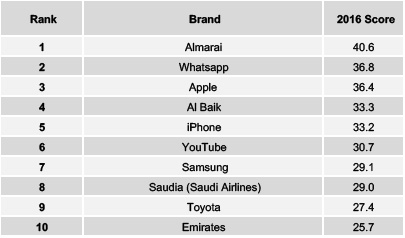
Source: Yougov Brandindex. Top ranked-brands for KSA in 2016.

The YouGov Brandindex rankings for 2016 reflect an eclectic love affair for brands. Brands were rated using BrandIndex’s Buzz score* which asks respondents, “If you've heard anything about the brand in the last two weeks, through advertising, news or word of mouth, was it positive or negative?”

The Buzz Rankings chart shows the brands with the highest average Buzz scores* between January and December 2016. According to YouGov:

1 Almarai (non-mover)

Source: YouGov Brandindex website. Al Marai makes dairy products.
Source: YouGov Brandindex website. Almarai makes food and dairy products.
The largest vertically integrated dairy producer in the Middle East ignited social media in 2016 with the launch of its film on mother’s milk and its family-focused advertising. The mother’s milk video became the second most shared video on YouTube in the world in one week and came in globally as the 7th most shared video of 2016. This also made the brand the third-most popular fast-moving consumer goods (FMCG) brand on Facebook with over 45 million views.

According to Euromonitor's Dairy in Saudi Arabia report, Almarai leads in the cheese, drinking milk as well as yoghurt and sour milk categories.

2 WhatsApp (up three places)

The world’s most popular messaging app has moved up from fifth place in 2015 to second place in 2016. The Facebook-owned app is one of the most popular ways to communicate in KSA.

3 Apple (non-mover)

The release of the new MacBook Pro, iOS 10 Software, the Apple Watch Series 2 and the iPhone 7 with wireless AirPods have not affected Apple’s rank greatly.

Source: ALBAIK Facebook page.
Source: ALBAIK Facebook page. Banner for Earth Hour 2017.

ALBAIK (non-mover)

ALBAIK has been making the headlines for its corporate social responsibility initiatives throughout 2016. The brand’s Please Park It Right community initiative received the Global SABRE Award as one of the world’s top 40 CSR programmes at end-2015. 2016 saw the kingdom’s leading quick service chicken restaurant hit the headlines for switching off its lights to mark Earth Hour and sponsoring the fourth Saudi Youth Sports Initiative aimed at enriching the lives of youth and contributing to the development of soccer and basketball in Jeddah.

5 iPhone (up one place)

The smartphone brand from Apple introduced water-resistance and an improved camera, which were welcomed by consumers.

6 YouTube (up two places)

Owing to the continued increase in content, as well as the introduction of 4K and 360° video, the world’s largest video-streaming platform continues to grow in popularity in the region.

7 Samsung (down five places)

Samsung is at seventh place after falling from second place in the 2015 rankings. Samsung has gone through a tough period with the company recall of some 2.5 million Note 7 devices following multiple battery issues worldwide, but has still maintained high levels of positive Buzz throughout 2016. The release of the Galaxy S7 and S7 Edge Pink Gold version smartphones exclusively for the Saudi market helped boost Samsung’s BrandIndex scores.

8 Saudi Airlines (new entry)

Saudi Arabia’s flagship airline has fallen from sixth place since its debut in the 2016 mid-year rankings. Saudia has announced fleet retirement and renewal for 2017, new flight routes, and the delivery of its first A330-300 regional aircraft which will boost capacity on several of the  Saudi Arabian airline's most in-demand routes. 2016 also saw the carrier win platinum status for Fast Travel implementation from the International Air Transport Association (IATA).

9 Toyota (new entry)

New launches, announcements and awards sawToyota land 9th place. In the last six months, the popular car brand achieved success at the 2016 Middle East Car of the Year (MECOTY) Awards, winning recognition for the Best Midsize Sedan and Best Midsize Truck. Toyota also chose KSA to make its GCC debut launch of the new 2016 Toyota Prius. A partnership with Uber also hit the headlines following the announcement the two brands will create new leasing options in which car purchasers can lease their vehicles from Toyota Financial Services.

10 Emirates (new entry)

Emirates has entered the Buzz Rankings in Saudi Arabia for the first time. The airline has capitalised on the positive and downplayed the negative to increase its reach across the region.

Source: Yougov Brandindex. Top Buzz improvers over 2016 for KSA.

The Buzz Improvers chart ranks the brands with the highest increase in Buzz comparing scores in years 2015 and 2016. Both scores are representative of the general population.

The top Buzz improvers were Mobily, Zain and Snapchat. Notably, KFC and Malaysian Airlines went from negative scores to positive scores in in 2016.

Other highlights included:

+Automotive brands Toyota, Mercedes Benz and BMW were in the top three. Mercedes-Benz, Audi and Mazda saw the best improvements in Buzz rankings.

+For restaurants and eateries Al Baik, Al Tazaj and Pizza Hut topped the list. KFC, McDonald's and Hardee's did best on Buzz improvements. In KFC's case, the scoring moved from negative to the low positives.

+Retailers IKEA, Panda, and Jarir were the best known brands. EXtra, Carrefour and Souq.com made the most gains for Buzz.

+The consumer electronics space was dominated by Apple, Samsung and Sony. Nikai, which makes audiovisual equipment and phablets, Black & Decker and JVC demonstrated the most Buzz improvement, the first from a negative score to a positive one.

+In the area of financeAl Rajhi BankNational Commercial Bank (NCB, Al Ahli), and Alinma Bank won out. GIBSaudi Investment Bank and Alawwal Bank made the most gains in Buzz.

+The travel category saw airlines Saudia, Emirates and Qatar Airways as its three leaders. Malaysia Airlines, Saudia and Air France/KLM grew in popularity over the last year, from negative to positive in Malaysia Airlines' case.

Interested?

Watch the Almarai mother's milk video (Arabic). At the time of writing the video had been viewed over 12 million times

Read how Almarai rode on YouTube to reach its target audience in KSA in 2016

Watch the Please Park it Right video from ALBAIK (Arabic) 

Sunday, 19 February 2017

Digital brands are king in Malaysia

Source: YouGov Brandindex 2016 rankings for Malaysia are heavy on digital brands.
Source: YouGov Brandindex 2016 rankings for Malaysia are heavy on digital brands. 

The YouGov Brandindex rankings for 2016 reflect a love affair with digital brands in Malaysia. WhatsApp, Facebook and Google were in the top three , followed by e-commerce site Lazada, the Apple iPhone, and YouTube in the top seven.

Brands were rated using BrandIndex’s Buzz score* which asks respondents, “If you've heard anything about the brand in the last two weeks, through advertising, news or word of mouth, was it positive or negative?”

The Buzz Rankings chart shows the brands with the highest average Buzz scores* between January and December 2016.

Source: YouGov Brandindex. Top Buzz improvements in Malaysia for 2016.
Source: YouGov Brandindex. Top Buzz improvements in Malaysia for 2016. 

The Buzz Improvers chart ranks the brands with the highest increase in Buzz comparing scores in years 2015 and 2016. Both scores are representative of the general population.

The top Buzz improvers were Huawei, KFC and Lazada. Huawei in particular went from single-digit territory in 2015 to double digits in 2016.

Other highlights included:

+Automotive brands Toyota, Honda and BMW were in the top three.

+Quick service (QSR) restaurants and casual dining brands were all US brands, KFC, Domino's and McDonald's. KFC, McDonald's, and Texas Fried Chicken did best on Buzz improvements.

+In the area of finance, Maybank, CIMB and Public Bank won out. Insurance players Prudential, Great Eastern Life and AIA were in the lead, while AIG, Kurnia and AXA made the most gains in Buzz.

+Fashion retailers were more a mix of general goods providers which also offer fashion as well as pure fashion retailers. Uniqlo, JUSCO and Adidas were the best known brands. Adidas, FashionValet - which offers designer brands online - and Puma made the most gains for Buzz.

Telecom, Internet and pay-TV operators that were the most well-known included Digi, Celcom and U Mobile. P1 WiMax, while still in negative territory, and U Mobile did best on Buzz improvement.

+The e-commerce/m-commerce category saw e-marketplace Lazada, online fashion retailer Zalora and e-marketplace Mudah.my as its three leaders. Lazada, Fashionvalet and e-marketplace Alibaba grew in popularity over the last year.

+The mobile space was dominated by Apple's iPhone, Apple and Samsung. Huawei, Blackberry and Motorola demonstrated the most Buzz improvement, the latter two from more negative scores to less negative scores.

*All Buzz scores listed have been rounded to a single decimal place; additional precision was used internally to assign ranks.

Monday, 13 February 2017

Cheese becomes popular in Indonesia

More Indonesian families, particularly in the big cities, are expected to start using cheese as a main ingredient in their meals. According to research firm Euromonitor, more consumers have started to prepare Western foods which use cheese as an ingredient by themselves at home. These include pizzas, pasta dishes, cakes, pastries and toast. Cheese has become very popular to serve with white bread as a substitute for chocolate sprinkles, jam or honey.

An increasing number of foodservice outlets and rising number of new menus using cheese by existing foodservice outlets may also prompt faster volume growth of food-service sales of cheese in the forecast period, Euromonitor said.

Kraft was named as the leading cheese brand in Indonesia in 2016, with Kraft Ultrajaya Indonesia PT commanding a 61% share of value sales. The company’s dominant position is attributed to its early entry into the Indonesian cheese market, a wide variety of other processed cheese products and aggressive marketing, using both television advertisements and below-the-line activities.

Interested?

Read the executive summary for the Euromonitor Dairy in Indonesia report, dated December 2016

Read the WorkSmart Asia blog post about popular brands in Indonesia

Sunday, 12 February 2017

YouGov BrandIndex 2016 rankings for Indonesia list Garuda in top place

Source: YouGov Brandindex. Brandindex rankings for 2016 for Indonesia.

The YouGov Brandindex rankings for 2016 show diversity in Indonesia. It's national carrier Garuda in top place, followed by Samsung and Aqua, the mineral water brand from Danone.

Brands were rated using BrandIndex’s Buzz score* which asks respondents, “If you've heard anything about the brand in the last two weeks, through advertising, news or word of mouth, was it positive or negative?”

The Buzz Rankings chart shows the brands with the highest average Buzz scores* between January and December 2016.

Source: YouGov Brandindex. Brand reputation improvements in 2016.

The Buzz Improvers chart ranks the brands with the highest increase in Buzz comparing scores in years 2015 and 2016. Both scores are representative of the general population.

The top Buzz improvers were Air Asia, CNN Indonesia and Malaysia Airlines. Air Asia in particular went from negative territory in 2015 to being seen in a significantly positive light. Malaysia Airlines, also viewed negatively in 2015, made some inroads in improvement.

Other highlights included:

+For healthcare and pharma, it was all about Tolak Angin, a herbal medicine used for flu, headache, nausea and flatulence; Panadol and cold medicine Promag.

+Aqua, Pocari Sweat and Teh Botol Sosro made the top three for beverages. Top improvers were Coca-Cola, Sprite and Kratingdaeng, an energy drink. The confectionery and snacks category was dominated by Asian brands. Euromonitor reported in December 2016 that Ceres PT, which belongs to Singapore's Petra Foodsis the market leader for chocolate with a value share of 52% in 2016. Silver Queen from Ceres is No. 1, then Beng Beng from Mayora of Indonesia and OT Group's Tango. The best buzz improvements came from Better, a biscuit brand from PT Citra Sukses Internasional, Beng Beng - which started from an already high score - and Oops, also from the OT Group.

+For dairy brands - including yoghurt and ice cream - Walls, an ice cream maker, Yakult, yoghurt based drinks, and Milo, a chocolate malt beverage from Nestlé, were in the top three. According to Euromonitor, Yakult has a 69% market share in yoghurt and sour milk products in Indonesia for 2016. Cimory, a provider of milk, soy milk and yoghurt-based drinks, Japfa's Real Good milk drinks and Qeju cheese from Dairylea were the top three winners for Buzz improvement.

+Quick service (QSR) restaurants and casual dining brands were all US brands, KFC, Pizza Hut and McDonald's. McDonald's, California Fried Chicken - better known as CFC - and Mr Baso, whose menu includes meatball (editor's note: 'meatball' is 'bakso' in Bahasa Indonesia), noodle and rice dishes, did best on Buzz improvements.

+When it comes to airlines the top three were Garuda Indonesia, Singapore Airlines, and Garuda's budget airline brand Citilink Indonesia. The top brand improvements were from Air Asia and Malaysia Airlines, followed by ANA.

+For hotels and spas Aston Hotels, Ritz Carlton and Grand Hyatt were the top three. Major Buzz improvements were experienced by the Holiday Inn Express, Cozy Spa and the Ibis.

+The personal care category had Pepsodent, Lifebuoy and Dettol in the top three places. Shinzu'i lightening skincare, Tje Fuk, also for skin lightening and Wardah, known for its halal cosmetics, saw the Buzz improvement in 2016.

+Fashion retailers were more about general goods providers which also offer fashion than pure fashion retail. Carrefour, Indomaret and e-marketplace MatahariMall were the best known brands. Robinson, Galeries Lafayette and Ikea made the most gains for Buzz.

+The e-commerce/m-commerce category saw Tokopedia, e-travel site Traveloka and Bukalapak as its three leaders. Tokopedia, Bukalapak and Blibli seem to have grown in popularity over the last year. Blibli ranked 5th in the main leaderboard.

*All Buzz scores listed have been rounded to a single decimal place; additional precision was used internally to assign ranks.

Saturday, 11 February 2017

Azerbaijan cheese lovers going domestic in 2016

Currency devaluation led to a significant price jump for imported cheese in Azerbaijan in 2016, resulting in consumers moving to value-for-money domestic brands instead, says Euromonitor in its Dairy in Azerbaijan report.

Milk-Pro MMC led in the cheese category in 2016, accounting for 13% of value sales.

Over the forecast period (2016 to 2021) consumers of cheese are expected to switch from unpackaged to packaged products. The share of imported premium cheese is expected to grow, with interest in new flavours.
Interested?

Buy the Euromonitor Dairy in Azerbaijan report

Monday, 12 December 2016

10th Annual Muslim Achievement Awards names winners

Source: AMAA Facebook page. The winners of AMAA 2016.
Source: AMAA Facebook page. The winners of AMAA 2016. From left: Nazeem Hussain, Creative Artist of the Year, Sana Karanouh, Volunteer of the Year, Steve Dabliz, People's Choice of the Year & Social Media Award, Talal Yassine, Man of the Year, Father Rod Bower, Anglican Parish of Gosford, Abyssinian Award, Yasmin Khan, Lifetime Achiever, Dalya Ayoub, Role Model of the Year, Somayra Ismailjee, Youth of the Year, and Samah Sabawi, Creative Artist of the Year.

The 10th Annual Muslim Achievement Awards (AMAA) were held on 11 December. Organised by the Mission of Hope, the achievements of Australian Muslim individuals and organisations were celebrated in Granville, New South Wales.

"Mission of Hope is all about enhancing our community and providing opportunities that will enhance the lives of the most needy within our community. The Australian Muslim Achievement Awards is just one of those opportunities to help the community celebrate achievements of individuals who have excelled within their respected categories," said the President of Mission of Hope Nasreen Hanifi in a message shared by the AMAA Facebook page.

Winners included:

Yasmin Khan - Australian Muslim Lifetime Achiever of the Year
Talal Yassine- Australian Muslim Man of the Year
Sherene Hassan - Australian Muslim Woman of the Year
Somayra Ismailjee - Australian Muslim Youth of the Year
Father Rod Bower, Anglican Parish of Gosford - Australian Abyssinian of the Year
Associate Professor Halim Rane - Australian Muslim Professional of the Year
Usman Khawaja - Australian Muslim Sportsperson of the Year
Samah Sabawi - Australian Muslim Creative Artist of the Year
Nazeem Hussain - Australian Muslim Creative Artist of the Year
Sana Karanouh - Australian Muslim Volunteer of the Year
Dalya Ayoub - Australian Muslim Role Model of the Year
Steve Dabliz - Australian Muslim People's Choice of the Year and Australian Muslim Social Media Award of the Year
The White Coats / Homeless Run - Australian Muslim Community Organisation of the Year
Pillars of Guidance Community Centre - Australian Muslim Best New Community Project of the Year
Eid at Taronga Zoo - Australian Muslim Event of the Year, a Crescent Wealth event
OnePath Network - Australian Muslim Media Organisation of the Year
Crescent Wealth - Australian Muslim Business of the Year

In his acceptance speech Father Bower said that he was deeply humbled by the award and accepted it "with acknowledgement to every human being who has ever sought refuge from persecution". "I along with many others here tonight remain committed to the same principles that guided the decisions of the Negus of Abyssinia. Human need always comes before ideology; the spirit of hospitality always overcomes the fear of the stranger and at the end of the day bridges will always make us feel safer than walls," he said.

Interested?

Watch a video of Eid at the Zoo

View the list of 2016 finalists

Hashtag: #EIDattheZOO, #AustralianMuslimAchievementAwards, #MissionOfHope, #AMAA

Wednesday, 7 December 2016

Oman announces holiday to celebrate Prophet Muhammad's birthday

The Sultanate of Oman, represented by the Ministry of Awqaf and Religious Affairs, will celebrate the birthday of Prophet Muhammad (ﷺ) in a ceremony on December 7. The ceremony will be held under the patronage of Dr Said bin Khamis al-Ka'abi, Chairman of the Public Authority for Consumer Protection (PACP), the Oman News Agency has reported.

The Ministry's celebration will focus on the meanings and lessons of the biography of the Prophet, as well as the historic value of the occasion.

Sayyid Khalid bin Hilal bin Saud al-Busaidi, Minister of the Diwan of Royal Court and Chairman of the Civil Service Council, separately announced that 12 Rabi' Al Awwal, 1438 which corresponds to December 12 2016, will be an official holiday for employees of the ministries, public authorities and other departments of the state administrative apparatus on the occasion of the Prophet Muhammad's (ﷺ) birthday.

Sheikh Abdullah bin Nasser al-Bakri, Minister of Manpower has issued a ministerial decision in parallel that private sector companies and establishments will stop work on December 12 on the occasion of the Prophet’s birthday (ﷺ).

The decision allows employers and employees to agree on work arrangements during the holiday if necessity arises. Employees whose weekly off-days coincide with this occasion shall be compensated.

Sunday, 4 December 2016

Halal International 2016 mixes fame, food, fashion and lifestyle items

Poster near the Expo entrance.
Halal International 2016, by MegaXpress International, was extremely crowded on day 3.

The four-day exhibition, at Singapore Expo, focused on food primarily, followed by fashion, lifestyle items and other services.

Stage entertainment is a traditional part of the event. Many in the audience returned every day to watch the show.

The event was in aid of the Muhammadiyah Association, which had a free booth and collection boxes at the showfloor.

The Muhammadiyah Association had a free booth courtesy of the organisers, and had collection boxes at the entrance of the exhibition.

Highlights of the day included:

A number of products at Halal International 2016 were plant based and listed various benefits if used regularly. This is fig tea made of 100% fig leaves from At-Tin (التين literally, 'the fig' in Arabic). It was introduced to Singapore in early 2016.

Gourmet popcorn in intriguing flavours, including cheese curry and caramel. Popcorn Gourmet is on Instagram.

Premixed coffee from AgroMas with habbatus sauda, also called 'black seed'*. The Agromas booth also featured sardine spreads, sauces, instant spice mixes, and cordials. Products from Agromas can be purchased at Agrobazaar  at Sultan Gate and at the Malaysia Halal Centre at Big Box in Jurong East. 

  8tarts n Pastries started out with Hong Kong style pastries. Its kitchens at Woodlands and Vivo City are halal certified. The company is also open for distribution and franchising.

Chef Ammar served chicken and lamb shank mandi (المندي) at his booth, together with packaged spice mixes for various Arab dishes such as kabsa and mandi. He has an office address at #02-21 Tanjong Katong Complex.

Chef Ammar poses with his team. The lamb shank mandi (S$18, bottom left) was all gone by 6pm, and most of the chicken (S$8).
HALADEEN.com is a premium halal marketplace focused on a global audience. The Haladeen B2B platform markets products and services to wholesale buyers while the B2C platform reaches to consumers. Products and service categories include food, pharmaceutical, cosmetics, and travel.

Comprehensive packaged wedding and catering services are available from For You Wedding Services.

One wedding package advertised quoted S$14,000 for 500 wedding guests that included live stations, decorations, and an interactive booth of the couple's choice.

Malaysia-based Mieqa Arissa was one of several ladies' fashion booths at the event, selling 'instant' shawls. Hijabs were a popular exhibition item, with the cheapest going for S$5, followed by tops and palazzo pants. There were also abayas and jilbabs (caftans or jubahs) on sale.

Ayana was another exhibitor selling hijabs.

Bepang Hijau had many different hijab styles at its booth. The company offers modesty wear.

Jubahs galore.

This booth specialised in scent. Pictured are nuggets of frankincense and what are likely to be oud chips.

Perfumed oils for sale at the same booth. These can be mixed to create custom fragrances.

Wali Finest Fragrances specialises in fragrances inspired by scents from well-known brands as well as fragrances from the Middle East.


Wardah Cosmetics, from Indonesia, are halal and sold via agents in Singapore.


Mosaic lamps of all kinds.

Halal International 2016 features Celebrands booths, where celebrities focus on brands or products that they have conceived. Precious Al Jannah by Azza Elite (in the background) featured outfits.

Some of the tops at the Precious Al Jannah booth.

A poster of celebrity Adam Corrie, with Mrs Corrie behind. The Adam Corrie Lee booth featured clothing for men.

Adam Corrie at the Adam Corrie Celebrands booth.

Hady Mirza himself was at Halal International 2016 to promote Sunnah Products' (SP's) SP Mix, which draws on products such as pomegranates and honey to create a liquid food supplement for general health.

Standee promoting Hady Mirza's SP Mix.
Interested?

Halal International 2016, runs till 4 December 2016 at Singapore Expo Hall 5A from 10am to 10pm. This event supports the Muhammadiyah Association of Singapore.

Hashtag: #sghalal, #halalinternational2016, #megaxpress2016, #halalexpo

*Click on the glossary page to find out more about habbatus sauda, under the Prophetic Medicine section.

posted from Bloggeroid