The Sultan Qaboos Higher Center for Culture and Science (SQHCCS) has named this year's winners for the Sultan Qaboos Awards for Culture, Arts and Literature, the Oman News Agency has reported.
The Sultan Qaboos Awards for Culture, Arts and Literature is an annual
award that is awarded every two years, alternating between Arab
recipients in one year, and Omanis only the next year. In its sixth incarnation, the awards are devoted to Arabs in economic studies within culture and architectural design, as well as for arts and literary criticism within literature.
The award for economic studies in culture was given to Jalaluddin Ahmed Amin from Egypt, while Saad bin Abdul Rahman al-Bazai from KSA received the award for literary criticism. The award for architectural design in art was withheld as the nominees did not meet the standards for the award.
Habib bin Mohammed al-Riyami, Secretary General of SQHCCS said the
awards indicate the level of cultural, artistic and literary life at the
local and Arab levels. He shared that there were 26 nominees for the award for economic studies, 22 submitted for architectural design and 28 for literary criticism.
Showing posts with label winner. Show all posts
Showing posts with label winner. Show all posts
Thursday, 16 November 2017
Sunday, 16 October 2016
Divine Connect wins Innovation 4 Impact Awards with simultaneous translation technology
• Five projects shortlisted for finals out of 250 submissions
• Competition harnesses technology to create innovative solutions that meet Muslim needs
A US company that allows Muslims around the world to hear Friday prayers and announcements from Islam’s holiest sites took first place in the Innovation 4 Impact Awards at the Global Islamic Economy Summit (GIES).
The competition, organised by Dubai Silicon Oasis Authority (DSOA) and Dubai Islamic Economy Development Centre (DIEDC) in partnership with Thomson Reuters, aims to connect global entrepreneurs with the resources needed to create innovative products that redefine the future of the global Islamic and digital economy.
Divine Connect manufactures translation handsets for pilgrims performing Hajj and umrah, as well as for Muslims around wanting to hear the Jumu’ah khutbah (خطبة الجمعة, Friday sermon) from the Masjid Al Haram in Makkah, and Masjid Al Nabawi in Madinah, KSA translated into their own languages. Sermons and announcements, which are delivered in Arabic, are translated in real-time into seven different languages, benefitting over 70% of non-Arabic speakers on Hajj or umrah.
The award was presented to Divine Connect’s President and CTO Mohamed Pazhoor by Dr Jumma Al Matrooshi, Deputy CEO, DSOA, Badr Buhannad, Executive Vice President of Corporate Strategy and ICT at DSOA, and Mustafa Adil, Head of Islamic Finance, Thomson Reuters. Divine Connect received a trophy and a cash prize of US$20,000 in addition to a range of business incubator services worth more than US$10,000, including free office space for a year at the Dubai Technology Center for Entrepreneurship. Divine Connect also receives an opportunity to establish its business in Dubai.
At the launch of the technology in September Mohamed Pazhoor said, “A team of product designers and engineers have worked tirelessly for the last three years on creating this technology to support digital equipment that transmits real-time translations of the spoken Arabic into Urdu, English, Indonesian, French, Turkish, Hausa, and Persian languages, simultaneously.
“We have already done several tests of this technology and are very happy with the results. This is a historic breakthrough and we remain committed to providing excellent service to the 20 million pilgrims who visit Makkah annually.”
At the award ceremony Mohammad Pazhoor said, “We overcame the challenges with sheer dedication. We want to take our project to the global level and welcome investors and partners. We remain committed and have an intention to set up a production and operation centre in Dubai.”
More than 250 applications were submitted from over 40 countries, representing a wide range of sectors including data, social media, e-commerce and many more. Applications were reviewed by a committee of experts comprised of business and industry leaders in the Islamic economy space. The five entrepreneurs in the field of digital Islamic technology and Arabic content who successfully passed the two initial assessment rounds to make it to the finals presented their business ventures towards supporting digital Islamic economy and enhancing Arabic content during GIES 2016.
Nadim Najjar, MD, Thomson Reuters, Middle East and North Africa, said: “The digital economy cluster plays an essential role in sustaining an innovative, competitive and a growing environment in developing economies, and the Innovation 4 Impact competition emerged from our commitment to nurturing the spirit of entrepreneurship in the Islamic digital economy sphere."
DSOA’s Bader Buhannad said: “We would like to congratulate all those who made it to the finals. They are the trendsetters in the Islamic digital economy, and their innovative business solutions are true examples of how we can take the Islamic economy to a new level.”
Ahmad Alshugairi, CEO of ARAM TV and part of the judging panel, said: “The ideas that were presented actually address and fill genuine needs of the people. I was happy to see the diverse range of ideas that again show how important innovation is to tackle challenges around the world.”
Divine Connect is working on adding more languages and aims to provide the service in 35 different languages.
Interested?
Watch the video introducing the translation technology
Apply to be a distributor
Hashtag: #GIES2016
• Competition harnesses technology to create innovative solutions that meet Muslim needs
 |
| Source: Dubai Chamber. Divine Connect receives the award. |
The competition, organised by Dubai Silicon Oasis Authority (DSOA) and Dubai Islamic Economy Development Centre (DIEDC) in partnership with Thomson Reuters, aims to connect global entrepreneurs with the resources needed to create innovative products that redefine the future of the global Islamic and digital economy.
Divine Connect manufactures translation handsets for pilgrims performing Hajj and umrah, as well as for Muslims around wanting to hear the Jumu’ah khutbah (خطبة الجمعة, Friday sermon) from the Masjid Al Haram in Makkah, and Masjid Al Nabawi in Madinah, KSA translated into their own languages. Sermons and announcements, which are delivered in Arabic, are translated in real-time into seven different languages, benefitting over 70% of non-Arabic speakers on Hajj or umrah.
The award was presented to Divine Connect’s President and CTO Mohamed Pazhoor by Dr Jumma Al Matrooshi, Deputy CEO, DSOA, Badr Buhannad, Executive Vice President of Corporate Strategy and ICT at DSOA, and Mustafa Adil, Head of Islamic Finance, Thomson Reuters. Divine Connect received a trophy and a cash prize of US$20,000 in addition to a range of business incubator services worth more than US$10,000, including free office space for a year at the Dubai Technology Center for Entrepreneurship. Divine Connect also receives an opportunity to establish its business in Dubai.
At the launch of the technology in September Mohamed Pazhoor said, “A team of product designers and engineers have worked tirelessly for the last three years on creating this technology to support digital equipment that transmits real-time translations of the spoken Arabic into Urdu, English, Indonesian, French, Turkish, Hausa, and Persian languages, simultaneously.
“We have already done several tests of this technology and are very happy with the results. This is a historic breakthrough and we remain committed to providing excellent service to the 20 million pilgrims who visit Makkah annually.”
At the award ceremony Mohammad Pazhoor said, “We overcame the challenges with sheer dedication. We want to take our project to the global level and welcome investors and partners. We remain committed and have an intention to set up a production and operation centre in Dubai.”
More than 250 applications were submitted from over 40 countries, representing a wide range of sectors including data, social media, e-commerce and many more. Applications were reviewed by a committee of experts comprised of business and industry leaders in the Islamic economy space. The five entrepreneurs in the field of digital Islamic technology and Arabic content who successfully passed the two initial assessment rounds to make it to the finals presented their business ventures towards supporting digital Islamic economy and enhancing Arabic content during GIES 2016.
Nadim Najjar, MD, Thomson Reuters, Middle East and North Africa, said: “The digital economy cluster plays an essential role in sustaining an innovative, competitive and a growing environment in developing economies, and the Innovation 4 Impact competition emerged from our commitment to nurturing the spirit of entrepreneurship in the Islamic digital economy sphere."
DSOA’s Bader Buhannad said: “We would like to congratulate all those who made it to the finals. They are the trendsetters in the Islamic digital economy, and their innovative business solutions are true examples of how we can take the Islamic economy to a new level.”
Ahmad Alshugairi, CEO of ARAM TV and part of the judging panel, said: “The ideas that were presented actually address and fill genuine needs of the people. I was happy to see the diverse range of ideas that again show how important innovation is to tackle challenges around the world.”
Divine Connect is working on adding more languages and aims to provide the service in 35 different languages.
Interested?
Watch the video introducing the translation technology
Apply to be a distributor
Hashtag: #GIES2016
Monday, 18 April 2016
Sheikh Zayed Book Award names Amin Maalouf Cultural Personality of the Year 2016
 |
| Source: Sheikh Zayed Book Award. Amin Maalouf, French novelist. |
The Sheikh Zayed Book Award’s board of trustees and scientific committee have named Lebanese-born French novelist Amin Maalouf as their winner for this year’s Cultural Personality of the Year Award in recognition of his achievements as a novelist.
The Award recognises Maalouf’s ability to recreate unique experiences and adventures in an extraordinary literary style that amalgamates distinctly Arabic narrative and modernist Western styles in creative works and intellectual research. Maalouf’s treatment of themes that touch upon modern-day fears and concerns, in intricate poetic and narrative forms, secured his indisputable position within the literary world, and informed the decision by the Sheikh Zayed Book Award to name him Cultural Personality of the Year, according to a statement from the award organisers.
Maalouf has continued to make use of history in his fiction and to employ his narrative skill in his historical studies. He has published a number of novels based on history, including Leon Africanus (1986), Samarkand (1988), The Gardens of Light (1991), and The Rock of Tanios (1993).
Interested?
The award ceremony will take place on May 1, coinciding with the Abu Dhabi International Book Fair. Maalouf will receive a prize of AED1,000,000, a gold medal bearing the Sheikh Zayed Book Award logo, as well as a certificate of merit.
Maalouf holds a degree in economics and sociology from Beirut University. He worked in the Beirut-based daily Al-Nahar, reporting on international and political affairs. He had firsthand experience of the Lebanese civil war, and then moved to Paris with his wife and children, where he worked for the weekly newspaper Al-Nahar Al-Arabi and at the French Jeune Afrique.
Maalouf has conveyed in French some key moments in the history of Arab and other Eastern peoples to the world, shedding light on distinguished personalities dedicated to promoting harmony and dialogue between the East and the West. His works are characterised by a consistent array of themes ranging from his civil war experience, constant search for identity, cultural tolerance, and world citizenship. The themes are embodied in his characters, most of whom speak several languages, master more than one talent, and enjoy multiple citizenships. Several characters in his novels are victims of circumstances (migration, war, and unremitting suffering); nevertheless, they are able to reinvent their own destinies, relying on their talent and belief in their high human values.
Maalouf has conveyed in French some key moments in the history of Arab and other Eastern peoples to the world, shedding light on distinguished personalities dedicated to promoting harmony and dialogue between the East and the West. His works are characterised by a consistent array of themes ranging from his civil war experience, constant search for identity, cultural tolerance, and world citizenship. The themes are embodied in his characters, most of whom speak several languages, master more than one talent, and enjoy multiple citizenships. Several characters in his novels are victims of circumstances (migration, war, and unremitting suffering); nevertheless, they are able to reinvent their own destinies, relying on their talent and belief in their high human values.
His first book in French, The Crusades through Arab Eyes (1983), revealed his fundamental interests: history on one hand, and narrative writing on the other. Back then, the Crusades were a central theme in French historical studies and literary texts based on history, but they were rarely presented from an Arab perspective. Maalouf‘s book presented the Crusades as experienced by the Arab community in its various segments and affiliations. He followed a strictly objective approach founded on a humanism that pervades all his work. The Crusades were not merely wars of religion as they are sometimes taken to be; they were cultural clashes whose impact can still be witnessed today.
Maalouf has continued to make use of history in his fiction and to employ his narrative skill in his historical studies. He has published a number of novels based on history, including Leon Africanus (1986), Samarkand (1988), The Gardens of Light (1991), and The Rock of Tanios (1993).
Interested?
The award ceremony will take place on May 1, coinciding with the Abu Dhabi International Book Fair. Maalouf will receive a prize of AED1,000,000, a gold medal bearing the Sheikh Zayed Book Award logo, as well as a certificate of merit.
Saturday, 16 January 2016
IDB announces winners of the Award for Best Application of Agent-Based Simulation in Islamic Finance
 |
| Source: IDB. |
The award, a collaboration of IDB, the Saudi Arabia Basic Industries Corporation (SABIC) Chair for Islamic Financial Markets (Riyadh, Saudi Arabia) and the Islamic Financial Engineering Lab (Rabat, Morocco), was first launched in February 2015. Winners receive US$8,000, US$6,000 and US$4,000 for first, second and third place respectively.
The Award Committee received eight completed projects, which were anonymously screened to select the best five. The screened projects then were sent to two external referees for evaluation, after which the Committee chose three winners.
The Award Committee received eight completed projects, which were anonymously screened to select the best five. The screened projects then were sent to two external referees for evaluation, after which the Committee chose three winners.
The 2015 first-place winner is Mohamed Wail Aaminou for his project Leveraging ethics to expand Islamic banks’ customer base: A fuzzy agent-based modeling approach.
The second prize is awarded to Safae Badraoui, Khalid Bensaid, and Ahmed Mouad El Haloui for their team project The impact of qualitative characteristics on market equilibrium: Application to Shariaa compliance simulation with agent-based modeling.
The third prize recipient is Sara Bourhime for her contribution to the project Agent-based simulation in Islamic microfinance: Qard Hassan peer-lending.
The award ceremony will be held in Rabat, Morocco, on 18 February 2016.
Monday, 2 March 2015
King Faisal International Prize winners presented to Saudi King
 |
| Source: King Faisal International Prize website. |
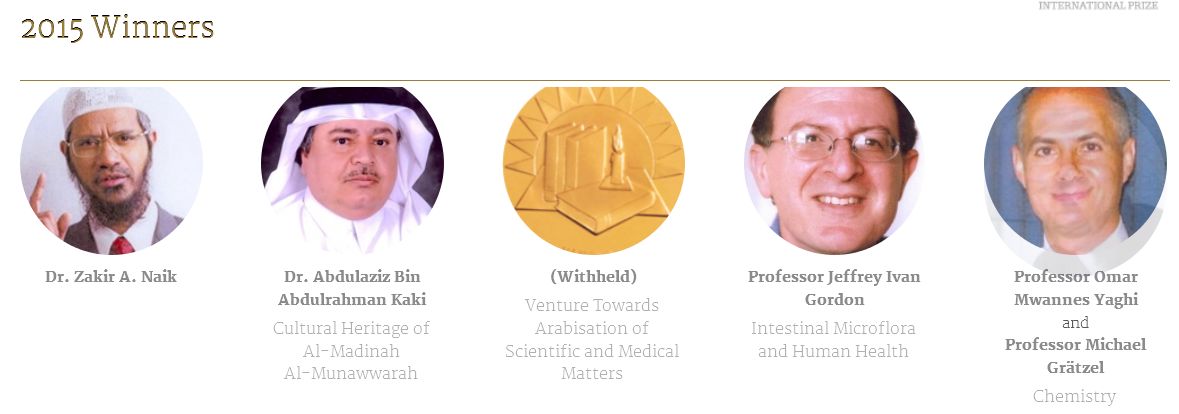
Winners of the 37th annual King Faisal International Prize (KFIP) were presented to His Majesty King Salman bin Abdulaziz Al Saud in early March. The award ceremony is one of the most important events of the year for the King Faisal Foundation, the philanthropic organisation established in 1976 by the children of the late King Faisal bin Abdulaziz, in commemoration of their father.
This year's award winners were Dr Zakir Naik for Service to Islam; Dr Abdulaziz Bin Abdulrahman Kaki for Islamic Studies; Professor Jeffrey Ivan Gordon for Medicine; and Professor Michael Grätzel and Professor Omar Mwannes Yaghi, who were jointly recognized for Science.
 |
| Source: King Faisal Foundation. King Salman Bin Abdulaziz hands over the award to Dr (Engineer) Abdulaziz Bin Abdulrahman Kaki. |
Dr Abdulaziz Bin
Abdulrahman Kaki from Saudi Arabia, Consultant at Al-Madinah Al-Munawwarah Development
Commission, was awarded the King Faisal International Prize in
Islamic Studies for his distinguished research on the cultural heritage of Al-Madinah
Al-Munwwarah. This is best demonstrated by his multi-volume Arabic text
on architectural and historic landmarks of Al-Madinah Al-Munawwarah,
particularly volume seven which deals with the foundations and
characteristics of the ancient architectural fabric of the city. In this
research, the author combines cultural dimensions with field work and
supports his study with various illustrations including old and modern
images, maps and other illustrations, making it a major reference in the
field.
Dr Zakir Naik, President of the Islamic Research Foundation in India, was awarded
the King Faisal International Prize in recognition of his services to Islam, including the following:
- Presenting hundreds of public lectures and debates which explain the Islamic creed, defend its teachings and propagate its principles on the basis of the Holy Quran and authentic sunnah*
- Shared his expertise on comparative religion. His religious knowledge extends to other religions including Christianity, Hindu, Judaism, Buddhism and Sikhism. He has also established a specialised organisation for comparative religious studies and organised several training courses for scholars of this field worldwide
- Founded a television channel, Assalam (Peace), which remains the only television channel in the world specialising in comparative religion. Its programs are broadcast in English, Urdu and Bangali and viewers of the English channel are estimated to exceed 100 million.
- Established a series of schools, initially in India and subsequently in a number of Arabic and Islamic countries. These schools train non-Arab students from an early age in Arabic language and Quranic studies, in addition to regular classes of other curricula in English.
The establishment of the King Faisal Foundation, and the inception of the King Faisal International Prize as one of the Foundation's projects, drew from the humanitarian values of Islam, which King Faisal championed throughout his life. The prize seeks to realise some of his aspirations for the progress of mankind, and particularly his desire to emphasise the role of Arabs and Muslims towards that progress, recognising the outstanding works of individuals and institutions in five categories: Service to Islam, Islamic Studies, Arabic Language and Literature, Medicine, and Science. No prize was awarded in the Arabic Language and Literature category this year.
Over the past 37 years, a total of 234 scholars from 42 countries have been awarded the King Faisal International Prize, with 17 winners also awarded the Nobel Prize.
Over the past 37 years, a total of 234 scholars from 42 countries have been awarded the King Faisal International Prize, with 17 winners also awarded the Nobel Prize.
Subscribe to:
Posts (Atom)