Showing posts with label Cultural. Show all posts

Friday, 25 May 2018

Esplanade’s Pesta Raya reinterprets traditional Nusantara arts

The 17th edition of Esplanade – Theatres on the Bay’s Pesta Raya – Malay Festival of Arts returns from 12 to 15 July 2018, coinciding with the celebration of Hari Raya Aidilfitri, which extends till mid-July.

This year, the festival showcases the history of the Nusantara. Said Fezhah Maznan, Programmer, The Esplanade Company, “Pesta Raya has always celebrated the rich Malay heritage, arts and culture from the region, and through the festival we hope to continue forging meaningful relationships with the artists and our audiences. This year, we have works which highlight the Malay identity, with thoughtful re-imagining of Malay folklore and characters in our festival commission Alkesah, and fresh re-interpretations of the traditional keroncong and dikir barat.

"We also look back and pay tribute to the rich history of Malay dance in Singapore, with a special performance by Sriwana. We hope that many will find ways to connect with the diverse programmes at the festival and immerse themselves in some of the very best the Nusantara can offer.”

Dikir barat is a traditional musical form that involves singing in groups, while keroncong is both the name of a musical instrument and the name of an Indonesian musical style.
 
Festival commissions

• Written by Zulfadli Rashid and helmed by director Aidli Mosbit, this year’s festival commission Alkesah (“as the story goes”) re-imagines Malay folklore. Beloved characters such as Mat Jenin (the hopeless dreamer), Sang Kancil (the mouse deer), Pak Belalang (the village astrologer) and more, come together in Kampung Alkesah in a tale of misfortune, survival and secret love.

This is the first time the festival is commissioning a Malay pantomime at the Esplanade Theatre Studio, and will feature a stellar cast including Siti Khalijah Zainal, Jeff Catz, Siti Hajar Gani, Hatta Said and more. Alkesah will also see musical theatre veteran Elaine Chan and vocal coach Babes Conde working for the first time on a Malay production.

• Another first for the festival is a commission for a non-ticketed performance, GhaMuhyi: Melampaui Sempadan Ghazal, which will open the festival at the Esplanade Outdoor Theatre on 12 July. This collaboration melds contemporary ghazal by the ensemble GhaMuhyi from Malaysia and the work of Singapore traditional Malay music groups Sri Mahligai and Orkestra Sri Temasek.

• Dress vintage and joget during Pesta Berpesta at the Esplanade Annexe Plaza and Annexe Studio on 14 July with popular music from the ’60s to the ’80s. The Esplanade presents Tarakucha!, a kebaya jazz performance conceived by Malaysian singer and actor Sean Ghazi. The event will feature original compositions and songs by P Ramlee, Sudirman and Jimmy Boyle.

There will be free performances by NADA (comprising Singapore musicians Rizman Putra and Safuan Johari), who will present a contemporary visual arts and sound project that specialises in conjuring up lost eras through music, as well as Indonesian duo Iramamama who will be playing nostalgic tunes and quirky sounds, from funk to post-punk music from their home country.

• Singapore-born Kuala Lumpur-based singer-songwriter Imran Ajmain, who sang the hit Seribu Tahun, celebrates a decade in music with a concert, First 10 Years, at the Esplanade Recital Studio. He follows in his father Ahmad Husaini Ajmain’s footsteps, writing for an array of Singaporean and Malaysian musicians such as Taufik Batisah, Hady Mirza, SleeQ and more. Besides featuring songs from his upcoming album, Imran will also be singing hits from the ’70s and ’80s which his father penned.
 
• Inspired by Indonesian folklore, guitarist Addy Cradle has written an epic love saga about a prince and a warrior princess. In Transcendence – The Legend of Ryu Wuri at the Esplanade Recital Studio, Addy provides the instrumental backdrop to his dark tale where visual artist Muhammad Izdi and video artist Wu Jun Han add to this multidisciplinary performance. This will be the first of three volumes that features a fusion of rock and traditional music from China, Indonesia, Japan and India.

• Trace the history of Malay dance with Singapore’s oldest Malay performing arts group Sriwana as they present Lenggang Legenda: Merintis Sejarah on 13 July at the Esplanade Outdoor Theatre. The audience will be treated to iconic dances by the company that has produced the who’s who of the Singapore Malay dance scene, including Som Said, Osman Abd Hamid, Rizman Kassim and more.

The Classic Tarian Workshop by Sriwana on 14 July will be conducted by Ibu Surianty – also known as Mdm Lim Ah Choon – the Indonesian dance teacher who introduced repertoires of zapin and other Malay dances to Singapore in the ’60s.

• In their first-ever concert in Singapore, and fresh from performing on Astro’s singing competition Gegar Vaganza 2017, Dua Diva features ’80s pop diva Aishah and ’90s sensation Liza Hanim. With music direction by composer Datuk Ramli MS, who was also the judge of Gegar Vaganza, this one-night only performance will see them performing their own songs and also together.

• With 26 albums over the course of their 24-year career, Indonesian pop rock band GIGI returns to Singapore after seven years to perform classics such as 11 Januari, Terbang, Andai and Kepastian Yang Ku Tunggu. 

Screen capture from the Pesta Raya page on the Esplanade website, featuring theatre, music and dance acts as well as workshops.

• Combining Javanese and Western music traditions keroncong is widely believed to be a genre brought to Indonesia by the Portuguese, evolving to become the ukulele, guitar, violin, flute, cello and bass ensemble that many recognise today. For Pesta Raya, Indonesian composer Pak Liliek Jasqee leads his ensemble to pay homage to the musical, cultural and language ties between Indonesia and Singapore in Titian Nada Persaudaraan. Singapore jazz artist Rudy Djoharnaen will also perform familiar tunes and new compositions with the ensemble.

• The festival continues to feature programmes for the young and their families, including Walang Weh, a storytelling performance by the musicians and vocalists of RENTA Collective, Dek Hujan, a performance by P7:1SMA that combines spoken word, dance and soundscapes, as well as Kemas (a Malay term that means “tidy up”), a series of roving site-specific movement pieces performed at venues around Esplanade that examines everyday cleaning rituals as engaging and spiritual chores.

• At the Esplanade Outdoor Theatre, Ceria! Konsert Si Cilik returns this year where Singapore’s Malay children's songs are celebrated in a concert featuring performers between the ages of 10 to 16.

• Over at Esplanade’s dedicated space for children and families—PIP’s PLAYbox—will feature interactive storytelling sessions by Dalifah Shahril, who will also share more about how the sarong plays a significant part of Malay culture and identity, as well as sessions where children will also be able to craft their own kuih-muih (desserts).

• Following previous editions of Dikir Battle, this year’s festival offers another interpretation of the traditional art form of dikir barat. Dikir-pella by JUARA will showcase for the first time, classic dikir songs sung acappella by some of the finest singers in the scene.

• Back by popular demand, Pasar Pesta! curated by online shopping hub LalooLalang returns with a wide range of traditional handicraft as well as specially curated food vendors selling “instagram-able” and unique Malay food items.

Details:

Tickets for Pesta Raya – Malay Festival of Arts 2018 are available from Esplanade’s Box Office at Mezzanine level (call +65 6828 8377), the SISTIC Hotline (call +65 6348 5555) and all SISTIC outlets.

Get programme details

Follow Facebook updates

Sunday, 21 May 2017

Emaar creates waterfront dining and cultural experience for Ramadhan

Source: Emaar. Emaar marks Ramadhan with Ramadan Nights at RISE - Dubai Creek Harbour.

Emaar Properties is marking the spirit of togetherness with an inspiring experience at Dubai Creek Harbour with its spectacular views of the Dubai skyline. Ramadan Nights at RISE - Dubai Creek Harbour is a dining experience for iftar and suhoor that includes cultural performances from regional talent.

Enjoy a buffet with an array of Arabian delights accompanied by international dishes together with the ambient work of music composer and qanun player Khalil Ghadri.

Throughout Ramadhan visitors to Ramadan Nights at RISE - Dubai Creek Harbour can also participate in workshops such as making Eid Cards and assembling Ramadhan gift hampers to learning how to create Islamic geometric patterns. There are book readings for children, board games for adults and a curated pop-up store featuring home décor, accessories, gifts and fashion.

Interested?

Ramadan Nights at RISE - Dubai Creek Harbour 
RISE at Dubai Creek Harbour
Ramadhan
Sunday to Wednesday: Sunset to 2am
Thursday to Saturday: Sunset to 3am
Iftar AED140, suhoor AED125

Thursday, 1 September 2016

Upcoming events discuss how Muslims can coexist in modern multicultural times

Source: Muis Facebook page. Poster for talk on Muslims in contemporary world.
Source: Muis Facebook page.
Two upcoming events focused on how Muslims can co-exist in a contemporary, multicultural world have been organised.

Through the Adult Islamic Learning (ADIL) programme, the Office of The Mufti is organising a half-day closed-door knowledge retreat session, Muslims in Contemporary World, on September 10. Admission is free.

The ADIL Knowledge Retreat will discuss how Muslims in Singapore can stay faithful to religious values while fulfilling the demands of the modern society, including handling new challenges that come along the way, including radicalism and terrorism propagated by a minority. Questions discussed include:
  • What does it mean to be a Muslim in the contemporary world?
  • How do we reconcile our religious values and fulfilling the needs of the modern society?
  • How do we examine the roots as well as the manifestations of the extremist thoughts?
  • How can we co-exist confidently in the existing economic and political system?
  • How can we project the faith of Islam as a positive force for humanity?
There are two speakers for the event. Ustaz Dr Nazirudin Mohd Nasir is Director, Religious and Policy Development, Islamic Religious Council of Singapore (MUIS). He recntly completed his Dr of Philosophy degree  at St Cross College, Oxford, in the comparative study of the Abrahamic religions.

Ustaz Dr Mohamed Bin Ali is Assistant Professor at Studies in Inter-Religious Relations in Plural Societies (SRP) Programme, S. Rajaratnam School of International Studies (RSIS), Nanyang Technological University (NTU), Singapore. His areas of research include Islamic jurisprudence, Islamist ideology, religious extremism, inter-religious relations and rehabilitation of Muslim extremists. Dr Mohamed obtained his Bachelor of Arts in Islamic Jurisprudence from Al-Azhar University in Cairo, Egypt in 2002, Masters of Science in International Relations at RSIS, NTU in 2007 and Dr of Philosophy in Arab and Islamic Studies from the University of Exeter, UK in 2013.

Register
Date: September 10, 2016
Time: 9am to 1pm
Venue: Al Ansar Mosque, 155 Bedok North Avenue 1 

Source: Muis Facebook page. Poster for a lecture on interfaith relations.
Source: Muis Facebook page.
This year's Abdul Aleem Siddique Memorial Lecture is happening on Friday, 16 September 2016. Ustaz Dr Nazirudin will discuss Revisiting Interfaith Relations in a Postsecular Age, specifically whether religion coexisting with secular cultures change the dynamics of interreligious relations. This could mean that differences between faiths become accentuated, and pose a challenge to interfaith leaders and especially youths who want to ensure interfaith relations remain healthy.

Using examples from the interaction between religion and science as well as religious ethics on socio-political issues, Ustaz Dr Nazirudin will address these questions as part of reflecting on the next phase of interfaith relations in Singapore.

Register or visit the organiser, the Harmony Centre, to find out more. The Centre represents one of the key initiatives of MUIS to bring about a greater understanding of Islam and Muslims amongst the multiracial and multireligious society of Singapore. 

Date: September 16, 2016
Time: 6pm to 9.30pm
Venue: Singapore Islamic Hub - Annex Building level 4, 273 Braddell Road

Hashtag: #OfficeofMuftiSG

Monday, 18 April 2016

Sheikh Zayed Book Award names Amin Maalouf Cultural Personality of the Year 2016

Source: Sheikh Zayed Book Award. Amin Maalouf, French novelist.

The Sheikh Zayed Book Award’s board of trustees and scientific committee have named Lebanese-born French novelist Amin Maalouf as their winner for this year’s Cultural Personality of the Year Award in recognition of his achievements as a novelist. 

The Award recognises Maalouf’s ability to recreate unique experiences and adventures in an extraordinary literary style that amalgamates distinctly Arabic narrative and modernist Western styles in creative works and intellectual research. Maalouf’s treatment of themes that touch upon modern-day fears and concerns, in intricate poetic and narrative forms, secured his indisputable position within the literary world, and informed the decision by the Sheikh Zayed Book Award to name him Cultural Personality of the Year, according to a statement from the award organisers.

Maalouf holds a degree in economics and sociology from Beirut University. He worked in the Beirut-based daily Al-Nahar, reporting on international and political affairs. He had firsthand experience of the Lebanese civil war, and then moved to Paris with his wife and children, where he worked for the weekly newspaper Al-Nahar Al-Arabi and at the French Jeune Afrique.
Maalouf has conveyed in French some key moments in the history of Arab and other Eastern peoples to the world, shedding light on distinguished personalities dedicated to promoting harmony and dialogue between the East and the West. His works are characterised by a consistent array of themes ranging from his civil war experience, constant search for identity, cultural tolerance, and world citizenship. The themes are embodied in his characters, most of whom speak several languages, master more than one talent, and enjoy multiple citizenships. Several characters in his novels are victims of circumstances (migration, war, and unremitting suffering); nevertheless, they are able to reinvent their own destinies, relying on their talent and belief in their high human values.

His first book in French, The Crusades through Arab Eyes (1983), revealed his fundamental interests: history on one hand, and narrative writing on the other. Back then, the Crusades were a central theme in French historical studies and literary texts based on history, but they were rarely presented from an Arab perspective. Maalouf‘s book presented the Crusades as experienced by the Arab community in its various segments and affiliations. He followed a strictly objective approach founded on a humanism that pervades all his work. The Crusades were not merely wars of religion as they are sometimes taken to be; they were cultural clashes whose impact can still be witnessed today.

Maalouf has continued to make use of history in his fiction and to employ his narrative skill in his historical studies. He has published a number of novels based on history, including Leon Africanus (1986), Samarkand (1988), The Gardens of Light (1991), and The Rock of Tanios (1993). 

Interested?

The award ceremony will take place on May 1, coinciding with the Abu Dhabi International Book Fair. Maalouf will receive a prize of AED1,000,000, a gold medal bearing the Sheikh Zayed Book Award logo, as well as a certificate of merit.

Tuesday, 9 February 2016

Browse Archaeological Survey of India exhibits online

Source: Google Cultural Institute. A 360-degree exploration of the Taj Mahal is available at the Archaeological Survey of India minisite at the Google Cultural Institute.

The Archaeological Survey of India is part of the Google Cultural Institute, enabling Internet users to view historical photographs of various landmarks online, including photographs of the Taj Mahal from the late 1800s up to the present day, views of various mosques, including the Qutubuddin Mosque and the Moti Masjid, and several perspectives of Humayun's Tomb.

The Archaeological Survey of India (ASI), under the Ministry of Culture of India, is the premier organisation for archaeological research and the protection of the nation's cultural heritage.

Interested?

Visit the Archaeological Survey of India at the Google Cultural Institute, including the 360 degree museum views of the Taj Mahal

Read the Suroor Asia blog post on the al Sabah Collection at the Google Cultural Institute

Monday, 4 January 2016

View the al Sabah Collection at the Google Cultural Institute

Rectangular emerald stone, w3.35 x h2.92 cm, inscribed with seven lines of 'naskhi' script from the Quran (2:255).
Source: al Sabah Collection, from the Google Cultural Institute. Captioned. 'Inscribed Royal Gemstone, 1,001 AD'. Rectangular emerald stone, w3.35 x h2.92 cm, inscribed with seven lines of 'naskhi' script from the Quran (2:255). View this item online.

The al Sabah Collectionregarded by international authorities as one of a small handful of the most comprehensive collections of Islamic art in the world.  has 48 items available for viewing online via the Google Cultural Institute.

The Collection was begun in 1975 when Sheikh Nasser Sabah al Ahmed al Sabah purchased a mid-14th century enamelled glass bottle from a London art gallery. Curated by Sheikh Nasser and his wife Sheikha Hussah Sabah al Salem al Sabah, the Collection was moved in 1983 from Sheikh Nasser’s private residence to a new location at the Kuwait National Museum. The building became known as Dar al Athar al Islamiyyah (DAI), and Sheikha Hussah became the organisation’s Director General. Since its inception in 1983, DAI has diversified from managing the loan of the al Sabah Collection of art from the Islamic world to the State of Kuwait to becoming an internationally-recognised cultural organisation.

The Collection has now grown to more than 30,000 objects representing the full geographic and chronological range of the Islamic world, from Spain to China, from the 7th to 19th centuries. It features all aspects of art, including arms and armour, calligraphy, carpets and textiles, ceramics, coins, ivory, jewellery, extraordinary manuscripts and miniatures, metalwork, scientific instruments, stone and stucco, wood and glass. The Collection actively publishes volumes focused on its holdings, organises special exhibitions, and loans objects to exhibitions elsewhere in the world.

Interested?

View the Suroor Asia blog post on the Google Cultural Institute and the Aan Collection


Thursday, 3 December 2015

Arabic hospitality with coffee named as an intangible cultural heritage for humanity

The UNESCO committee for the safeguarding of intangible cultural heritage meeting in Namibia has inscribed 20 new elements on the Representative List of the Intangible Cultural Heritage of Humanity. The Representative List includes forms of expression that testify to the diversity of the intangible heritage and raise awareness of its importance. The review of nominations for inscription on this list is finished for this year, which saw 23 elements inscribed out of a total of 35 that were proposed.

The following elements were some of those inscribed on December 2:

Azerbaijan - Copper craftsmanship of Lahij
Copper craftsmanship of Lahij is the traditional practice of making and using copperware in the Lahij community of the Caucasus. The copper-smelting master prepares the copper which the coppersmith-hammerer then moulds it into thin plates. A craftsperson engraves the plates with designs that represent their environment and reflect traditional knowledge and values. People from Azerbaijan buy the copperware for daily use. The practice is transmitted from father to son and said to be a clear marker of Lahij identity.

Kazakhstan, Kyrgyzstan - Aitysh/Aitys, art of improvisation
Aitysh/Aitys is a contest between two people on poetry improvisation spoken or sung to music of traditional instruments like the Kazakh dombra. The audience chooses the topics and the contestant who demonstrates the best musical skills, rhythm, originality and wit wins. Aitysh/Aitys is a popular cultural component and identity marker of bearer communities in multiethnic societies of Kyrgyzstan and Kazakhstan, featuring at local festivities or nationwide events often to raise important social issues. Transmission is from older to younger generations.

Saudi Arabia - Alardah Alnajdiyah, dance, drumming and poetry in Saudi Arabia
Alardah is a traditional cultural expression combining dance, drumming and poetry chanting that is considered fundamental to practising communities. It involves a poet chanting verses, which are then sung by other performers carrying swords and moving in time to beating drums. Featured at family, local and national events, it is performed by males while women design the costumes. Neither age nor class acts as a barrier to participation, assisting social cohesion. Practice transmitters are individuals, schools, troupes, neighbourhoods and provinces.

Turkmenistan - Epic art of Gorogly
The epic art of Gorogly is an oral performing tradition that describes the achievements of legendary hero Gorogly and his 40 cavalrymen. Practitioners are performers in Turkmenistan who specialise in the epic, which incorporates narration, singing, poetry, vocal improvisation and music. It gives bearer communities a strong sense of identity, reflecting aspirations of the Turkmen people for a happy life and promoting values such as bravery, honesty, friendship, and fairness. Masters combine informal teaching with skills transmission during public performances.

UAE, Oman - Al-Razfa, a traditional performing art
Al-Razfa is a traditional performing art of the United Arab Emirates and Sultanate of Oman that was initially used in victory celebrations. Now, it is a popular form of communal entertainment seen at festive events, involving groups of men holding wooden replica rifles chanting verses, often featuring traditional Nabati poetry, to music.  To appeal to a younger audience, instruments and music have been adapted. Skills transmission is informal within families.

P1060441
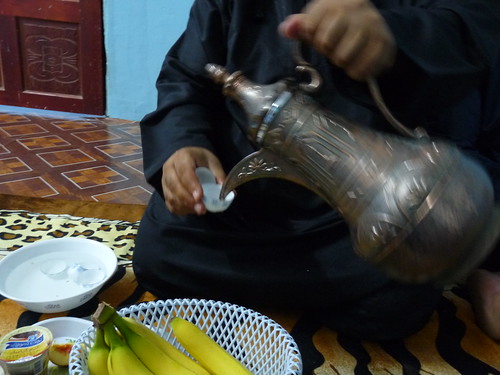
In the act of serving coffee, or qahwa, in a majlis in Oman, with a traditional coffee pot. The coffee cups are traditional Chinese tea cups. Qahwa is traditionally offered with dates to balance the bitter taste. Fresh fruit is also served.

UAE, Saudi Arabia, Oman, Qatar - Arabic coffee, a symbol of generosity
Serving Arabic coffee is an important aspect of hospitality in Arab societies. Traditionally prepared in front of house guests by men and women, it is also served by sheikhs and heads of tribes. The beans are roasted, ground with a mortar and pestle then brewed in a pot. The most important or oldest guest is served first. The practice is passed on within families and includes young people visiting the market with their elders to learn how to select beans.

UAE; Saudi Arabia; Oman; Qatar - Majlis, a cultural and social space
Majlis (sitting places) are community spaces where people discuss local issues, settle disputes, exchange news and be entertained, playing an important role in the transmission of oral heritage. The areas are usually large, comfortable and equipped with beverage-making facilities. Elders with extensive local knowledge are the main practice bearers, while judges and religious sheikhs adjudicate on disputes. Women have their own Majlis, although prominent figures may attend others more academic. Practice transmission occurs when children attend with older community members.

Interested?

Get the recipe for Omani coffee

Saturday, 28 November 2015

ISESCO, International Turkic Academy sign MoU

Source: ISESCO.
A Memorandum of Understanding was co-signed between the Islamic Educational, Scientific and Cultural Organization (ISESCO) and the International Turkic Academy in Baku, Azerbaijan, alongside the plenary session of ISESCO 12th General Conference.


The MoU was co-signed for ISESCO by its Director General, Dr Abdulaziz Othman Altwaijri, and for the International Turkic University by its President, Dr Darkhan Kydyrali. It provides for cooperation to drive progress in the areas of education, science, culture and communication, promote mutual understanding between peoples, contribute to peace and security, stimulate research in areas of common interest, and ramp up support for national and regional efforts toward sustainable development goals.

Monday, 9 November 2015

Explore works from Pakistan in the Aan Collection via the Google Cultural Institute

Source: Google Cultural Institute website.

The Google Cultural Institute has placed images of artworks, collections and stories from around the world online so that they can be explored in detail and shared socially.

One such collection is the Opening Exhibition of the AAN Collection on the Google Cultural Institute, Pakistan, Moment/Momentum – Contemporary Art From Pakistan, which debuted in April 2015. The exhibition focuses on the works of Modernist Zahoor-Ul-Akhlaque and the contemporary artists who followed his lead. The exhibition included the works of Ul-Akhlaque and the contemporary artworks of Shahzia Sikander, Imran Qureshi, Rashid Rana, Aisha Khalid, Naiza Khan and Faiza Butt.

Believed to be the largest and most comprehensive collection of Pakistan visual art to date, the AAN collection is a private collection of Asian art primarily focused on Pakistani modern and contemporary art. The collection consists of works ranging from third century Gandhara to contemporary artworks.

The title of the collection, ‘AAN’, is derived from an Urdu word (Aan) and literally means both ‘honour’ as well as ‘a moment’. The title also fits in well with the acronym of the collectors names. The collection honours the tradition, creativity and ingenuity of Pakistani artists.

There are sculptures, works on paper and canvas, photographic works, video installations, light boxes and other new media works in this collection. The largest work is Desperately Seeking Paradise by Rashid Rana, a cubic sculpture which reaches over ten feet in height, while the smallest works are Mughal miniatures painted on ivory as well as contemporary miniatures by Ahsan Jamal which are 3" in diameter.

According to the collectors, “What makes it such a unique as well as robust collection is that the works have been collected because we loved them and with a vision to capture the art of those before us as well as of those artists who live and work in this time. A snapshot of the time we exist in as well as a nod to our past."

Sunday, 28 December 2014

Sheikh Zayed bin Sultan Al Nahyan Cultural Centre officially open in Ningxia

The Sheikh Zayed bin Sultan Al Nahyan Cultural Centre and Mosque in Wuzhong city, Ningxia autonomous province, China, has been officially opened, WAM, the Emirates News Agency said.

At the ceremony Professor Zhou Yu Dong, Deputy Ruler of Ningxia, thanked the UAE, led by President His Highness Sheikh Khalifa bin Zayed Al Nahyan, for the donation to build the Sheikh Zayed bin Sultan Al Nahyan Cultural Centre and a mosque in province, pointing out that the project would contribute towards achieving stability and ensuring settlement of the region's displaced inhabitants, who are minority Muslims.

He also highlighted the level of the Chinese-UAE bilateral relations, extending an open invitation to the Emiratis to exchange visits and cooperate with Ningxia. He said that Ningxia, as per the strategy of the Chinese government, is deemed an important gateway for cooperation with Arab and Islamic countries.

In response, Omar Ahmed Adi Nasib Al Bitar, UAE Ambassador to the People's Republic of China, extended thanks to the Ningxia government for cooperation with the UAE citizens to contribute in providing for humanitarian projects in the province, stressing the UAE's keenness on enhancing cooperation in all domains with China in general and Ningxia in particular.

The mosque, which will provide services to Ningxia Muslims in particular and China in general, will accommodate more than 1,200 male and 300 female worshippers, school classrooms, housing apartments and other services. The construction of the mosque was completed in a record time of under nine months.

Dubai's Islamic Affairs and Charitable Activities Department in Dubai (IACAD) separately took delivery of the Ali bin Abi Talib Mosque at Safa (1) District, WAM added.

Mohammed Saeed Al Muhairi, Head of Mosque Affairs Committee, IACAD, said the mosque, built at the expense of Abdullah Rashid Al Suwaidi, will accommodate 630 including a prayer corner which can accommodate 97 ladies.