Showing posts with label China. Show all posts

Saturday, 18 July 2026

New at SIAL Guangzhou: a Halal Food Village

Source: Comexposium-SIAL Exhibition Company. Poster for SIAL Guangzhou.


New initiatives planned for SIAL Guangzhou in 2026 include a Halal Food Village, reflecting rising demand from Muslim consumers across Southeast Asia, South Asia, and the Middle East as well as growing interest from retailers and foodservice operators looking for certified products with international potential. 

The village will showcase halal-certified products from China's major Muslim food-producing regions, including Xinjiang and Gansu, alongside international exhibitors and country pavilions, including from Thailand. 

With Indonesia, Malaysia, Bangladesh, Pakistan, and Gulf markets continuing to expand on halal food imports that respond to mainstream expectations around quality, convenience and innovation, the segment is expected to become one of the exhibition's fastest-growing categories. 

According to the organisers, the halal category also overlaps with clean labelling, traceability, premiumisation and food safety, all themes that resonate beyond Muslim-majority markets. 

Taking place from 3 to 5 September 2026 at the Guangzhou Poly World Trade Center Expo, SIAL in Guangzhou arrives at a time when international buyers, distributors and retail procurement teams are looking more closely at supplier reliability, product differentiation and faster access to Asian growth markets.

The event is expanding to four exhibition halls this year, hosting over 1,500 exhibitors across 15 sectors. The ambition is to make South China’s edition a more prominent international sourcing platform, especially for buyers seeking export-ready Chinese suppliers and Asian market insight in the same place.

Details

SIAL Guangzhou 2026 | 3–5 September | Guangzhou Poly World Trade Center Expo, Guangzhou, China

Register at https://dwz.cn/I3xC9VAY


Tuesday, 13 November 2018

Conference on Islamic banking and finance advances China-UAE relations

The 3rd China-UAE conference on Islamic Banking and Finance (CUCIBF III) in Shanghai, China, saw delegates hailing Dubai's strides in becoming a global capital of the Islamic economy.

Source: Hamdan Bin Mohammed Smart University. The event was a collaboration between the UAE Ministry of Economy, Dubai Center for Islamic Banking and Finance of Hamdan Bin Mohammed Smart University (HBMSU), Dubai Islamic Economy Development Center, China Islamic Finance Club, and the ZhiShang Inter-culture Communication, with the participation of Thomson Reuters as a knowledge partner.
The conference discussed the prospects of the participatory economy and the financial system from the perspective of growth, development and integration, highlighting the importance of joint efforts between the UAE and China to meet the emerging challenges, and to enhance the role of Islamic finance in achieving the objectives of China's One Belt, One Road initiative.

The two-day forum focused on the present and the future of Islamic finance in the UAE and China, with a focus on China's growing economic impact in the Middle East. The session Blockchain Technologies: Opportunities and Challenges in the Participatory Economy also explored the potential of international capital cooperation in private and public sector partnerships, highlighting the need for joint financial openness and international strategic alliances in education. Another roundtable session, Sukuk and Economic Development: Opportunities and Challenges, discussed challenges and opportunities to enhance the contribution of Islamic finance tools to the success of the Belt and Road initiative.

HE Abdulla Al Saleh, Under-Secretary of the Ministry of Economy for Foreign Trade and Industry, said that the t3rd China-UAE Conference on Islamic Banking and Finance, in conjunction with the official visit of the UAE delegation to China, further strengthens the relations between the two countries and adds new momentum to the growth of bilateral trade, joint ventures and investment flows.

He added that China continues to strengthen its position as the UAE's first trading partner in the non-oil sectors, highlighting the shared interest in applying the Islamic economy model to achieve the objectives of the Belt and Road initiative. This will stimulate and guide the economy to serve the sustainable development goals, underscoring the UAE’s and China’s roles as influential forces on the regional and global economic map.

He said: “The conference comes at a strategic time when economic relations between the UAE and China are growing stronger, reflected by the rise of non-oil trade in 2017 to US$53.3 billion, a growth of 15% year-on-year (YoY) and 10% over the past five years. Last year witnessed remarkable progress in terms of trade and economic relations. The UAE accounted for 30% of China's total exports to Arab countries and 22% of the total Arab-Chinese trade. The discussions were extremely fruitful and focused on ways to overcome the current and emerging challenges facing the Islamic finance sector.

"These sessions highlighted the UAE’S pioneering experience in developing the Islamic economy, with the unlimited support from wise leadership, while also enabling Chinese companies to access investment and learning opportunities, education and knowledge related to the Islamic economy. We look forward to building bridges with our counterparts in China to develop strategies and frameworks that further strengthen the Islamic economy, which is expected to grow at an annual rate of 8% to reach US$3 trillion by 2023, globally.”

Dr Mansoor Al Awar, Chancellor of HBMSU, emphasised the importance of the conference’s 3rd edition as a reflection of the strong relationship between China and the UAE, pointing out that it is a great step towards strengthening the strong economic ties between the two countries. This is further underscored by the historic visits made by GG Sheikh Mohammed bin Zayed Al Nahyan, Crown Prince of Abu Dhabi and Deputy Supreme Commander of the UAE Armed Forces; and the Chinese President Xi Jinping, who agreed to establish a comprehensive strategic partnership and to deepen cooperation within the Belt and Road initiative to achieve shared goals.

Al Awar expressed his happiness in the success of strategic discussions, which reflected the concerted efforts of the UAE and China in supporting the global Islamic economy. He noted that the economy is currently experiencing an accelerated annual growth rate of 8%, reinforcing its role as one of the key sectors of the future.

He cited HH Sheikh Hamdan bin Mohammed bin Rashid Al Maktoum, Crown Prince of Dubai, Chairman of the Executive Council and General Supervisor of the Dubai The Capital of the Islamic Economy strategy, who said: “We look forward to effective dialogues on the alternatives needed to promote the growth of the Islamic economy and to explore the opportunities that support sustainability from a global perspective.”

"The event provided an ideal platform to highlight the competitiveness of the UAE in playing a pivotal role in the achievement of the Belt and Road initiative’s objectives. Its position as a link that connects the East to the West, and as an important centre for the re-export of Chinese imports to the world, particularly Africa and Europe, supported by infrastructure, sophisticated economic growth and a vibrant cultural environment play key roles in this,” he said.

“The 3rd edition of the forum was an ideal platform to discuss the opportunities arising from the expansion of China's economic influence in the Middle East, which will drive the growth of Islamic finance in the Chinese market. This was held at a time when the Islamic finance sector is attracting unprecedented global attention as an integrated system that provides innovative and supportive models for economic growth, based on feasible alternatives of investing in the traditional financial system, which have been strongly affected by the global financial crisis.

"It also strengthens the UAE-China relations in the banking and finance sector, which has more than 1,000 institutions in 75 countries around the world, as part of our confidence in the prospects of both countries, with unlimited government support to invest in new sectors that will mark the beginning of a new phase of growth, sustainability and prosperity."

Two agreements were signed at the event. The first was between HBMSU and the ZhongGuanCun the Belt and Road Industrial Promotion Association (ZBRA); the China Islamic Finance Club (CIFC); and Xunlei to promote cooperation between China and the UAE in innovation and entrepreneurship research, education, training, artificial intelligence (AI) and Blockchain technology, sustainable development and exploring new horizons to promote innovation in environmentally-friendly technology in the future. Xunlei is known for its peer-to-peer downloading software, and began offering Blockchain products in 2017.

The agreement was signed by Chin Lee, CEO of XunLei, China; Zhang Xiaodong, President of Zhongguancun the Belt and Road Industrial Promotion Association, China; Huang Lei, CEO of the China Islamic Finance Club; and Professor Nabil Baydoun, Vice Chancellor for Academic Affairs, HBMSU.

All parties highlighted the need to promote international innovation for young people and entrepreneurs under the joint agreement. The partnership establishes solid foundations for promoting dialogue, communication and cooperation between countries to support innovation, leadership spirit and excellence and building the capacities of young people in the world, in line with the requirements of the 21st century.

The Shanghai Overseas Education Exchange Center and the China Islamic Finance Club (CIFC) signed another agreement to explore the prospects for cooperation in education and student exchange to support the Belt and Road initiative, through the development of human capital in the participatory economy, providing education, training, research and development and dissemination of international best practices using virtual learning environment and lifelong learning approach.

The agreement was signed by Zhang Minhua, Director of the Shanghai Overseas Education Exchange Center; Huang of the China Islamic Finance Club; and Professor Nabil. Both parties emphasized their commitments to facilitate the exchange of faculty and students, exchange of knowledge, experience and best practices, through organising conferences and interactive workshops.

Professor Nabil, Vice Chancellor for Academic Affairs of HBMSU, said: “The 3rd China-UAE Conference on Islamic Banking and Finance has once again established itself as an important international forum to explore the future of the participatory economy by taking advantage of the leading position of the UAE and China with a focus on unifying joint efforts to drive the growth of the assets of the global Islamic finance industry, which is expected to reach US$4 trillion by 2020.

"The outcome of the event was equally ambitious, as it resulted in the creation of strategic partnerships and the establishment of a clear roadmap to advance the growth of the Islamic economic system based on the optimal investment in education, training, development and research, which are all important components in building a human capital with technical expertise, knowledge and practical skills to direct the economy towards new levels of excellence, growth and leadership.

"We look forward to utilising our expertise at Hamdan Bin Mohammed Smart University in serving international efforts to improve the state of Islamic banking and finance, with a focus on knowledge, science and strong will to envision the future of the economy and to enhance Dubai’s position as the world capital of the Islamic economy.”

Sunday, 14 May 2017

Katara offers Arabic calligraphy exhibition and workshops by Chinese artists

Source: Katara Twitter account. Poster for the Arabic Calligraphy by Chinese Artists Exhibition and Workshop.
The Cultural Village Foundation-Katara has put together the Arabic Calligraphy by Chinese Artists Exhibition and Workshop at the Katara Art Studios.

Katara is part of a vision to position Qatar as a cultural beacon in the Middle East through activities around theatre, literature, music, visual art, conventions and exhibitions.

Interested?

Both the exhibition and the workshops will be held from 15 to 20 May. The exhibition will be held from 10am to 10pm at Building 19, Gallery 02, Katara Art Studios. The workshops will also be at Building 19, from 5pm to 9pm. Call +974 4408 0233 to register

Download the Katara mobile app

Hashtag: #Katara

Wednesday, 10 May 2017

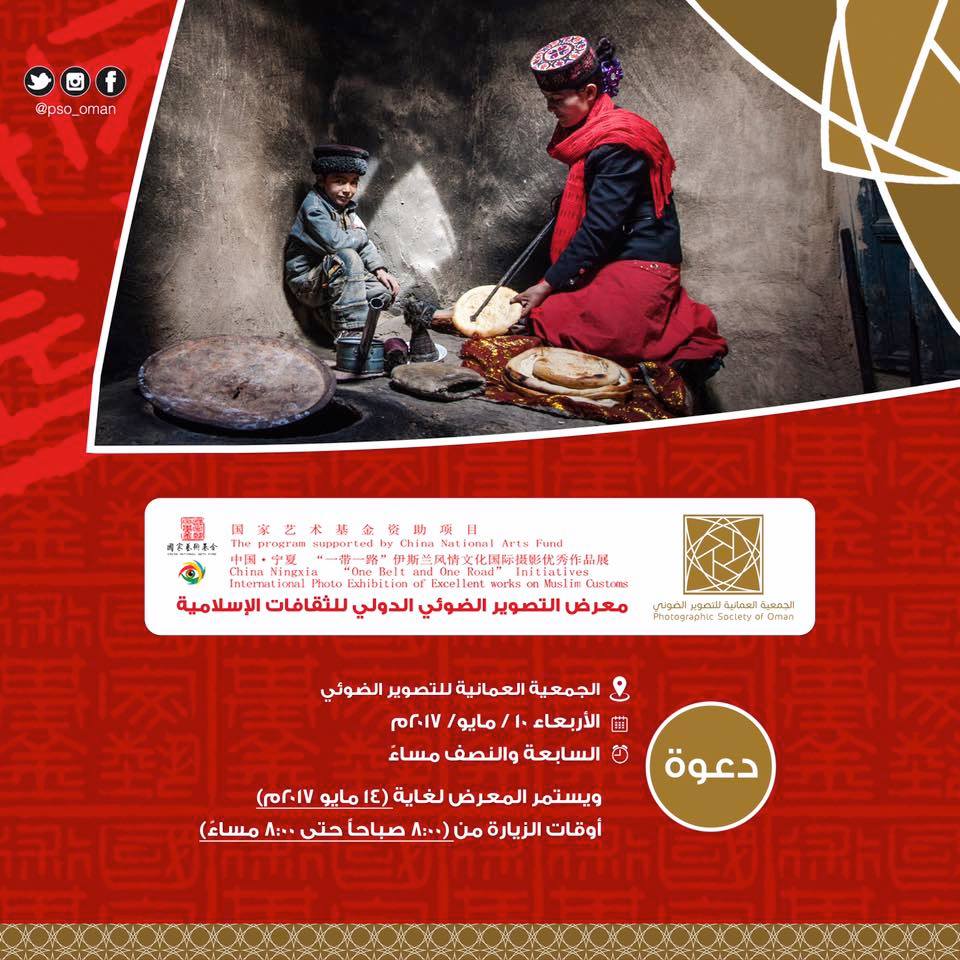
International Photography Exhibition for Islamic Cultures on in Muscat

Source: Omani Photographic Society. Exhibition poster.
The International Photography Exhibition for Islamic Cultures has opened at the headquarters of the Omani Photographic Society (OPS) at the Sultan Qaboos Higher Centre for Culture and Science (SQHCCS) under the theme One Belt, One Road, the Oman News Agency has reported.

The event, under the patronage of Dr Salim bin Shutait al-Ghanmi, Director General of Medical Services and the Diwan of the Royal Court, exhibition aims to promote cooperation among Islamic countries and to show the different religious characteristics, customs and traditions of Islamic countries.

The International Photography Exhibition for Islamic Cultures features images that reflect the Islamic culture of Asia, Africa, Europe and America. One hundred and fifty works from 50 countries are on exhibit, 35% of them from China. The exhibition also includes an introductory seminar on Muslim customs in China.

The exhibition will be travelling to other Islamic countries along the Silk Route. With its strategic geographical location, Oman is considered a key station along the route.

Hashtag: الجمعية_العمانية_للتصوير_الضوئي

Saturday, 15 April 2017

China Huiyuan Juice Group, Yeo Hiap Seng to launch halal beverages

The China Huiyuan Juice Group will launch a new juice brand, YAMI to Malaysia in conjunction with Yeo Hiap Seng (Yeo's), a well-known food and beverage company in Malaysia. It will be the Huiyuan Juice Group's first fruit juice beverage product in Malaysia.

Source: Huiyuan Juice. The first product, YAMI juices, from Huiyuan Juice and Yeo Hiap Seng.
Source: Huiyuan Juice. The first product, YAMI juices.
In March 2016, Huiyuan and Yeo's, agreed to establish a joint venture to build up a long-term strategic advantage in the international market. The joint venture, established January 2017, will take advantage of Malaysia's stable political and economic environment and enable Huiyuan to expand its business to other ASEAN countries with preferential terms on tariffs and trade while perfecting alignment with local halal product regulations. The joint venture will focus first on Singapore and Malaysia, and then expand to countries like Cambodia and Myanmar thereafter.

Huiyuan is also planning to import products that suit the Chinese market and consumers into China by taking advantage of resources from the joint venture and selling them through related channels.

By focusing on Malaysia and Singapore in its first phase of development, the joint venture established by Huiyuan and Yeo Hiap Seng will launch juice products under the joint venture brand YAMI. YAMI beverages are designed to appeal to the tastes and preferences of Southeast Asian consumers and will be sold through local sales channels related to Yeo Hiap Seng.

Huiyuan and Yeo Hiap Seng will launch their first YAMI beverage product in May. With juice content of up to 10%, the beverages will feature apple, pear, orange and white grape flavours, and will be available in 250ml tetrapaks as well as 350ml bottles. This launch will be closely followed by another functional juice beverage with the addition of iron, calcium, dietary fibre and collagen and other nutrients, which will be available in four flavours - orange, red grape, mango and grapefruit.

Tuesday, 20 December 2016

Alibaba's Tmall to offer beef from Inner Mongolia, mutton from Ningxia for Chinese New Year

Alibaba Group pulls out all the stops for the largest Chinese festival on the calendar, due to start January 28. The company has kicked off its second Ali Chinese New Year Shopping Festival (阿里年货节) with a lineup of activities that not only encourage trade between urban and rural areas.

Using its strengths in marketplace, big data and logistics, Alibaba will again connect rural communities with city dwellers so the latter can stock up on Spring Festival supplies while giving rural economies a lift.

Sun Lijun, VP, Alibaba Group, who oversees the company’s rural business division, said, “Alibaba strives to create closer connections between urban and rural areas in China, narrowing the wealth gap and improving the living standard of those who live in villages. Having launched Rural Taobao in 2014, we are continuing to do more than just promoting online trade – we are striving to serve the real needs of village dwellers by also making health services, entrepreneurial support, public welfare services and more available to them.”

Tmall.com’s fresh food channel will introduce fresh fruit and meat produce from abroad – such as cherries from Australia and orange roughies from New Zealand – to Chinese consumers. At the same time, meat from the countryside – including beef from the Horqin Grassland of Inner Mongolia and mutton from Yanchi County of Ningxia Hui Autonomous Region – will be brought to dining tables in the cities.

Saturday, 10 December 2016

IFRAS paper compares Jammu & Kashmir with Xinjiang Uyghur Autonomous Region

The International Forum for Rights and Security (IFRAS), a Canada-based think tank, has released a research paper comparing Jammu & Kashmir in India with the Xinjiang Uyghur Autonomous Region (XUAR) in China.

Jammu & Kashmir and Xinjiang Uyghur Autonomous Region - A Study in Contrasts highlights how the Indian and Chinese governments have adopted distinctly different approaches and methods to deal with comparable challenges in the two regions.

Both regions host a Muslim-majority local population, extremism, cross-border terrorism emanating from Pakistan and the disputed border. Despite special political status granted to the two regions, the study highlights that while China's Regional Ethnic Autonomy Law has proven largely ineffective in ensuring true self-governance by ethnic groups like the Uyghurs whereas the people of Jammu & Kashmir have been provided guarantees under Article 370 of the Indian Constitution, and a strong foundation on which to build a system of local governance.

The study also observes that India has not imposed the kind of controls on Muslims of the Kashmir Valley as China has done in Xinjiang.

Interested?

Read the paper

Saturday, 8 October 2016

Museum of Islamic Art focus on China in new exhibit

 Source: MIA Facebook page. The Treasures of China exhibition is on till 7 January 2017.
Source: MIA Facebook page. The Treasures of China exhibition is on till 7 January 2017. 

The Museum of Islamic Art (MIA) in Doha, Qatar is running the Treasures of China exhibition till 7 January 2017.

The famous terracotta warriors of Xian, China from the first emperor’s terracotta army are on show as part of the exhibition. Divided into The Birth of Civilisation, Ceremonies and Kingdoms, Splendid Unification, Prosperity and the Silk Road and Porcelain, Imperial China and the Royal Arts, the exhibition involves all major historical periods of ancient China and displays 116 pieces dating from the Neolithic period to the Qing dynasty, the last dynasty before China became a republic.

Islam arrived in China within 20 years of the Prophet Muhammad's death, according to Wikipedia.

The museum plans to feature carpets next year in Imperial Threads: Motifs and artisans from Turkey, Iran and India in 2017. From 15 March 2017 to 4 November 2017 visitors to the MIA can study the exchange of artistic and material cultures between the Ottoman (Turkey), Safavid (Iran), and Mughal (India) empires. Exhibits from the museum's collection will be contextualised within the politics and artistic production of their time, primarily from the 16th to the 18th centuries.

Interested?

Plan your visit

Hashtag: #TreasuresofChina

Wednesday, 24 February 2016

HK expects to issue third sukuk to finance AA projects

Hong Kong's Financial Secretary, John C Tsang, unveiled the 2016-17 Budget on February 24, saying that the city should act swiftly to identify new development opportunities as a result of a new economic order .

The government will strengthen Hong Kong's commercial connectivity to maintain the city's position as an aviation and maritime centre and support the development of high value-added logistics services. The Airport Authority Hong Kong (AA) is pressing ahead with the implementation of the three-runway system.

The government will strengthen efforts to highlight Hong Kong's edge in developing green financial products and the AA will explore the feasibility of financing through green bonds. Following the success of the two sukuk issuances over the past two years, the government plans to issue a third sukuk in a timely manner, Tsang said.

Randstad Technologies' Maggie Li, Associate Director for Banking & Financial Services, said: “Ranging from the push for the exchange-traded fund (ETF) market, profits tax exemption initiatives, further plans to issue sukuk, to the new Hong Kong Monetary Authority office to finance projects on the back of the One Belt One Road strategy, the financial services sector is set to benefit from the Government’s initiatives and see growth in various areas such as corporate treasury.”

Thursday, 4 February 2016

West Air now connects Chongqing and Singapore

Source: Changi Airport Group. A West Air aircraft.
Changi Airport in Singapore has welcomed today the addition of West Air to its family of airlines, with the arrival of the airline’s inaugural international flight from Chongqing, China. The Chongqing-based airline is operating a thrice-weekly service between Singapore and the Western Chinese city on an Airbus A320-200, with a capacity of 180 seats. The new service, which represents the West Air's first international service, comes on the back of a bilateral pledge to grow air connectivity between Singapore and Chongqing.

On 8 January 2016, Changi Airport Group (CAG), Chongqing Airport Group, SilkAir, Air China Limited Chongqing Branch, China West Air, and Chongqing Airlines entered into a six-party memorandum of strategic cooperation to enhance air connectivity between Western China and Singapore. Under this memorandum, both airports will work closely with the airline partners to mount new flights and increase flight frequencies, not just between Singapore and Chongqing, but also to boost transfer traffic via both hubs. Both airports will support the airlines to develop connectivity from cities in Western China (such as Urumqi, Xining, Lhasa) via Chongqing to Singapore, cultivating the aviation market between Singapore and relevant cities under China’s One Belt, One Road plan.

Lim Ching Kiat, CAG’s Senior Vice-President for Market Development, said, “For Changi Airport, Western China represents exciting untapped growth opportunities. Following the signing of the memorandum of strategic cooperation, we are delighted to welcome the initial fruit of our collaboration through the commencement of West Air’s operation to Changi Airport. The growth of the aviation market involves the joint efforts of both airports and airlines to stimulate and facilitate the growth of the entire ecosystem. Going forward, we will continue to work with our partners under this framework to develop air connectivity and promote both trade and tourism flow between the two cities and our respective air hubs.”

Chongqing, one of China’s four municipalities, has a wide range of activities for visitors to choose from - cruises along the Yangtze River, the Porcelain Village (磁器口), hot springs, and authentic Chongqing hotpot meals. According to CrescentRating, Islam has was introduced to Chongqing in the Yuan Dynasty (1278 to 1368).

With 32 city links to China, Changi Airport is well-connected to the country. In 2015, China continued to be a key market for Changi Airport, with 4.9 million passenger movements for the sector. Contributing about 9% to Changi’s total passenger traffic, China is the airport’s fifth-largest passenger source market. With West Air’s entrance, there are 12 airlines at Changi Airport operating direct services to China, offering some 560 weekly flights between the two countries.

Interested?

Read CrescentRating's guide to Chongqing for Muslim travellers

Tuesday, 19 January 2016

Quota for Chinese Hajj pilgrims is 14,500 for 2016

Source: Ministry of Haj, KSA. The Ministry of Haj meets with the Chinese delegation regarding Hajj 2016.
Source: Ministry of Haj, KSA. The Ministry of
Haj meets with the Chinese delegation regarding
Hajj 2016.
His Excellency the Haj Affairs Undersecretary of the KSA, Dr Hussein Bin Nasser Al-Sharif has met His Excellency the Chinese Islamic Association Deputy Chairman, Yang Ji Poh and his entourage.

The meeting, part of the Saudi Ministry of Haj efforts to coordinate with various Offices of Pilgrim Affairs, tackled arrangements and requirements of Chinese pilgrims coming to perform the Hajj rituals for 2016 (1437). The organisation of Chinese pilgrims, their housing and transportation, and the services provided to them by Arbab Al-Tawaif Establishments, the Unified Agents Office, and General Cars Syndicate were discussed.

Dr Al-Sharif highlighted the efforts and achievements of the Saudi government at the Two Holy Mosques and the holy sites, and stressed compliance with instructions prior to arrival, particularly safety instructions. The undersecretary also emphasised the need to use the electronic portal for pilgrims, compliance with transportation plans and schedules, and coordination with the ministry transportation units to maintain the pilgrims' safety.

Yang praised the achievements at the Two Holy Mosques and thanked the Ministry of Haj for its cooperation and coordination with, and the services it provides to their Haj office delegation.

There will be 14,500 pilgrims from China this year.

Interested?

Read the Suroor Asia blog post about the Ministry of Haj's overview of Hajj 2016
Read the Suroor Asia blog post about Turkey's visit to the Ministry of Haj

Tuesday, 15 December 2015

Emirates to add flights to Ningxia

Source: Emirates. Jade Emperor Pavilion, Yinchuan.
Emirates will expand its services in mainland China with four weekly flights to Yinchuan (INC) and Zhengzhou (CGO), utilising a Boeing 777-200LR aircraft, from 3 May 2016. These services will offer new international connectivity for two of China’s fastest growing cities, and expand Emirates’ destination offering on the mainland to five, the other cities being Beijing, Shanghai, and Guangzhou.

Yinchuan, the capital of Ningxia, lies to the west of the Yellow River and to the east of Helan Mountain. With a large Muslim population, it serves as a gateway connecting China to Arab countries, and is positioned as a hub for economic and trade cooperation and cultural exchange between China and the Middle East. Zhengzhou, is the capital of Henan Province and a major transportation interchange for central China.

“With the opening of these new strategic routes, Emirates looks forward to contributing to the enhancement of China’s trade links with the rest of the world, in particular with the UAE and Arab world. We believe the new international air links that we are launching will help create tourism and trade opportunities for Chinese business and leisure travellers that may not otherwise exist,” said HH Sheikh Ahmed bin Saeed Al Maktoum, Chairman and Chief Executive, Emirates Airline and Group.

“With our established network across Africa, Europe and the Middle East, Emirates is a ready-made connector of people and trade, and we look forward to further developing aviation links with China in a mutually beneficial way.”

Emirates has been a large part of the China growth story, being the first airline to establish non-stop connectivity between the Middle East and mainland China, first with freighter operations to Shanghai starting in 2002, followed by passenger services in 2004. Emirates’ new services will connect Yinchuan and Zhengzhou with new destinations via a connection in Dubai, and help boost trade and tourism flows to the growing central and western parts of China where these cities are located.

Emirates flights to Yinchuan and Zhengzhou will depart on Tuesdays, Wednesdays, Fridays and Saturdays from Dubai as EK326 at 02:45 arriving at Yinchuan Hedong International Airport at 13:35. The service will then depart from Yinchuan at 15:20 and arrive at Zhengzhou Xinzheng International Airport at 17:00. The return flight, EK327, will depart Zhengzhou at 21:10, arriving at Yinchuan at 22:55. It will then depart Yinchuan at 00:40, arriving in Dubai at 04:30 the next day*. Timings of the new service have been scheduled to allow for seamless connections to many Middle East, European and African destinations.

Passengers travelling on Emirates’ Boeing 777-200LR will be able to enjoy the airline’s entertainment system with up to 2,000 channels of on-demand content, including Mandarin language movies and music. Emirates flights to and from China feature Mandarin-speaking cabin crew on board, and inflight cuisine options with popular Chinese dishes. 

The services will be operated by a three class configured Boeing 777-200LR aircraft, offering 266 seats and 14 tonnes of cargo capacity in the belly hold. As with all Emirates flights, passengers travelling on the Yinchuan and Zhengzhou services will enjoy the Emirates baggage allowance of 30kg in economy class, 40 kg in business class and 50 kg in first class. 

“As China's regions continue to open up to the global economy, Emirates remains keen to support this with the further expansion of air services in mainland China. In particular we’re interested in exploring the opportunity of daily services to Hangzhou and Chongqing, and a second daily service to Guangzhou,” added HH Sheikh Ahmed.

Ties between Dubai and China continue to grow stronger. A growing number of Chinese banks and businesses are establishing branches within Dubai’s business and financial districts and the city is now home to over 3,000 Chinese companies and 200,000 Chinese residents. Growth in visitor numbers to Dubai from China grew by 25% in 2014.

*Flight times are as per summer schedule

Tuesday, 1 September 2015

China's Hajj pilgrims leave for KSA

The China Daily has reported that the Ningxia Hui autonomous region began sending Hajj pilgrims to KSA on 31 August.

A total of 14,500 Chinese Muslims will take 47 charter flights on Mecca pilgrimages in 2015, the China Daily said, quoting to the China Islamic Association.

China has more than 20 million Muslims, who mainly live in the western provinces and Xinjiang, Qinghai, Gansu, Yunnan and Ningxia regions. About half of Chinese Muslims are from the Hui ethnic group. Ningxia is home to the largest Hui population, numbering more than 2.36 million Hui, or about 35% of China's total Hui population.

Thursday, 6 August 2015

Muslim Travel Warehouse adds halal friendly familiarisation tours to Yunnan and Beijing

Muslim Travel Warehouse now has halal-friendly holiday packages to China for travel agents. The company connects suppliers of tour packages and activities with travel agents from around the world. Muslim Travel Warehouse also works with suppliers to help them adapt their products for Muslim tourists.

The current packages are for Yunnan and Beijing. Yunnan province is known for being home to a third of China’s ethnic minorities. The global travel aggregator recommends:
  • The Yunnan Ethnic Cultural Village for the architecture, art, food, customs and clothing, 
  • The old towns of Guan-Du and Dali, including the Erhai Lake cruise 
  • Bai ethnic tea and performances
  • Jade Dragon Snow Mountain National Park
  • The Stone Forest, a UNESCO World Heritage Site.
Mosque visits are included in the Yunnan tour, including HuiDongYuan Mosque, YongNing Mosque and Lijiang Old-town Mosque. 

For Beijing, the Islamic history of China is recognised with the visit of the oldest Mosque in the city, the Niujie Mosque, built in 996. 

Halal food is provided throughout all tours with a range of cuisines and at multiple accomodations.

Interested?

Wednesday, 4 February 2015

China Seafood Expo moves to new Qingdao venue

To celebrate its 20th Anniversary, China Fisheries & Seafood Expo, the second-largest seafood exhibition in the world, is moving to the Qingdao International Exhibition Center (QIEC). The event will be held from November 4 to 6, 2015.


Source: Sea Fare Expositions.

Located on Aoshan Bay, about 40 minutes north of downtown, Qingdao International Exhibition Center (QIEC) has ten exhibit halls with the capacity to hold 6,000 booths, making it one of the largest and most modern exhibit halls in China. 

QIEC is the anchor for the new Water City at Aoshan Bay, which is part of a regional economic strategy designed to increase and promote tourism, convention and resort activities in greater Qingdao and Shandong Province. The area has five-star hotels and a championship golf course. Shuttle buses will run from downtown Qingdao to the QIEC and a light rail from downtown Qingdao is scheduled to be completed in 2016.

Thursday, 29 January 2015

International Islamic Trade, Business and Tourism Fair 2015 to be held 30 January

Source: i-TRADEBIZ.
The International Islamic Trade, Business and Tourism Fair 2015 (i-TRADEBIZ 2015) will debut in Malaysia at the Putra World Trade Centre, Kuala Lumpur, Malaysia on 30 January 2015. 

The three-day event is organised by the Ministry of Tourism & Culture through its Islamic Tourism Center and Malaysian People Unity Welfare Foundation (Yayasan Kebajikan Perpaduan Rakyat Malaysia) and supported by Ministry of International Trade (MITI) with the theme of Trade, Business & Tourism. Participation is expected from Organisation of Islamic Cooperation (OIC) countries, ASEAN countries and areas where there are Muslim minorities. 

The event will be the launchpad for the Malaysia, China and Muslim Countries' Chamber of Commerce (MCMCC). The fair's Secretariat Chairman Abdul Halim Abdul Rahman said the chamber of commerce is a joint initiative from the secretariat as well as from China's International New Silk Road Cultural Committee (ICNSRC) Chairman Dato' Paduka Tan Thian Lai. 

Source: i-TRADEBIZ.
Abdul Halim.
"Malaysia has good relationship with the OIC and we want to use Malaysia as the standard of communication between the countries," said Abdul Halim. "The main objective for the establishment of the MCMCC is to make Malaysia a hub between China and Muslim countries. We will promote Malaysia as the Asian and global hub for China's cultural, trade and commerce activities with Muslim countries."
 
At a press conference to announce the fair earlier this month, Abdul Halim said the event is inspired by Admiral Cheng Ho's voyages and the silk route. "The legacy continues here in Malaysia with the formation of the MCMCC (Dewan perniagaan Malaysia, China dan Negara-negara islam), which was initiated to unite all Muslim and non-Muslim countries to build a strong Asian trading network," he said. 

Abdul Halim said China as the strongest economy in Asia should take the lead in uniting Asia, while Malaysia as a strong member of the OIC can acting as the hub for business, culture and tourism between Muslim nations, minority Muslim nations and China. He also noted that Admiral Cheng Ho, a Muslim, had visited 45 nations and returned to China with knowledge, culture and trade agreements. 

"The intention of this exhibition is to create this awareness and relationship. We have about 250 booths with exhibitors from manufacturing, construction, trading, plantations, investments, tourism, electronics, silk and ceramics," he said. 

The secretariat expects some 30,000 visitors to visit the fair, which will have daily workshops along with business matching on the final day of the exhibition. International VIP guests will include senior government officials from Ningxia, China and from Indonesia. 

Dato' Paduka Tan, who is also the Co-chairman of i-TRADEBIZ 2015 and Chairman of the MCMCC, said in a statement in early January that the event is endorsed by the Chinese government which will act as facilitators to business partnerships and trade opportunities in exporting and importing of products and services between the countries. The ICNSRC will also be present to facilitate discussions on national infrastructure projects and development programmes.

"Through the MCMCC we are organising business matching activities," Abdul Halim said during the press conference. "The list is very encouraging and expanding. Since the President, Vice President and CEO of many of the participating China companies will be coming, we looking forward to new ventures, contracts and partnerships."

Sunday, 28 December 2014

Sheikh Zayed bin Sultan Al Nahyan Cultural Centre officially open in Ningxia

The Sheikh Zayed bin Sultan Al Nahyan Cultural Centre and Mosque in Wuzhong city, Ningxia autonomous province, China, has been officially opened, WAM, the Emirates News Agency said.

At the ceremony Professor Zhou Yu Dong, Deputy Ruler of Ningxia, thanked the UAE, led by President His Highness Sheikh Khalifa bin Zayed Al Nahyan, for the donation to build the Sheikh Zayed bin Sultan Al Nahyan Cultural Centre and a mosque in province, pointing out that the project would contribute towards achieving stability and ensuring settlement of the region's displaced inhabitants, who are minority Muslims.

He also highlighted the level of the Chinese-UAE bilateral relations, extending an open invitation to the Emiratis to exchange visits and cooperate with Ningxia. He said that Ningxia, as per the strategy of the Chinese government, is deemed an important gateway for cooperation with Arab and Islamic countries.

In response, Omar Ahmed Adi Nasib Al Bitar, UAE Ambassador to the People's Republic of China, extended thanks to the Ningxia government for cooperation with the UAE citizens to contribute in providing for humanitarian projects in the province, stressing the UAE's keenness on enhancing cooperation in all domains with China in general and Ningxia in particular.

The mosque, which will provide services to Ningxia Muslims in particular and China in general, will accommodate more than 1,200 male and 300 female worshippers, school classrooms, housing apartments and other services. The construction of the mosque was completed in a record time of under nine months.

Dubai's Islamic Affairs and Charitable Activities Department in Dubai (IACAD) separately took delivery of the Ali bin Abi Talib Mosque at Safa (1) District, WAM added.

Mohammed Saeed Al Muhairi, Head of Mosque Affairs Committee, IACAD, said the mosque, built at the expense of Abdullah Rashid Al Suwaidi, will accommodate 630 including a prayer corner which can accommodate 97 ladies.

Sunday, 14 September 2014

Hong Kong reports a successful first sukuk offering

The Government of the Hong Kong Special Administrative Region of the People’s Republic of China have announced a successful sukuk offering under the Government Bond Programme. The news came from the Hong Kong Monetary Authority, which acts as the HKSAR Government’s representative in the sukuk offering under the Government Bond Programme. The primary objective of the Government Bond Programme is to promote the further and sustainable development of the local bond market. 

The sukuk was priced on 10 September 2014 at 2.005% (23 basis points over five-year US Treasuries, and saw strong demand from global investors, attracting orders exceeding US$4.7 billion and recording oversubscription of 4.7 times, allowing final pricing to tighten by 7 basis points from its initial price guidance. 

Pricing at a spread of 23 basis points over the corresponding yield of US Treasuries represents the tightest spread ever achieved on a benchmark US-dollar issuance from an Asian (ex-Japan) government, setting an important new benchmark for Hong Kong and the rest of Asia.

The deal attracted interest from a diverse group of conventional and Islamic investors. The sukuk was allocated to over 120 global institutional investors, with 36% of the sukuk distributed to the Middle East, 47% to Asia, 6% to Europe and 11% to the US. By investor type, 11% was distributed to fund managers, 56% to banks and private banks, 30% to sovereign wealth funds, central banks and supranationals, and 3% to insurance companies.

“We are pleased to see such strong demand for the HKSAR government’s inaugural sukuk, as evidenced by the significant orderbook size and tight pricing. The Sukuk marks the first US-dollar sukuk originated by an AAA-rated government in the global Islamic financial market and signifies an important milestone in the development of the Islamic capital market in Hong Kong,” said John Tsang, the Financial Secretary of Hong Kong.

Tsang added, “The success of this transaction demonstrates that issuance of sukuk using Hong Kong’s platform is a viable fund-raising option and widely accepted by investors around the world. I hope that the Sukuk issuance will catalyse the further growth of the sukuk market in Hong Kong by encouraging more issuers and investors to participate in our market.”

The Sukuk issuance comes after the legislative changes made in Hong Kong in July 2013, which provide a taxation framework for sukuk issuances comparable to that for issuances of conventional bonds.

The strong investor demand for the sukuk is a testament of investor confidence in Hong Kong’s credit strengths and strong economic fundamentals. The sukuk was assigned credit ratings of AAA by Standard and Poor’s and Aa1 by Moody’s.

The sukuk uses an ijarah structure, underpinned by selected units in two commercial properties in Hong Kong. The sukuk is issued by a special purpose vehicle, Hong Kong Sukuk 2014, established and wholly owned by the HKSAR Government. The sukuk is expected to be settled on 18 September 2014 and listed on the Hong Kong Stock Exchange, Bursa Malaysia (Exempt Regime) and NASDAQ Dubai.